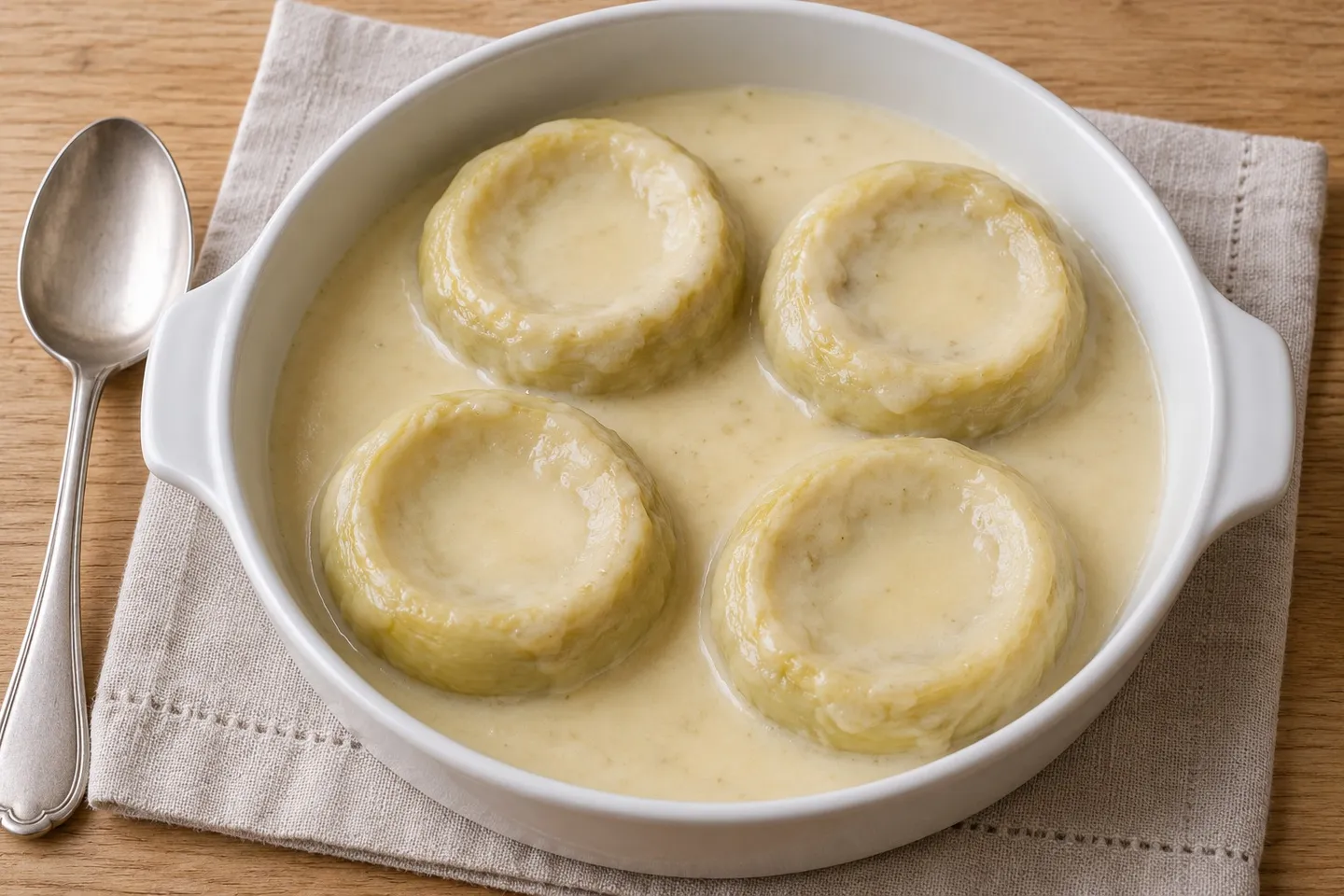
Artichoke Bottoms with Velouté (1907)
Reader ratingsArtichoke bottoms with velouté, after Escoffier’s 1907 method: globe artichoke bottoms simmered white in a lemon and flour court-bouillon, finished in butter and coated with a simple velouté sauce.
- Recipe makes
- 4 servings
- Prep
- Cook
- Total
Make the velouté while the artichoke bottoms simmer; both take about 25 minutes. The bottoms can be cooked a few hours ahead and kept in their cooking liquid in the refrigerator.
Artichoke bottoms in velouté sauce.
The story behind the recipe
The bottom is the tender base of the globe artichoke, left when every leaf and the hairy choke are cut away. In Paris in 1919 it had a course of its own: after the roast turkey, the Senate’s lunch for Wilson served “Fonds d’artichauts au velouté,” artichoke bottoms in a white sauce.
Kept white
Escoffier cooked artichoke bottoms in a blanc, a court-bouillon of water whisked with flour, salt and lemon juice that keeps pale vegetables pale. They were trimmed first and rubbed with lemon “to prevent their blackening.” He took them out “somewhat firm,” and in one of his versions stewed them in butter before they were sauced. His velouté was a pale roux thinned with white veal stock and simmered for about two hours, seasoned with salt, nutmeg and white pepper and, when he had them, mushroom parings. He disliked the habit of adding carrots, an onion stuck with a clove and a bouquet of herbs, and wrote that “the stock should be sufficiently fragrant of itself.”
His 1907 Guide to Modern Cookery has no dish under the Senate’s name, and the Senate’s kitchen left nothing in writing, so the dish is assembled here from his pages. The rest of the Senate’s card is in What Did the Peacemakers Eat in Paris in 1919?
Read more about this recipe
Making it today
We make the velouté with chicken stock, which turns it into Escoffier’s poultry velouté, and simmer it for 20 minutes rather than his two hours. Trimming the artichokes takes some patience; good jarred or frozen artichoke bottoms are a fair shortcut, and they skip straight to the butter.
The bottoms can be cooked hours ahead and kept in the refrigerator, which frees the stove for the Bass with Venetian Sauce (1907), whose sauce starts from the same pale roux.
Select some medium-sized artichokes; clear them of their leaves and their chokes; trim their bottoms, rub them with lemon to prevent their blackening, and cook them in a Blanc (No. 167), keeping them somewhat firm. ...
Recipe makes: 4 servings
Ingredients
For 4 servings. Quantities are shown as written.
Quantities as written here, for 4 servings.
Artichokes
- Large globe artichokes4
- Lemons2
Court-bouillon
- Cold water8 cups
- All-purpose flour2 1/2 tbsp
- Salt2 tsp
Velouté
- Unsalted butter1 1/2 tbsp
- All-purpose flour1 1/2 tbsp
- Chicken stock, low-sodium1 1/2 cups
- Pinch of nutmeg
- Pinch of white pepper
To finish
- Unsalted butter2 tbsp
- Salt
Measurement notes
Ingredients as written here
- 4 large globe artichokes
- 2 lemons
- 8 cups cold water
- 2½ tbsp all-purpose flour
- 2 tsp salt
- 1½ tbsp unsalted butter
- 1½ tbsp all-purpose flour
- 1½ cups chicken stock, low-sodium
- Pinch of nutmeg
- Pinch of white pepper
- 2 tbsp unsalted butter
- Salt
Equipment
- Sharp paring knife and a serrated knife
- Teaspoon or melon baller
 Large saucepan
- Small saucepan
 Whisk
- Wide lidded skillet
- Warm vegetable dish
Instructions
For the court-bouillon, whisk the flour into the cold water in the large saucepan a little at a time until smooth. Add the salt and the juice of half the lemons. Bring to a boil over medium heat, stirring so the flour doesn’t settle and catch.
Meanwhile, trim the artichokes one at a time. Halve the remaining lemons for rubbing. Snap off the outer leaves, then slice off the remaining cone of leaves just above the base. Pare away the dark green from the base and stem until only pale flesh is left, cut the stem flush, and scoop out the hairy choke with the spoon. Rub every cut surface with lemon as you go.
Drop the bottoms into the boiling court-bouillon, lower the heat and simmer for 20 to 25 minutes, until a knife goes in with slight resistance.
While they cook, make the velouté. Melt the butter in the small saucepan over medium-low heat, stir in the flour and cook for 2 to 3 minutes without letting it color. Whisk in the chicken stock a little at a time, add the nutmeg and white pepper, and simmer gently for 20 minutes, stirring now and then, until it coats a spoon. Taste for salt.
Drain the artichoke bottoms and rinse off the court-bouillon.
Melt the butter in the skillet over low heat, add the bottoms in one layer, season lightly with salt, cover and stew gently for 5 minutes, turning once.
Set the bottoms in the warm vegetable dish, hollow side up, coat with the velouté and serve.
Nutrition
150calories per serving
- Recipe makes
- 4 servings
- Servings
- 4
Estimated per serving from USDA FoodData Central values for the listed ingredients (artichoke bottoms only).
Recipe notes
When adjusting quantities
Allow one large artichoke per person. The court-bouillon needs only enough liquid to cover the bottoms.
Notes
Quantities mentioned in these notes don’t change when you adjust the servings.
Artichoke bottoms darken quickly once cut, so keep the lemon close at hand. If you cook the bottoms ahead, lift them from their chilled liquid, pat them dry and stew them covered in the butter over low heat for 8 to 10 minutes, until hot through, before saucing. If you use jarred or frozen bottoms, skip the court-bouillon and start at the butter. Contains milk and wheat.
Scaling changes the ingredients only; pan sizes and cooking times need their own judgment. To adapt this recipe further, try the recipe tool at TuneMyRecipe (opens in a new tab), our sister site.
Sources and attribution
After Auguste Escoffier, A Guide to Modern Cookery (London: Heinemann, 1907), Nos. 25, 26, 167, 2033 and 2035
Recipe details
- Course
- Side dish
- Dish family
- Vegetables & Sides
- Region
- French
- Era
- Edwardian
- Source decade
- 1900s
- Main ingredient
- Vegetables
- Difficulty
- Intermediate
- Occasion
- State banquet