
Consommé Printanier Royal (1907)
Reader ratingsConsommé printanier royal after Escoffier (1907): clear chicken consommé with tiny rods of carrot and turnip, peas, green beans, asparagus tips and squares of chervil royale custard.
- Recipe makes
- 4 servings
- Prep
- Cook
- Total
The royale poaches for about 30 minutes and must cool before it is cut. Cut the vegetables while it cooks; they need only about 10 minutes in the consommé.
Spring consommé with vegetables and squares of royale custard.
The story behind the recipe
Consommé Printanier Royal opens the menu typed for the Sultan of Morocco’s train from Mauriac to Paris on 1 July 1945: a clear soup with spring vegetables, and in our reading, the little custard shapes called royale. The menu gives the name and nothing else. This version is built from two recipes in Auguste Escoffier’s A Guide to Modern Cookery, published in London in 1907.
Two recipes in one name
“Printanier” is Escoffier’s spring garnish. His Consommé Printanier asks for a quart of chicken consommé and a tablespoon of each vegetable, carrot and turnip cut into “little rods” with a tubular cutter one-eighth of an inch across, then peas, French beans cut into lozenges, asparagus heads, and ten little rounds each of sorrel and lettuce. The rods are cooked in consommé until it reduces “to a glaze,” so the vegetables carry its flavor.
“Royal” is the open question. Escoffier’s royales are a whole family of savory custards, made from consommé or cream, eggs and a flavoring, poached in buttered molds, cooled and cut into dice, diamonds or rounds for clear soups. His “Ordinary Royale” infuses an ounce of chervil in a pint of boiling consommé before it meets the eggs. The name is older than the train: Escoffier’s French Guide of 1903 already lists a “Printanier Royal” among the soups of a July dinner. Reading “Royal” as the royale is our choice, and this page joins the two recipes.
Read more about this recipe
Making it today
A true consommé is clarified for hours; we start from a clear homemade or good bought chicken stock, strained through cloth, our biggest shortcut. We make about half of Escoffier’s royale and poach it in a small loaf pan, and we double his tablespoon of each vegetable for four bowls. The water around the royale must stay below a simmer, as he insists.
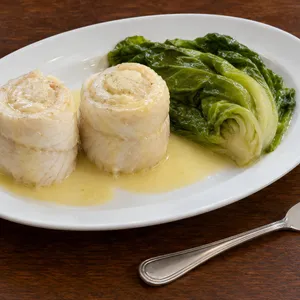
The train, its timetable and the rest of its menu are in What Was on the Royal Train’s Menu in 1945?. After the soup came the Paupiettes of Sole Choisy (1907).
Have ready one quart of chicken consommé, also cut one carrot and one turnip into roundels one-half inch thick. ...
Recipe makes: 4 servings
Ingredients
For 4 servings. Quantities are shown as written.
Quantities as written here, for 4 servings.
- Clear chicken consommé or strong chicken stock, divided5 cups
- Butter, for the pan1 tsp
- Fresh chervil, for the royale0.5 oz
- Large egg1
- Large egg yolks3
- Small carrot1
- Small turnip1
- Shelled peas2 tbsp
- Thin green beans, cut in small diamonds2 tbsp
- Asparagus tips2 tbsp
- Leaves soft lettuce4
- Leaves sorrel (optional)4
- Salt1 pinch
- Chervil, to finish4 sprigs
Measurement notes
Ingredients as written here
- 5 cups clear chicken consommé or strong chicken stock, divided
- 1 tsp butter, for the pan
- 1/2 oz fresh chervil, for the royale
- 1 large egg
- 3 large egg yolks
- 1 small carrot
- 1 small turnip
- 2 tbsp shelled peas
- 2 tbsp thin green beans, cut in small diamonds
- 2 tbsp asparagus tips
- 4 leaves soft lettuce
- 4 leaves sorrel (optional)
- 1 pinch salt
- 4 chervil sprigs, to finish
Equipment
- Small loaf pan or dish, about 3 cups
- Roasting pan for a water bath
- 2 saucepans
- Fine sieve lined with cheesecloth
- Small sharp knife
Instructions
Heat the oven to 300°F (150°C) and bring a kettle of water to a boil.
For the royale, bring a fifth of the consommé to a boil, add the chervil for the royale, cover, and leave off the heat for 20 minutes.
Whisk the egg and egg yolks in a bowl without making foam. Strain the chervil consommé onto them, whisking, then strain the mixture again through the cloth-lined sieve and skim off any froth.
Butter the loaf pan with the butter for the pan and pour the mixture in; set the pan in the roasting pan, and pour hot water around it to come halfway up. Bake for 25 to 35 minutes, until the royale is just set and a knife comes out clean. Keep the water from bubbling; if it starts to, lower the oven to 275°F (135°C). Let the royale cool in its pan.
While it cooks, peel the carrot and turnip, slice them ½ inch thick, and cut the slices into little rods about ⅛ inch across.
Simmer the carrot and turnip rods in a little of the remaining consommé until tender and the liquid has nearly evaporated, about 10 minutes.
In a little more of the consommé, simmer the peas, green beans and asparagus tips for 3 to 4 minutes, until just tender. Cut the lettuce and sorrel into small rounds with a cutter or knife, and drop them in for the last minute.
Turn the royale out and cut it into small squares or diamonds.
Bring the rest of the consommé to a boil and taste it, adding salt if needed. Divide the vegetables and royale among warm soup plates, pour the boiling consommé over, and finish each with the chervil sprigs, picked into leaves.
Nutrition
110calories per serving
- Recipe makes
- 4 servings
- Servings
- 4
Estimated per serving from USDA FoodData Central values for chicken consommé, eggs and the vegetables.
Recipe notes
When adjusting quantities
A double batch of royale needs a larger dish and about 10 minutes longer.
Notes
Quantities mentioned in these notes don’t change when you adjust the servings.
Without sorrel, use a few more lettuce rounds. The royale keeps, covered and refrigerated, for 2 days; cut it cold.
Scaling changes the ingredients only; pan sizes and cooking times need their own judgment. To adapt this recipe further, try the recipe tool at TuneMyRecipe (opens in a new tab), our sister site.

Sources and attribution
After A. Escoffier, A Guide to Modern Cookery (London, 1907), nos. 601 and 206
Recipe details
- Course
- Soup
- Dish family
- Soups & Broths
- Region
- French
- Era
- Edwardian
- Source decade
- 1900s
- Main ingredient
- Vegetables
- Difficulty
- Intermediate
- Season
- Spring