Carrot and Green Pea Loaf (1918)
Reader ratingsA carrot and green pea loaf from the meat substitutes chapter of a 1918 lunch-room book: dried green peas, carrots and rice, bound with egg and baked.
- Recipe makes
- 1 loaf, 5 servings of about 5½ oz
- Prep
- Cook
- Total
The split peas simmer for about 45 minutes before anything is ground; the carrots cook alongside them. Whole dried peas need soaking overnight and two to three hours of cooking.
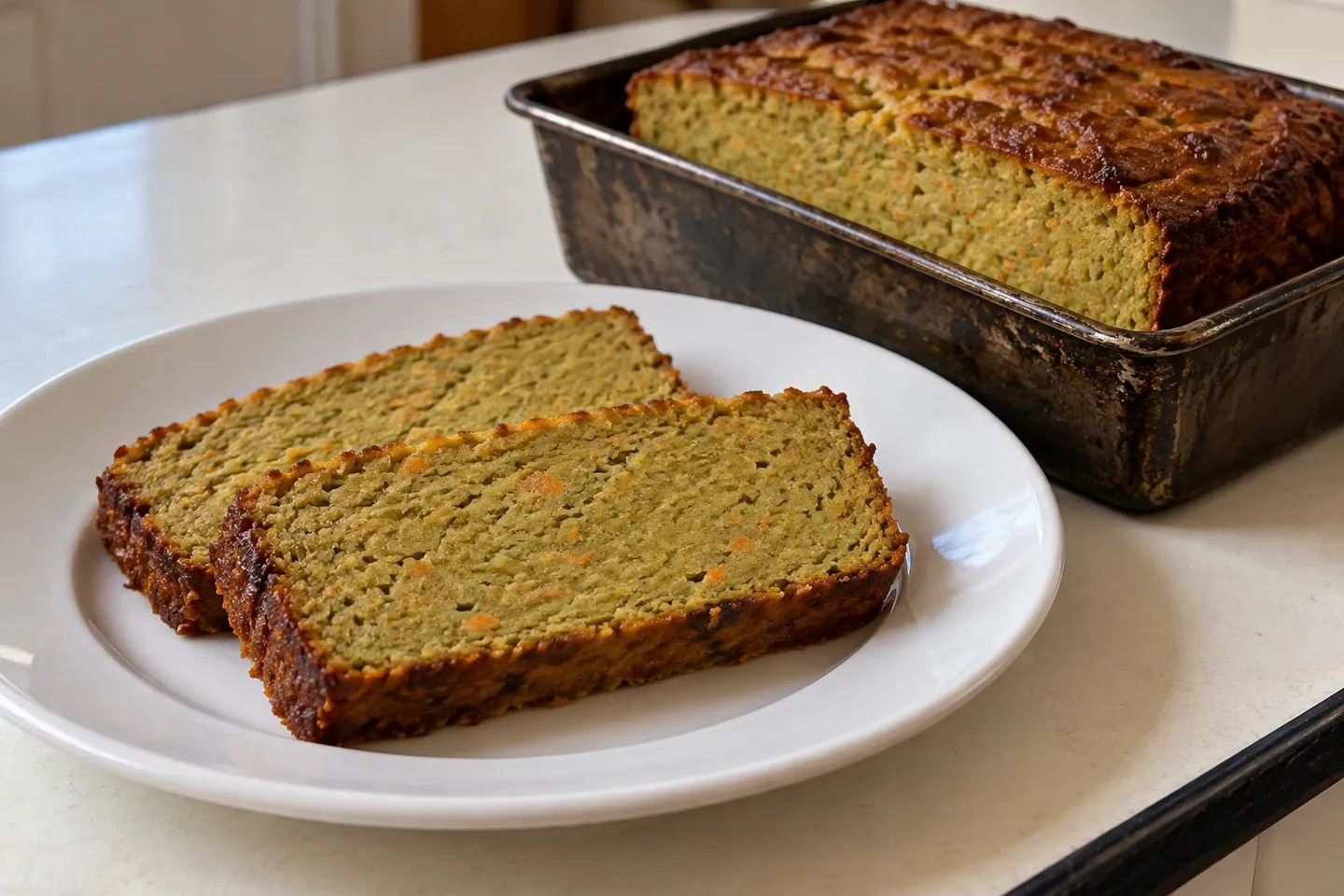
Slices of a baked loaf of green split peas, carrots and rice.
The story behind the recipe
Dried green peas, carrots and rice, ground together, bound with egg and a little bacon fat and baked to be sliced: this loaf stood in for meat on a lunch-room plate. Apart from the bacon fat, there is no meat in it. It comes from the meat substitutes chapter of Bertha E. Nettleton’s One Hundred-Portion War Time Recipes (1918), where the book serves it in portions of five to six ounces.
Written by weight
Nettleton wrote for lunch rooms, canteens and hospital kitchens, and the loaf’s quantities show it: six and a half pounds of dried peas, ten and a half of cooked carrots, twenty eggs. She explained why she gave the dry ingredients by weight: “Weights rather than measures are given for the dry ingredients to insure accuracy and to save time.” For anyone used to cups she added, “Cooks who are not used to scales soon learn to use them very successfully.”
The meat substitutes chapter answered a weekly need. In January 1918 the Food Administration asked for Tuesday to be kept meatless, in public eating places as well as homes. Tuesday was porkless too, and the rules as printed ruled out “lard or pork products,” so on a Tuesday the bacon fat would have had to give way to another fat. The chapter offers baked kidney and lima beans, fried corn mush with cheese, croquettes and this loaf. The same book’s soups and breads went without wheat, as How Did You Feed a Hundred People Without Wheat in 1918? explains.
Read more about this recipe
Making it today
The book calls for “Green peas, dry,” which it soaks overnight and cooks for two to three hours. We use green split peas, which need no soaking and soften in under an hour. At a twentieth of the book’s quantities the recipe takes exactly one egg and fills an 8 by 4-inch loaf pan. That is the biggest change we’ve made. The book bakes the loaf for “one-half to one hour in moderate oven”; we set the oven at 350°F (180°C) and bake until the center reaches 160°F (71°C), the safe temperature for a dish bound with egg.
A slice goes well after a bowl of the Corn Chowder (1918) from the same book.
Soak peas over night, drain and wash. Cover with salted water and cook two to three hours or until soft. ...
Recipe makes: 1 loaf, 5 servings of about 5½ oz
Ingredients
For 1 loaf, 5 servings of about 5½ oz. Quantities are shown as written.
Quantities as written here, for 1 loaf, 5 servings of about 5½ oz.
Peas and carrots
- Dried green split peas5.25 oz
- Water24 fl oz
- Salt for the cooking water1/2 tsp
- Carrots, peeled and cut in chunks9 oz
Loaf
- Cooked white rice5.25 oz
- Grated onion2 tsp
- Salt1 tsp
- Black pepper1/8 tsp
- Bacon fat, melted1 1/4 tbsp
- Large egg, beaten1
- Bacon fat for the pan1 tsp
Measurement notes
Ingredients as written here
- 5.25 oz dried green split peas
- 24 fl oz water
- ½ tsp salt for the cooking water
- 9 oz carrots, peeled and cut in chunks
- 5.25 oz cooked white rice
- 2 tsp grated onion
- 1 tsp salt
- ⅛ tsp black pepper
- 1.25 tbsp bacon fat, melted
- 1 large egg, beaten
- 1 tsp bacon fat for the pan
Equipment
- Two medium saucepans
- Food processor or meat grinder
- Mixing bowl
- 8 by 4-inch loaf pan
 Instant-read thermometer
Instructions
Rinse the split peas and put them in a saucepan with the water and the salt for the cooking water. Bring to a boil, skim off any foam, then simmer uncovered for 40 to 50 minutes, stirring now and then, until the peas are very soft and falling apart and most of the water has been absorbed.
Meanwhile, put the carrots in a second saucepan, cover with water and boil for 15 to 20 minutes, until tender. Drain.
If any water is left, stir the peas over the heat for a few minutes until it cooks off and they are a thick, dry purée.
Heat the oven to 350°F (175°C). Grease the loaf pan with the bacon fat for the pan.
Grind the peas, carrots, cooked rice and grated onion together in a food processor or meat grinder to a coarse, even paste.
Scrape the paste into a bowl and mix in the salt, pepper, melted bacon fat and beaten egg until evenly combined.
Pack the mixture into the pan and smooth the top.
Bake for 45 to 55 minutes, until the loaf is firm, the edges have pulled from the pan and browned, and the center reaches 160°F (71°C).
Leave the loaf in the pan for 10 minutes, then turn it out and cut into five thick slices.
Nutrition
210calories per serving
- Recipe makes
- 1 loaf, 5 servings of about 5½ oz
- Servings
- 5
Estimated per serving from USDA FoodData Central values for the listed ingredients.
Recipe notes
When adjusting quantities
This is one twentieth of the book’s recipe for a hundred portions, which makes the eggs exactly one. Double it for a 9 by 5-inch pan.
Notes
Quantities mentioned in these notes don’t change when you adjust the servings.
Using whole dried green peas instead, as the book does: soak them overnight, drain and rinse, then simmer in fresh salted water for 2 to 3 hours until soft.
The book gives bacon fat. Butter or a neutral oil makes the loaf vegetarian.
The loaf contains egg. Refrigerate leftovers within 2 hours and use within 3 to 4 days; slices can be browned in a little fat in a skillet.
Scaling changes the ingredients only; pan sizes and cooking times need their own judgment. To adapt this recipe further, try the recipe tool at TuneMyRecipe (opens in a new tab), our sister site.

Sources and attribution
After Bertha E. Nettleton, One Hundred-Portion War Time Recipes (Philadelphia: J. B. Lippincott, 1918), Carrot and Green Pea Loaf
Recipe details
- Course
- Main course
- Dish family
- Vegetables & Sides
- Region
- American
- Source decade
- 1910s
- Main ingredient
- VegetablesGrains & rice
- Difficulty
- Intermediate
- Occasion
- Rationing