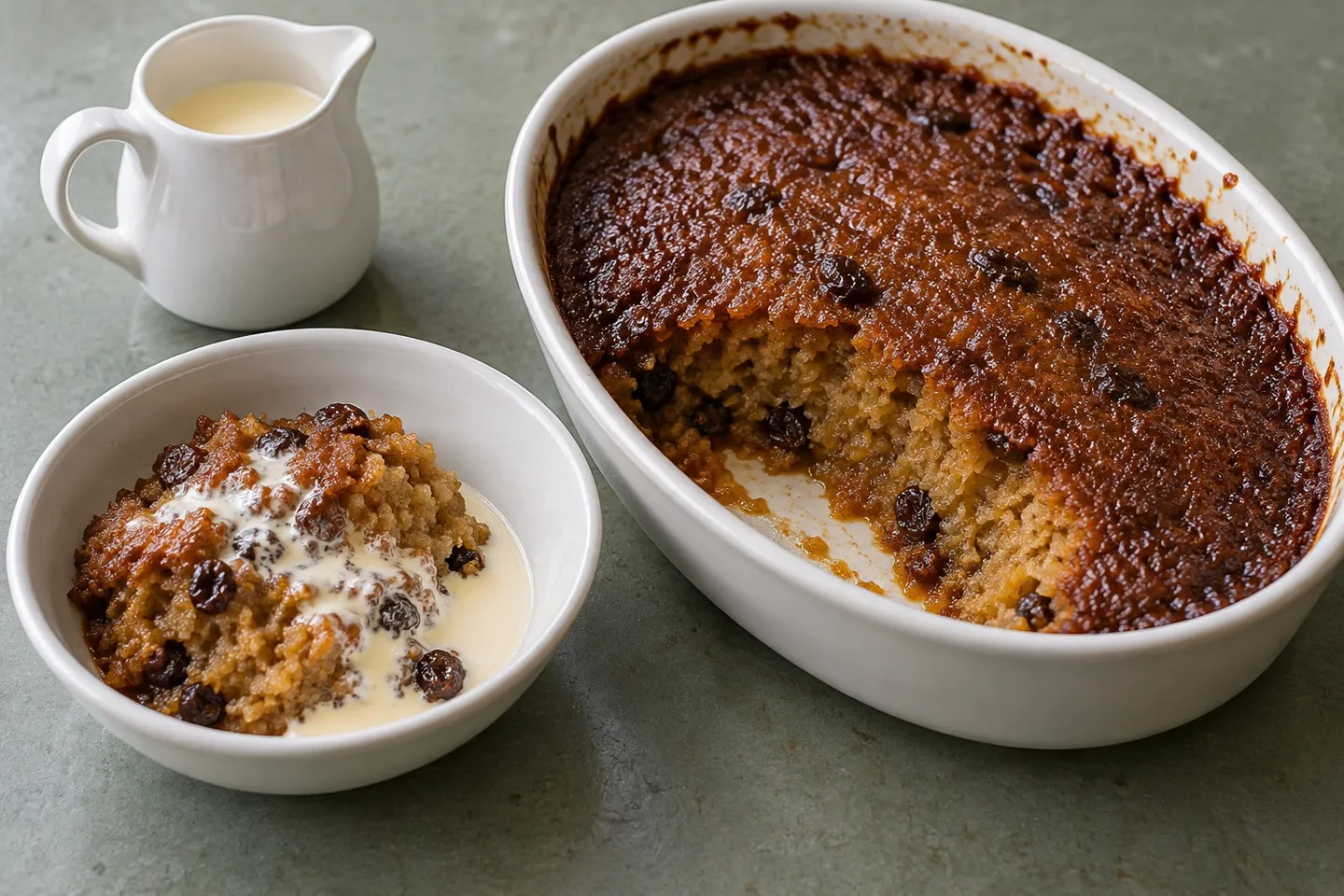
Baked Indian Pudding (1918)
Reader ratingsBaked Indian pudding from a 1918 lunch-room book of wheatless recipes: cornmeal and molasses with suet and raisins, baked slowly for hours, with no egg.
- Recipe makes
- 6 servings of about 4 oz
- Prep
- Cook
- Total
The cornmeal cooks in the milk for an hour on the stove, the pudding bakes slowly for two hours or more, and it should rest for half an hour before serving.
Baked cornmeal and molasses pudding with raisins, served with cream.
The story behind the recipe
Baked Indian pudding is cornmeal cooked slowly in milk, sweetened with molasses, spiced, and baked for hours until it turns soft and deep brown. “Indian” comes from Indian meal, the old American name for cornmeal. This version, from Bertha E. Nettleton’s One Hundred-Portion War Time Recipes (1918), adds ground beef suet and raisins, has no egg, and is served with cream.
Thirteen quarts of milk
For a hundred portions of four ounces each, the book’s pudding takes two pounds of cornmeal, thirteen quarts of milk, nearly three quarts of molasses and a pound and a half of ground beef suet. It is the first baked pudding in the chapter, after three that are set with gelatine. The next is a Baked Indian Apple Tapioca Pudding, with cornmeal, tapioca and sliced apples. Neither uses wheat flour or egg.
Suet was one of the fats home cooks were told they could use. Foods That Will Win the War and How to Cook Them, also published in 1918, says “butter and butter substitutes are best kept for table use and for flavoring,” and lists “lard and beef and mutton suet” among the shortening fats. Its own Indian pudding, for six at home, has no fat at all. Nettleton’s lunch room and the 1918 rules it cooked under are the subject of How Did You Feed a Hundred People Without Wheat in 1918?.
Read more about this recipe
Making it today
Use fresh beef suet from a butcher, grated fine while cold. Packaged shredded suet is often coated in wheat flour (one leading brand, Atora, is), which this wheatless pudding was meant to avoid, so if fresh suet is hard to find, use butter. A sixteenth of the book’s recipe fills a 1½-quart dish and serves six.
The book’s “slow oven” for “two hours or more” is our 300°F (150°C) for two to two and a half hours. A period slow oven ran cooler, but modern recipes for the pudding bake it at 300°F (150°C), and the long time matters more. Use ordinary molasses, not blackstrap. The book serves it “with Cream”; the amount is ours.
Nettleton’s book prints no menus, but its wheatless soups pair well with it; try the Corn Chowder (1918) first.
Cook cornmeal and milk in double boiler one hour. Add other ingredients, put in baking dishes and bake in slow oven two hours or more. ...
Recipe makes: 6 servings of about 4 oz
Ingredients
For 6 servings of about 4 oz. Quantities are shown as written.
Quantities as written here, for 6 servings of about 4 oz.
Pudding
- Whole milk26 fl oz
- Yellow cornmeal2 oz
- Fresh beef suet, finely grated1.5 oz
- Molasses5 1/2 fl oz
- Ground cinnamon1/3 tsp
- Ground nutmeg1/3 tsp
- Raisins2 oz
- Salt1/2 tsp
- Butter for the dish1 tsp
To serve
- Light cream6 fl oz
Measurement notes
Ingredients as written here
- 26 fl oz whole milk
- 2 oz yellow cornmeal
- 1.5 oz fresh beef suet, finely grated
- 5.5 fl oz molasses
- ⅓ tsp ground cinnamon
- ⅓ tsp ground nutmeg
- 2 oz raisins
- ½ tsp salt
- 1 tsp butter for the dish
- 6 fl oz light cream
Equipment
- Double boiler, or a heatproof bowl over a pan of simmering water
 Whisk
- 1½-quart baking dish
Instructions
Heat the milk in the top of a double boiler over simmering water until steaming. Whisk in the cornmeal in a thin stream.
Cook over the simmering water for 1 hour, stirring every 10 minutes, until the mixture is thick and smooth and the cornmeal no longer tastes gritty.
Heat the oven to 300°F (150°C). Grease the baking dish with the butter for the dish.
Stir the suet, molasses, cinnamon, nutmeg, raisins and salt into the cornmeal until the suet has melted in and the color is even. Pour into the dish.
Bake for 2 to 2½ hours, until the pudding is deep brown, set at the edges and still slightly soft in the center. It firms as it cools.
Leave it to rest for 30 minutes, then spoon it into bowls warm and pour a little cream over each serving.
Nutrition
310calories per serving
- Recipe makes
- 6 servings of about 4 oz
- Servings
- 6
Estimated per serving from USDA FoodData Central values for the listed ingredients, leaving out the cream to serve.
Recipe notes
When adjusting quantities
This is one sixteenth of the book’s recipe for a hundred 4-ounce portions. Keep the dish deep enough that the pudding stands at least 2 inches; a wider dish bakes faster.
Notes
Quantities mentioned in these notes don’t change when you adjust the servings.
If the top browns too fast, lay a sheet of foil loosely over the dish for the last half hour.
Contains milk. The pudding has no wheat, but check that the suet is fresh and not packaged with flour. Refrigerate leftovers within 2 hours and use within 3 to 4 days; it reheats well in a low oven.
Scaling changes the ingredients only; pan sizes and cooking times need their own judgment. To adapt this recipe further, try the recipe tool at TuneMyRecipe (opens in a new tab), our sister site.

Sources and attribution
After Bertha E. Nettleton, One Hundred-Portion War Time Recipes (Philadelphia: J. B. Lippincott, 1918), Baked Indian Pudding
Recipe details
- Course
- Dessert
- Dish family
- Desserts & Sweets
- Region
- American
- Source decade
- 1910s
- Main ingredient
- Grains & riceMilk & cream
- Difficulty
- Easy
- Occasion
- Rationing