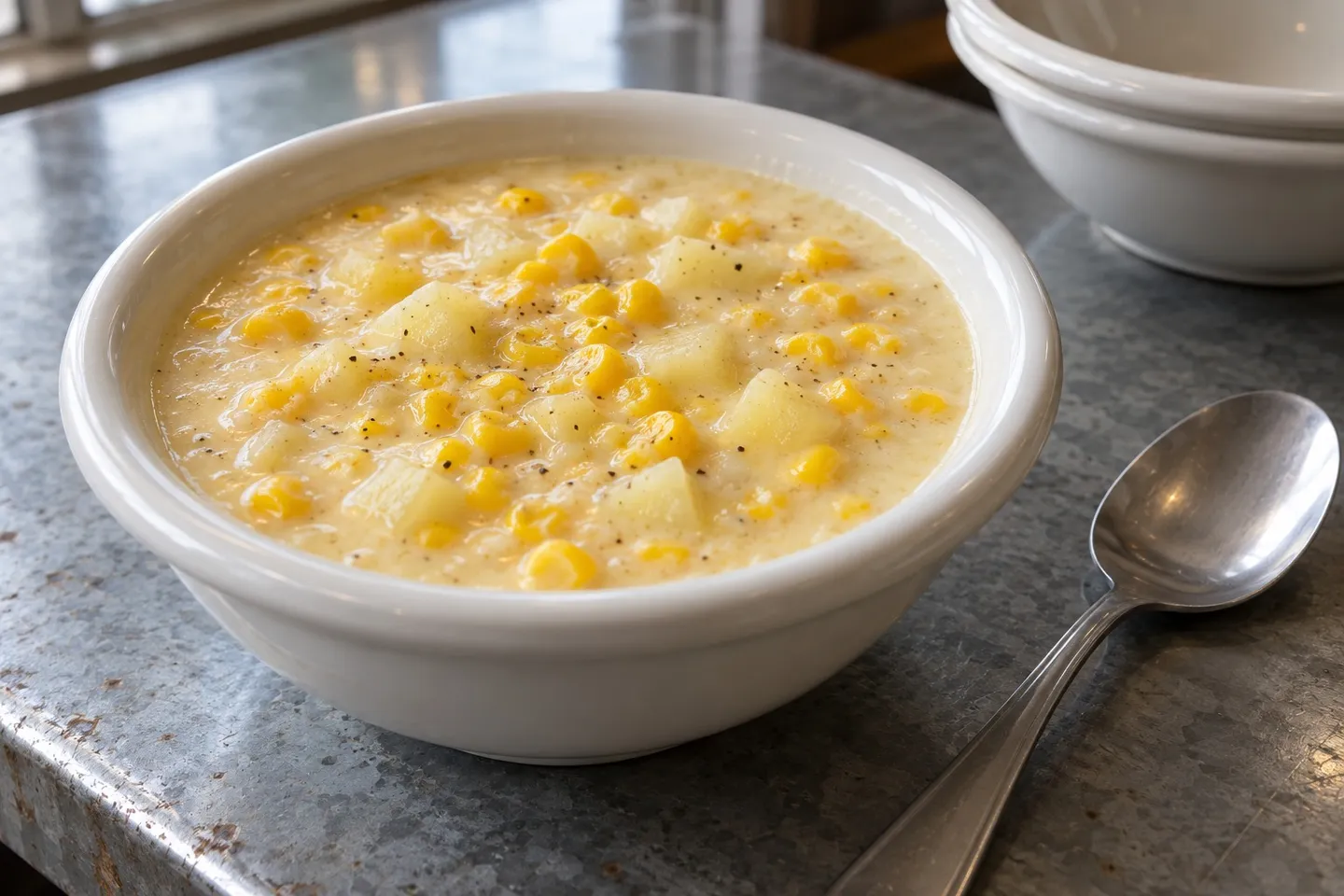
Corn Chowder (1918)
Reader ratingsA wheatless corn chowder from a 1918 lunch-room book: corn and potato in a celery-leaf stock thickened with rice flour and cornstarch and finished with milk.
- Recipe makes
- About 10 cups, 10 servings of 1 cup
- Prep
- Cook
- Total
The celery leaves simmer for half an hour to make the stock before the potatoes go in.
A bowl of corn and potato chowder in plain white hotel china.
The story behind the recipe
For a lunch line of a hundred in 1918, here is one of the book’s soups: potatoes and canned corn simmered in a stock made from celery leaves, thickened without wheat flour and finished with milk. It is the second soup in Bertha E. Nettleton’s One Hundred-Portion War Time Recipes (1918), where it serves a hundred portions of half a pint each.
A roux with no wheat
Nettleton ran the Horace Mann Lunch Room at Teachers College, Columbia University, and her soups are thickened the same way throughout. In place of the usual wheat flour, she uses equal weights of rice flour and cornstarch, 14 ounces of each for this chowder. Wheat was being saved for the war, and in January 1918 the Food Administration had asked for one wheatless meal every day, in public eating places as well as homes. Read How Did You Feed a Hundred People Without Wheat in 1918? for how a lunch room kept that rule from soup to pudding.
The seasoning is deliberately light. Nettleton explains that she gives salt, pepper and onion at their minimum, because “it is safer to under-season when catering to large numbers of people,” and she leaves the rest to whoever is at the stove: “It is expected that the cook will taste the dish and season it to please those to whom she caters.”
Read more about this recipe
Making it today
A tenth of the recipe makes about ten one-cup bowls and turns the book’s ten cans of corn into one 20-ounce can, the size the book calls No. 2. Modern cans hold about 15 ounces, so you may need a can and a third. The book says only “Fat.” We use butter, which keeps the chowder vegetarian. “Thicken” is all this recipe says, so we cook the rice flour and cornstarch in the butter first, as the book’s cream of celery soup does with its “fat and flour mixture.” Heating the milk before it goes in is our choice too.
TuneMyRecipe has a later home version, the Potato and Corn Milk Chowder (opens in a new tab) from the USDA’s Aunt Sammy’s Radio Recipes, made with salt pork. For a meat-substitute course to follow, the book has a Carrot and Green Pea Loaf (1918).
Cook celery leaves in water one-half hour. Strain and add potatoes and onions, cook twenty minutes. ...
Recipe makes: About 10 cups, 10 servings of 1 cup
Ingredients
For about 10 cups, 10 servings of 1 cup. Quantities are shown as written.
Quantities as written here, for about 10 cups, 10 servings of 1 cup.
Stock
- Water38 fl oz
- Celery leaves0.8 oz
Chowder
- Diced peeled potatoes1 2/3 cups
- Onion, chopped0.8 oz
- Canned whole-kernel corn, with its liquid20 oz
- Salt1 1/2 tsp
- Black pepper1/8 tsp
To thicken and finish
- Butter2.75 oz
- White rice flour1.4 oz
- Cornstarch1.4 oz
- Whole milk19 fl oz
Measurement notes
Ingredients as written here
- 38 fl oz water
- 0.8 oz celery leaves
- 1⅔ cups diced peeled potatoes
- 0.8 oz onion, chopped
- 20 oz canned whole-kernel corn, with its liquid
- 1.5 tsp salt
- ⅛ tsp black pepper
- 2.75 oz butter
- 1.4 oz white rice flour
- 1.4 oz cornstarch
- 19 fl oz whole milk
Equipment
- Large soup pot
 Fine sieve
 Small saucepan
 Whisk
Instructions
Put the water and celery leaves in a large soup pot, bring to a boil, then lower the heat and simmer for 30 minutes.
Strain the stock through a fine sieve, pressing on the leaves, and discard them. Return the stock to the pot.
Add the potatoes and onion to the stock, bring back to a simmer and cook for 20 minutes, until the potatoes are just tender.
Add the corn with its liquid, the salt and the pepper, and bring the chowder to a boil.
Meanwhile, melt the butter in a small saucepan over low heat. Whisk in the rice flour and cornstarch and cook, stirring, for 1 to 2 minutes, until smooth and bubbling. It will be a stiff paste.
Whisk a ladle of the hot chowder liquid into the paste until smooth, then a second. Stir this back into the pot and simmer, stirring, for 3 to 5 minutes, until the chowder thickens and no longer tastes floury.
Heat the milk in the small saucepan until steaming, then stir it into the chowder. Heat through without letting it boil. Taste and add more salt and pepper if you like, as the book expects you to, and serve.
Nutrition
180calories per serving
- Recipe makes
- About 10 cups, 10 servings of 1 cup
- Servings
- 10
Estimated per 1-cup serving from USDA FoodData Central values for the listed ingredients.
Recipe notes
When adjusting quantities
This is one tenth of the book’s recipe for a hundred half-pint portions, which makes the corn exactly one No. 2 can (20 oz).
Notes
Quantities mentioned in these notes don’t change when you adjust the servings.
The book’s quantity of potatoes is by measure: 4 quarts diced for a hundred, so about 1⅔ cups here. The book doesn’t say whether its canned corn was whole-kernel or cream-style; we use whole-kernel.
There is no wheat in this chowder. It contains milk. Cool leftovers quickly, refrigerate within 2 hours and use within 3 to 4 days. The chowder thickens as it stands, so thin it with a little milk when reheating.
Scaling changes the ingredients only; pan sizes and cooking times need their own judgment.
Sources and attribution
After Bertha E. Nettleton, One Hundred-Portion War Time Recipes (Philadelphia: J. B. Lippincott, 1918), Corn Chowder
Recipe details
- Course
- Soup
- Dish family
- Soups & Broths
- Region
- American
- Source decade
- 1910s
- Main ingredient
- VegetablesMilk & cream
- Difficulty
- Easy
- Occasion
- Rationing