The royal picnic at Top Cottage, Hyde Park · Hyde Park, New York
What Did the King and Queen Eat at the Roosevelts’ 1939 Picnic?
The menu for the Roosevelts’ 1939 hot dog picnic for King George VI at Hyde Park: Virginia ham, hot dogs, cold turkey, cranberry jelly and strawberry shortcake.
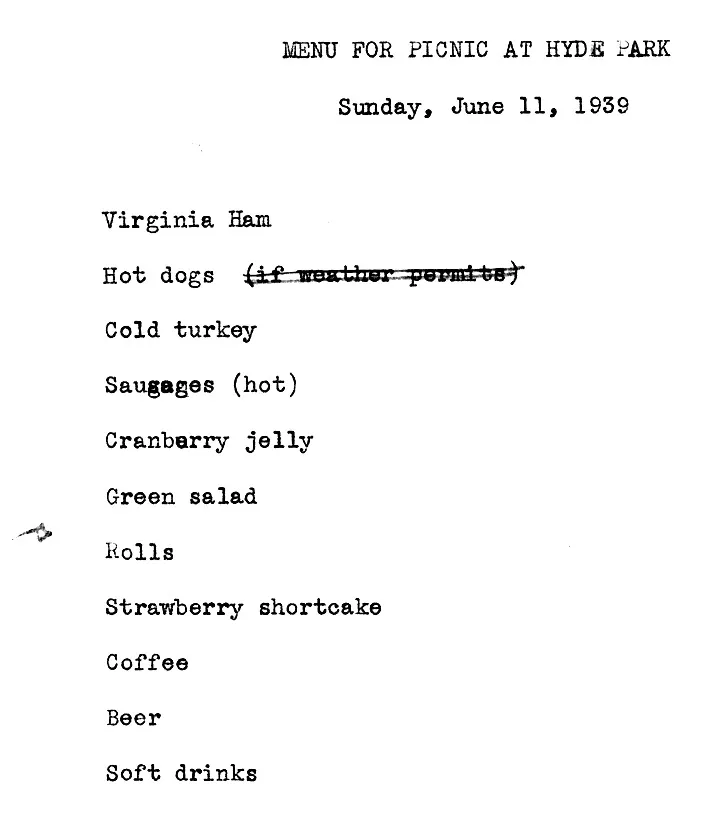
The King and Queen were offered a full lunch, hot and cold, with the hot dogs as one dish among eight. A typewritten “Menu for Picnic at Hyde Park,” dated Sunday, June 11, 1939, lists Virginia ham, hot dogs, cold turkey, hot sausages, cranberry jelly, green salad, rolls and strawberry shortcake, then coffee, beer and soft drinks. The hot dogs made the newspapers. On the sheet they come second, and someone has drawn a line through the three words typed after them: “if weather permits.”
The guests at Top Cottage
King George VI and Queen Elizabeth spent June 7 to 12, 1939, in the United States, the first reigning British monarch to visit the country, as the National Archives notes. Europe was a few months from war, and the Franklin D. Roosevelt Presidential Library describes the visit as an effort to strengthen British and American ties. After the state visit in Washington, which began on June 8, the Roosevelts took their guests up the Hudson to the family home at Hyde Park.
The picnic was the Sunday lunch. The President took the King and Queen to Top Cottage, his new retreat on a hilltop, and the library says they were served hot dogs on the cottage’s front porch. The menu itself names only Hyde Park.
A menu with a line through it
The Roosevelt Library keeps the menu as a single typed sheet. Its wording is plain and practical. The turkey is marked cold and the sausages hot, with a slip in the typing that makes them “Saugages (hot),” notes that show some thought about how each dish would reach the table. The rolls stand alone with no word on what they were to hold, and a small hand-drawn mark sits in the margin beside them, unexplained.
The hot dogs are the one dish the typist tied to the sky. Nothing else on the page is as hard to explain as the stroke through that condition. It carries no initials and no date. The date at the top belongs to the meal, and the stroke could have been added at any time before or after. What the paper shows is a plan that changed: the hot dogs were typed with a fair-weather condition, and after that stroke they had none.
Read as a list, the rest of the menu implies a good deal of work whatever the weather: a ham and a turkey cooked ahead, sausages kept hot on a hilltop, a jelly that has to set, a salad that wilts once it’s dressed and a shortcake put together near the end.
What the hostess wrote
Eleanor Roosevelt told the day from her side in “My Day,” her syndicated newspaper column, released on June 13 under a Monday dateline. After church, everyone changed “into picnic clothes,” and she hurried up the hill, hoping to arrive before her guests. The cars had raised so much dust that, she wrote, “Saturday night’s little shower had done little good.” At the top she found that “Miss Thompson and Mrs. Helm had everything all arranged.”
Her column is about people. Guests filed past the President and their Majesties, and a man who built roads on the estate brought nine of his ten children, enough that the King and Queen asked whether they all belonged to one family. After lunch Te Ata and Ish-Ti-Opi, Native American performers, gave a short program of songs and stories on a platform built around the trees, and the afternoon went to the swimming pool, where the President and the King swam. She doesn’t name a single dish.
The weather everyone remembers came later. A heavy thunderstorm broke during dinner that evening, and it was over by the time the cars set off for the Hyde Park station. The Queen, Mrs. Roosevelt reported, said that this completed the set: on the trip they had now had ice, snow, rain, great heat and a storm.
The hot dogs, in fact and in story
The Roosevelt Library says hot dogs were served, and the menu shows they were planned. Beyond that the stories thin. Harry Johansen, whose parents worked for the Roosevelts and who was a boy in June 1939, remembered them as a locally made brand called Swisher, the library reports. It calls the tale of him being sent three and a half miles by bicycle to Poughkeepsie to buy them a legend.
The next morning The New York Times ran the headline “King Tries Hot Dog and Asks for More.” Smithsonian magazine, retelling that coverage, quotes the Times reporter Felix Belair Jr. on the King enjoying “his two hot dogs with beer” and the Queen choosing a knife and fork. Belair also wrote that no reporters were present, so these details reached the paper secondhand.
The King’s own record of the visit is about something else. His notes for a memorandum on his conversations with the President on June 10 and 11, which the Roosevelt Library publishes in transcript, cover defense, American neutrality, Europe and possible naval patrols, with the Canadian prime minister, Mackenzie King, present for the first talk. They are the King’s account of what Roosevelt said. Nothing in them concerns lunch, and no source ties a hot dog to anything either man decided.
The recipes
No recipe from the Roosevelt kitchen for this lunch has come to light, so the four dishes below come from print, in the menu’s order. Three are from the United States Department of Agriculture’s Bureau of Home Economics, published in 1931 for American households; the fourth is from Fannie Merritt Farmer’s Boston Cooking-School Cook Book in its 1918 edition.
- Boiled Ham with a Brown Sugar Crust (1931) stands in for the Virginia ham: Aunt Sammy’s Radio Recipes soaks a salty ham overnight, simmers it to 170°F (77°C) by thermometer and browns it under brown sugar and cloves.
- Cranberry Jelly (1931) is the same book’s strained cranberry sauce, boiled to the jelly point and set in a mold to turn out beside the cold turkey.
- Parker House Rolls (1931) come from the bulletin Home Baking, which says shaped rolls can wait in a refrigerator and go into the oven later.
- Strawberry Shortcake (1918) is Farmer’s biscuit-dough cake, split and buttered, with warmed strawberries and her whipped Cream Sauce I.
The hot dogs, the cold turkey, the hot sausages and the green salad have no recipes here. Six years later another typed menu, for the Sultan of Morocco’s train to Paris, survived beside its timetable, and What Was on the Royal Train’s Menu in 1945? reads it.
Cooking it
Start the Boiled Ham with a Brown Sugar Crust (1931) two days before your own picnic: it soaks overnight, simmers about five hours the next day, and a night in the refrigerator after that lets it slice thin enough to go into a roll.
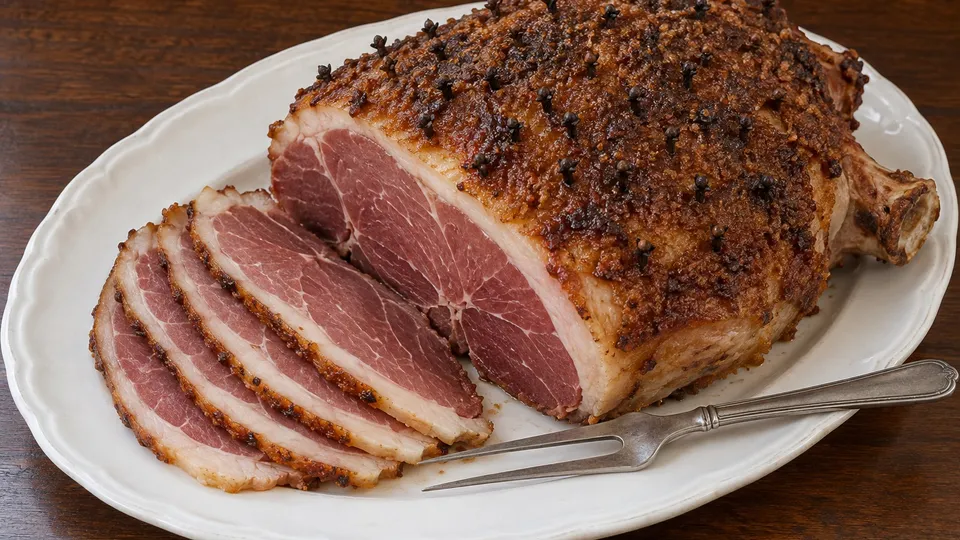 Cook it todayBoiled Ham with a Brown Sugar Crust (1931)
Sources
- “Menu for Picnic at Hyde Park, Sunday, June 11, 1939,” typescript, Franklin D. Roosevelt Presidential Library and Museum. fdrlibrary.org (opens in a new tab).
- Franklin D. Roosevelt Presidential Library and Museum, “The Royal Visit,” with the transcript of King George VI’s notes on his conversations with President Roosevelt, June 10 and 11, 1939. fdrlibrary.org (opens in a new tab).
- Franklin D. Roosevelt Presidential Library and Museum, “Hot Dogs: America’s Favorite Summer-Time Food.” fdrlibrary.org (opens in a new tab).
- Eleanor Roosevelt, “My Day,” June 13, 1939 (United Feature Syndicate), digital edition of the Eleanor Roosevelt Papers Project, George Washington University. gwu.edu (opens in a new tab).
- “A hot dog for the King,” Pieces of History, U.S. National Archives blog, December 27, 2010. archives.gov (opens in a new tab).
- “When Franklin Delano Roosevelt Served Hot Dogs to a King,” Smithsonian (online), quoting Felix Belair Jr. in The New York Times, June 12, 1939. smithsonianmag.com (opens in a new tab).
- Ruth Van Deman and Fanny Walker Yeatman, Aunt Sammy’s Radio Recipes Revised (Washington: U.S. Department of Agriculture, Bureau of Home Economics, May 1931), pp. v, 4, 6, 17, 74.
- Charlotte Chatfield, Home Baking, Farmers’ Bulletin No. 1450 (Washington: U.S. Department of Agriculture, issued 1925, revised December 1931), pp. 4–5, 7, 12.
- Fannie Merritt Farmer, The Boston Cooking-School Cook Book, revised edition (Boston: Little, Brown, and Company, 1918), pp. 83, 407.