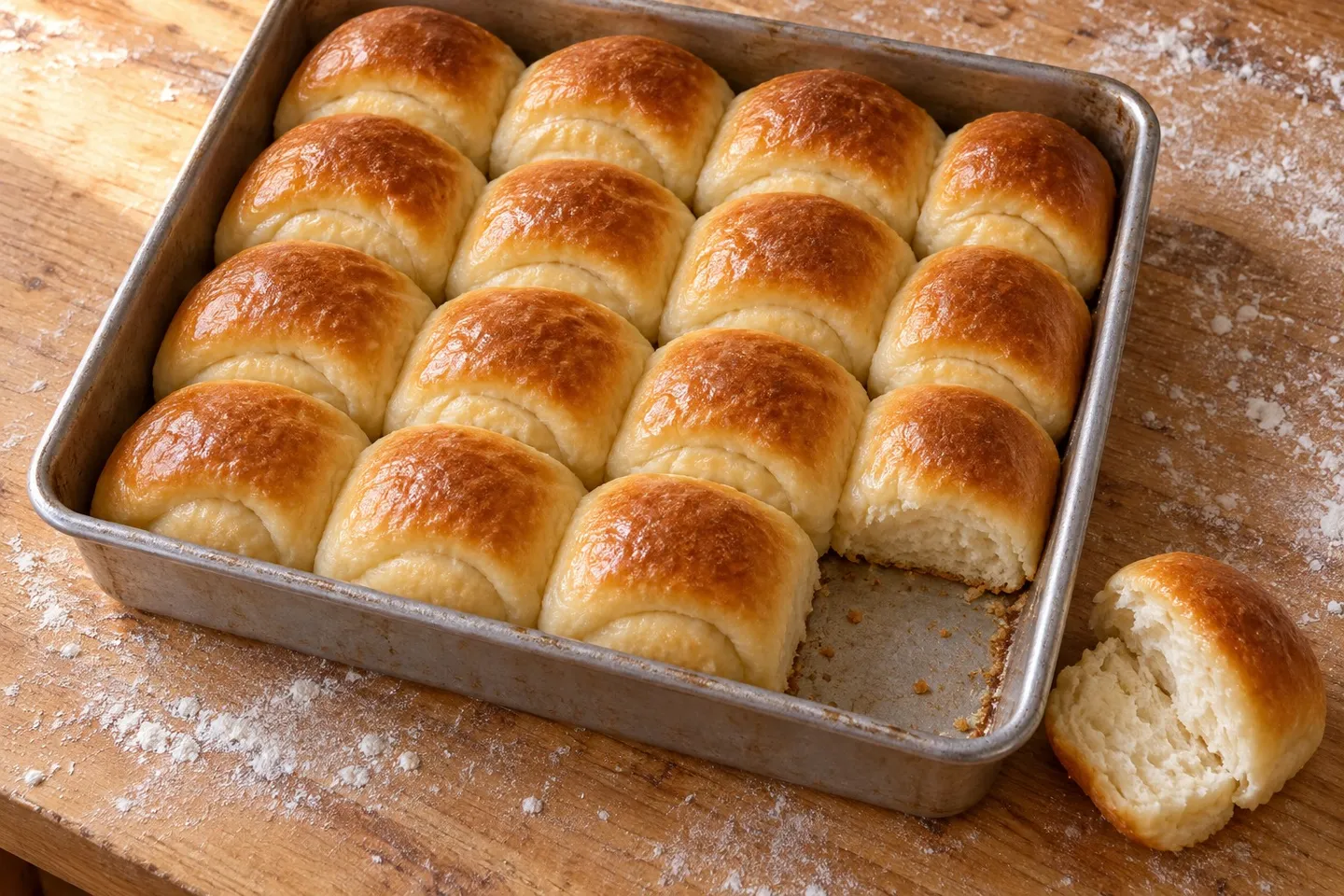
Parker House Rolls (1931)
Reader ratingsParker House rolls from the 1931 USDA bulletin Home Baking: soft milk-and-butter yeast rolls cut in rounds, buttered, creased and folded over, then baked hot.
- Recipe makes
- 16 rolls
- Prep
- Cook
- Total
About 30 minutes of work, a first rise of about 1½ hours, a second of about 45 minutes after shaping, and 10 to 15 minutes in a hot oven.
Folded Parker House rolls in a baking pan, one pulled open.
The story behind the recipe
The menu says only “Rolls,” without naming a kind, so this page takes the one roll recipe in Home Baking: Parker House rolls, soft yeast rounds folded over like a pocket before they bake. Home Baking is Farmers’ Bulletin No. 1450 of the United States Department of Agriculture, by Charlotte Chatfield of the Bureau of Home Economics. It was first issued in 1925, revised in December 1931 and sold for 5 cents (about $1.10 today, by US consumer prices, Minneapolis Fed).
Can rolls be shaped ahead and baked later?
Yes, the bulletin says. Once the rolls are shaped and in the pan, Chatfield writes, they “may be put in a refrigerator or other cold place to slow down the action of the yeast, and baked later,” then left somewhere warm until they have doubled. For anyone feeding a crowd, that meant shaping early and baking when the oven was free.
The bulletin opens on a plain fact about American eating: “Some kind of bread is served on the average American table three times a day.” It then works through bread step by step, with the dough held at about 82°F (28°C) and tested with a finger to see if it has risen enough.
Read more about this recipe
Making it today
Chatfield used a half-ounce cake of compressed yeast and “hard-wheat flour,” the strong flour sold today as bread flour. Our dry yeast stands in for the cake. She allows the dough’s second rising to be skipped, and we skip it. The buttered fold, creased with the handle of a table knife, is hers.
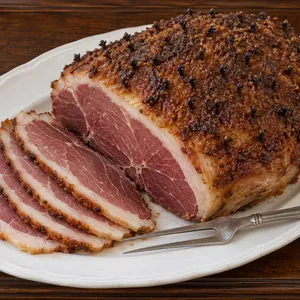
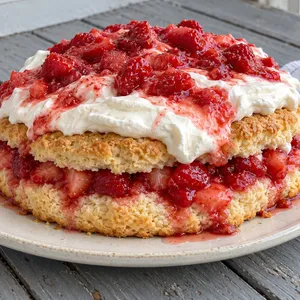
Split, they hold a slice of Boiled Ham with a Brown Sugar Crust (1931). What Did the King and Queen Eat at the Roosevelts’ 1939 Picnic? follows the rest of the lunch, from the struck-out weather clause to the shortcake.
The straight-dough method is perhaps the most convenient when only rolls are made. Allow the dough to rise the first time in the same way as for loaf bread. ...
Recipe makes: 16 rolls
Ingredients
For 16 rolls. Quantities are shown as written.
Quantities as written here, for 16 rolls.
- Whole milk1 cup
- Active dry yeast2 tsp
- Sugar1 tbsp
- Salt1 1/2 tsp
- Butter, for the dough1 1/2 tbsp
- Bread flour3 1/4 cups
- All-purpose flour, for the board2 tbsp
- Soft butter, for the bowl and pan1 tsp
- Melted butter, for brushing2 tbsp
Measurement notes
Ingredients as written here
- 1 cup whole milk
- 2 tsp active dry yeast
- 1 tbsp sugar
- 1½ tsp salt
- 1½ tbsp butter, for the dough
- 3¼ cups bread flour
- 2 tbsp all-purpose flour, for the board
- 1 tsp soft butter, for the bowl and pan
- 2 tbsp melted butter, for brushing
Equipment
 Small saucepan
- Large mixing bowl and a small bowl
 Instant-read thermometer
- Rolling pin
- Round cutter, 2½ inches across
- Table knife
- 9 by 13 inch baking pan
- Pastry brush
Instructions
Heat the milk in the saucepan until it steams and small bubbles show at the edge. Pour half of it into the small bowl and let it cool to about 100°F (38°C), then stir in the yeast and leave it for 5 to 10 minutes, until foamy.
Pour the rest of the hot milk over the sugar, salt and butter for the dough in the large bowl and stir until the butter melts. Let it cool to below 100°F (38°C).
Stir the yeast mixture into the large bowl, then add all but about a sixth of the bread flour and mix thoroughly. Add the rest a little at a time, only as much as you need for a dough that is soft but not sticky.
Dust the board with some of the flour for the board, turn out the dough and knead it with the palms of your hands for 8 to 10 minutes, until smooth and elastic.
Grease the bowl lightly with some of the soft butter, put in the dough, turn it once so the top is greased, cover and leave it somewhere at 80 to 85°F (27 to 29°C) for about 1½ hours, until doubled. It is ready when a finger pressed into it leaves a dent that stays.
Grease the pan with the rest of the soft butter. Press the dough down and roll it out about ⅜ inch thick on the floured board. Cut it into rounds with the cutter, gathering and rerolling the scraps once.
Brush the top of each round lightly with some of the melted butter. Press a crease across the middle with the handle of the table knife, fold one half over the other and press the top down. Set the rolls close together in the pan.
Cover and leave them in the warm place for about 45 minutes, until doubled. Heat the oven to 425°F (220°C) while they rise.
Brush the tops with the rest of the melted butter for a soft crust. Bake for 10 to 15 minutes, until golden brown and the center of a roll reads 190°F (88°C). Serve warm, or cool on a rack for a picnic.
Nutrition
130calories per serving
- Recipe makes
- 16 rolls
- Servings
- 16
Estimated per roll (16) from USDA FoodData Central values for bread flour, whole milk, butter and sugar.
Recipe notes
When adjusting quantities
The bulletin’s batch makes 16 rolls. Double it for 32 in two pans.
Notes
Quantities mentioned in these notes don’t change when you adjust the servings.
Chatfield’s half-ounce cake of compressed yeast is replaced with 2 teaspoons of active dry yeast, and her “hard-wheat flour” with bread flour; with soft-wheat flour she called for about 4 cups. We supplied the flour for the board, the butter for the bowl and pan, the amount of melted butter, the ⅜ inch thickness, the cutter size, the pan, the kneading time and the 190°F (88°C) reading. The bulletin’s 82°F (28°C) dough temperature and its 425°F (220°C) oven are kept. To bake later, as the bulletin suggests, cover the shaped rolls and refrigerate them, then leave them in a warm place until doubled before baking. Contains wheat and milk.
Scaling changes the ingredients only; pan sizes and cooking times need their own judgment. To adapt this recipe further, try the recipe tool at TuneMyRecipe (opens in a new tab), our sister site.
Sources and attribution
After Charlotte Chatfield, Home Baking, USDA Farmers’ Bulletin No. 1450 (Washington, revised 1931), Parker House Rolls
Recipe details
- Course
- Bread & baking
- Dish family
- Breads & Cakes
- Region
- American
- Era
- Interwar
- Source decade
- 1930s
- Main ingredient
- Grains & rice
- Difficulty
- Intermediate
- Season
- Summer