Dried Egg Madeira Cake (1945)
Reader ratingsThe Ministry of Food’s Madeira cake from its 1945 Dried Eggs leaflet: margarine, sugar and national flour, with the egg powder beaten in dry.
- Recipe makes
- One 7-inch cake, 8 slices
- Prep
- Cook
- Total
The cake bakes for about an hour. Let it cool for another hour on a rack before slicing.
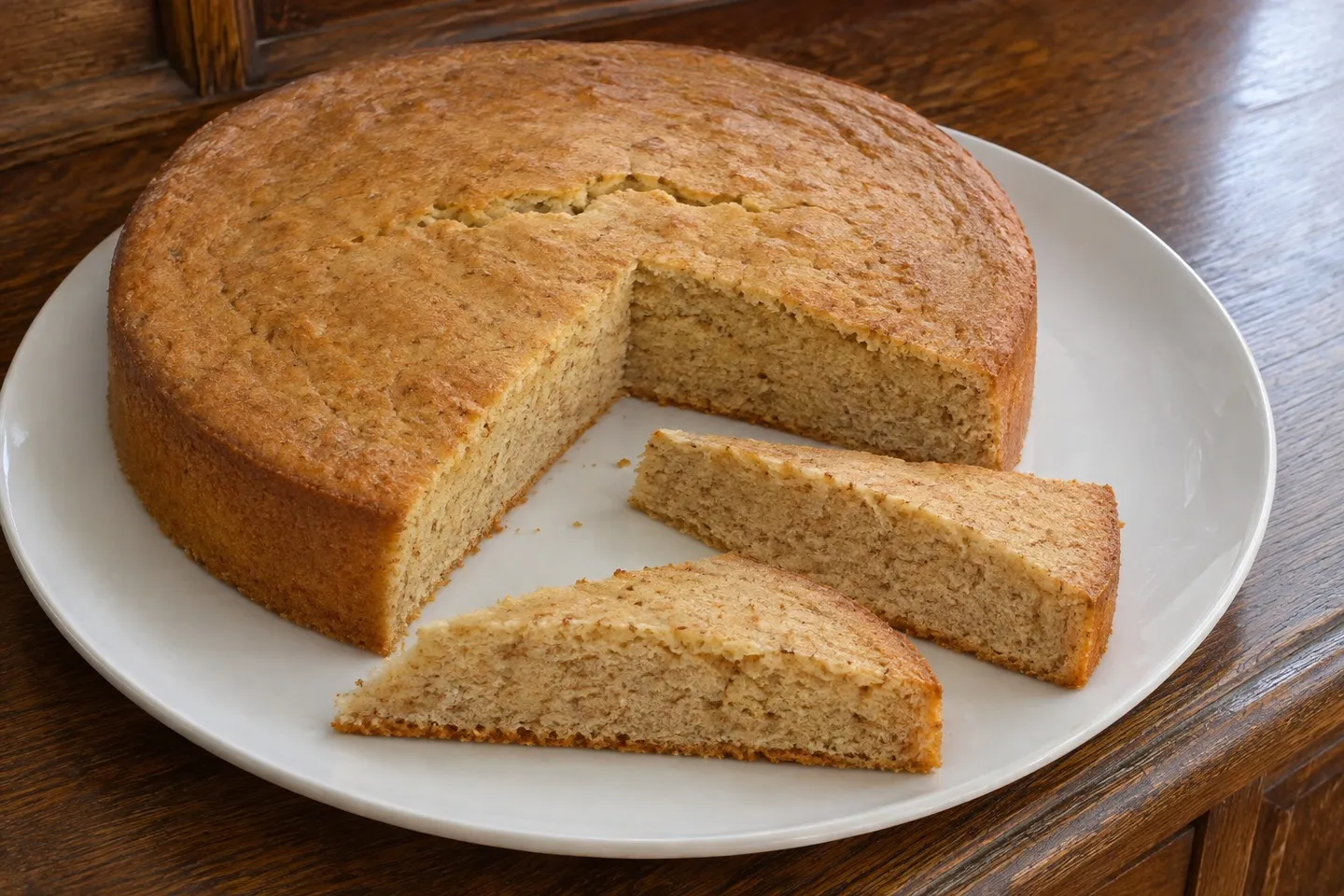
A plain round Madeira cake with two slices cut, showing a close, light brown crumb.
The story behind the recipe
The egg in this cake goes in as powder, straight from the tin. In Dried Eggs, War Cookery Leaflet No. 11, issued by the Ministry of Food in February 1945, the Madeira cake is creamed in the usual way, and then the dried egg is beaten into the margarine and sugar without being mixed with water first, and the water follows on its own.
Cake out of the week’s allowance
That trick is the leaflet’s own advice. For cakes and puddings made by creaming, it says, add the eggs dry to the creamed fat and sugar, beat well, and work in the water needed to reconstitute them a little at a time; for other plain cakes and batters the powder can be stirred in with the flour, so long as an extra two tablespoons of liquid go in for each egg.
Sugar stood at 8 oz a week for an adult, and margarine shared a single allowance with butter, so a cake was a decision about the week. The flour is the leaflet’s “national flour.” The Ministry’s 1946 account of its work says the extraction rate, the share of the wheat grain turned into flour, rose from 70 percent before the war to 85 percent in March 1942, when milling it was made compulsory, then came down to 82½ percent in October 1944 and 80 percent in December, so the flour of this leaflet was still browner than a pre-war white. High Teas and Suppers, the Ministry’s leaflet of November 1944, sets “Plain Cake” on three of its ten menus without giving a recipe for one; filling that gap with this Madeira cake from the next winter’s leaflet is our choice.
Read more about this recipe
Making it today
Dried whole egg powder is still sold, so the recipe keeps it, added dry as printed; the Recipe notes give a fresh-egg version. For national flour, a mix of plain and wholemeal flour is our stand-in. The leaflet says “Flavouring if liked,” and we use grated lemon zest. Its time, one and a half to two hours in a moderate oven, is long by modern standards, so the cake bakes at 325°F (160°C) for about an hour, until a skewer comes out clean. On the ration week it came out of, see What Was a Week’s Food Ration in Britain, 1940 to 1954? It belongs on the table with the leeks of Welsh Wonder (1944), Menu 1’s main dish.
MADEIRA CAKE
2½ oz. margarine; ½ lb. national flour;
3 oz. sugar; 4 level teaspoons baking powder;
2 dried eggs dry; 3—4 tablespoons milk;
4 tablespoons water; Flavouring if liked.Cream margarine and sugar, add eggs dry, beating thoroughly, beat in water gradually. Add flour, baking powder, flavouring and milk to make to a soft consistency. Bake in a moderate oven 1½—2 hours, in a 7 inch diameter tin.
Recipe makes: One 7-inch cake, 8 slices
Ingredients
For One 7-inch cake, 8 slices. Quantities are shown as written.
Quantities as written here, for One 7-inch cake, 8 slices.
- Margarine or soft butter2.5 oz
- Caster sugar3 oz
- Dried whole egg powder2 tbsp
- Water4 tbsp
- Plain flour6 oz
- Wholemeal flour2 oz
- Baking powder4 tsp
- Finely grated lemon zest1 tsp
- Milk4 tbsp
Measurement notes
Ingredients as written here
- 2.5 oz margarine or soft butter
- 3 oz caster sugar
- 2 tbsp dried whole egg powder
- 4 tbsp water
- 6 oz plain flour
- 2 oz wholemeal flour
- 4 tsp baking powder
- 1 tsp finely grated lemon zest
- 4 tbsp milk
Equipment
 18 cm (7-inch) deep round cake tin
 Baking parchment
 Bowl
 Wooden spoon
 Measuring spoons
 Sifter or sieve
 Skewers or cocktail sticks
 Instant-read thermometer
 Wire rack
Instructions
Heat the oven to 325°F (160°C). Grease the cake tin and line the base and sides with baking parchment.
Beat the margarine or soft butter and the caster sugar together in the bowl with the wooden spoon until pale and soft.
Add the dried whole egg powder, dry, and beat it in thoroughly. Beat in the water a little at a time until the mixture is smooth.
Sift the plain flour, wholemeal flour and baking powder together into the bowl, tipping back any bran left in the sieve. Add the lemon zest.
Stir in the flour with most of the milk, adding the rest only as needed, until the mixture is soft and drops easily from the spoon.
Spoon the mixture into the tin and level the top.
Bake for 55 to 65 minutes, until risen and golden, a skewer pushed into the middle comes out clean, and the center reads 205°F (96°C).
Cool in the tin for 10 minutes, then turn out onto the wire rack and leave until cold.
Nutrition
220calories per serving
- Recipe makes
- One 7-inch cake, 8 slices
- Servings
- 8
Estimated per slice (8) from USDA FoodData Central values for margarine, sugar, dried whole egg, flours and milk.
Recipe notes
When adjusting quantities
The leaflet’s quantities fill one 7-inch tin. A larger batch needs a larger tin and a longer bake; test the middle.
Notes
Quantities mentioned in these notes don’t change when you adjust the servings.
The leaflet’s dried eggs are measured as level spoonfuls: one level tablespoon of powder is one egg, by its own table. With fresh eggs, beat 2 large eggs and add them a little at a time to the creamed margarine and sugar in place of the powder and the water. The plain and wholemeal flour standing in for national flour, the lemon zest, the oven at 325°F (160°C) and the hour’s baking are ours; the leaflet gives a moderate oven for 1½ to 2 hours. The leaflet’s 3 to 4 tablespoons of milk is kept as 4, used as needed.
Scaling changes the ingredients only; pan sizes and cooking times need their own judgment. To adapt this recipe further, try the recipe tool at TuneMyRecipe (opens in a new tab), our sister site.
Sources and attribution
After Madeira Cake, in Dried Eggs, War Cookery Leaflet No. 11 (Ministry of Food, February 1945)
See the original pages (scan at National Library of Scotland) (opens in a new tab)
Recipe details
- Course
- Bread & baking
- Dish family
- Breads & Cakes
- Region
- British
- Source decade
- 1940s
- Main ingredient
- Eggs
- Difficulty
- Easy
- Occasion
- Rationing