Roast Beef with Horseradish Sauce (1894)
Reader ratingsAgnes Marshall’s roast beef with horseradish sauce, about 1894: a joint roasted under greased paper, with a cold sauce of grated horseradish, two mustards and whipped cream.
- Recipe makes
- One 1.5 kg joint and about 225 ml sauce, 6 servings
- Prep
- Cook
- Total
About 1¼ hours in the oven for a 1.5 kg joint, then a 20-minute rest, which is when the sauce and gravy are made. Marshall’s own rule before the fire was twenty minutes to the pound.
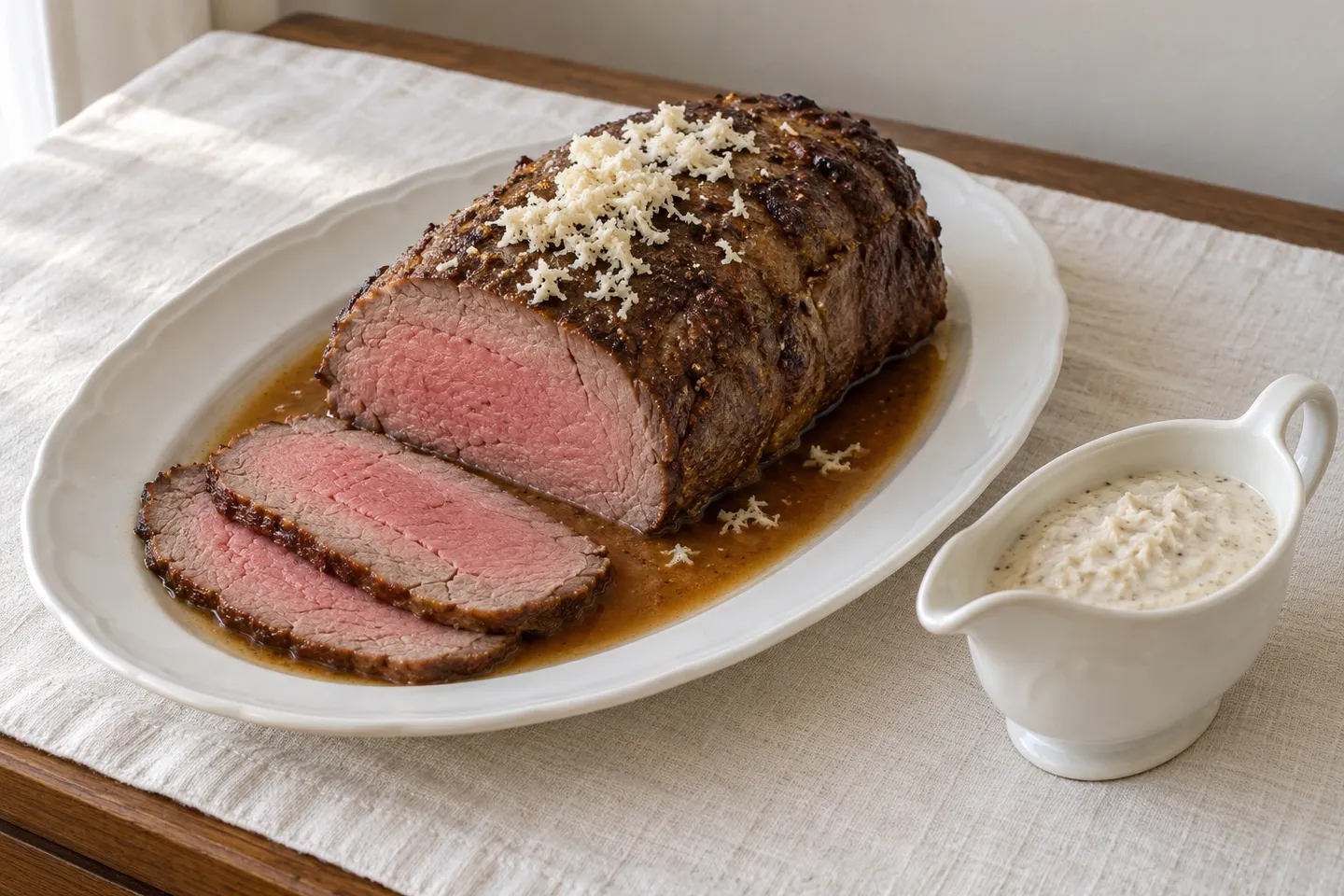
Roast beef garnished with scraped horseradish, with a boat of horseradish cream sauce.
The story behind the recipe
The Fulham card for the King’s Dinner of 5 July 1902 put “Roast Beef and Sauce” at the head of its menu and left the sauce unnamed. Agnes Marshall, who ran a cookery school in Mortimer Street, London, had an answer for a roast of beef: horseradish, grated fine and folded into whipped cream with two mustards. Her recipe, in Mrs. A. B. Marshall’s Cookery Book of about 1894, is the one given here. What Fulham’s caterers actually put in the sauceboat went unrecorded.
How did Marshall roast beef?
Before an open fire. She tied a well-greased paper round the joint, set it at a distance that depended “upon the range and the briskness of the fire,” and basted it throughout, at about twenty minutes to the pound. Half an hour before the end the paper came off so the meat could “take a pretty golden colour.” At table it was served on plated skewers in place of the plain ones, with scraped horseradish on top, a little clear gravy round it, the sauce in a boat and Yorkshire pudding beside it.
Marshall filed the dish under removes, the joints at the center of a dinner, and gave it a French name, Bœuf rôti au Sauce Raifort. Her sauce is a cold one, made from a stick of horseradish left in cold water “till quite firm” before it is scrubbed, peeled and grated.
Read more about this recipe
Making it today
The joint roasts in an oven, under parchment brushed with dripping in place of her greased paper, and the paper still comes off for the last half hour. The thermometer replaces her twenty minutes to the pound. Marshall’s sauce uses two raw egg yolks; ours, at half her quantity, uses one pasteurized yolk. The Yorkshire pudding she named is left to the Roast Beef and Yorkshire Pudding (1906), from the 1906 edition of Mrs. Beeton’s book. Fulham’s card itself, with its ale and temperance cordials sharing a line, is where What Did London’s Poor Eat at the King’s Dinner in 1902? begins.
Neatly trim the meat according to the joint, skewer it, tie it up, rub it all over with dripping, and tie a well-greased paper round it, put the joint to roast, not too close to the fire; the distance must depend upon the range and the briskness of the fire; keep it well basted during the roasting, and allow about twenty minutes for each pound of meat; half an hour before the meat is done remove the paper, and let the meat take a pretty golden colour. When ready to serve replace the ordinary skewers with plated ones, dish up, garnish the top with scraped horseradish, and pour a little clear gravy round the meat. Serve with horseradish sauce in a boat and Yorkshire pudding.
Horseradish Sauce, or Sauce Raifort.—Take a large stick of horseradish, and let it lie in cold water till quite firm, scrub it well and peel it, and grate from it a quarter of a pint; these gratings must be smooth and fine; add to this half a teaspoonful of English mustard, half a teaspoonful of French mustard, a good pinch of castor sugar, a pinch of salt, two raw yolks of eggs, and mix all together with one and a half tablespoonfuls of French vinegar; then add half a pint of thickly-whipped cream; stir well together and use.
Recipe makes: One 1.5 kg joint and about 225 ml sauce, 6 servings
Ingredients
For One 1.5 kg joint and about 225 ml sauce, 6 servings. Quantities are shown as written.
Quantities as written here, for One 1.5 kg joint and about 225 ml sauce, 6 servings.
Beef
- Boneless beef roasting joint, such as topside or sirloin, tied1.5 kg
- Beef dripping, softened30 g
- Salt, for the beef1 tsp
- Ground black pepper1/2 tsp
- Fresh horseradish root, for the garnish15 g
Gravy
- Beef stock250 ml
Horseradish sauce
- Fresh horseradish root, for the sauce40 g
- Prepared English mustard1/4 tsp
- Dijon mustard1/4 tsp
- Caster sugar1/4 tsp
- Salt, for the sauce1 pinch
- Pasteurized egg yolk1
- White wine vinegar2 tsp
- Heavy cream75 ml
Measurement notes
Ingredients as written here
- 1.5 kg boneless beef roasting joint, such as topside or sirloin, tied
- 30 g beef dripping, softened
- 1 tsp salt, for the beef
- 1/2 tsp ground black pepper
- 15 g fresh horseradish root, for the garnish
- 250 ml beef stock
- 40 g fresh horseradish root, for the sauce
- 1/4 tsp prepared English mustard
- 1/4 tsp Dijon mustard
- 1/4 tsp caster sugar
- 1 pinch salt, for the sauce
- 1 pasteurized egg yolk
- 2 tsp white wine vinegar
- 75 ml heavy cream
Equipment
- Roasting pan with a rack
- Parchment paper and kitchen string
 Instant-read thermometer
 Fine grater
- Mixing bowl and whisk
- Small saucepan and fine sieve
- Sauceboat
Instructions
Heat the oven to 350°F (180°C), or 320°F (160°C) for a fan oven. Put both pieces of horseradish root in a bowl of cold water to firm up while the beef roasts.
Pat the beef roasting joint dry, season it all over with the salt for the beef and the black pepper, and rub it with most of the beef dripping. Set it on the rack in the roasting pan.
Brush a sheet of parchment with the rest of the dripping, lay it greased side down over the top and sides of the joint and tie it on loosely with string.
Roast for 45 minutes, basting through the paper with the fat in the pan twice. Untie and remove the paper, baste the meat, and roast for about 30 minutes more, basting once, until it is golden brown and a thermometer in the thickest part reads 145°F (63°C) for medium rare, the USDA safe minimum for a beef roast. Go higher if you like it better done.
Lift the beef onto a warm platter, cover it loosely with foil and let it rest for 20 minutes.
While it rests, make the sauce. Scrub and peel the horseradish root for the sauce and grate it on the fine side of the grater into a bowl, turning your face away from the fumes. Stir in the English mustard, Dijon mustard, caster sugar, salt for the sauce, pasteurized egg yolk and white wine vinegar.
Whip the heavy cream to soft, thick peaks and fold it into the horseradish mixture. Spoon it into the sauceboat and keep it cold until you serve.
Pour off the fat from the roasting pan, add the beef stock and boil it over medium heat for 3 to 4 minutes, scraping up the browned bits, until it has reduced a little. Strain it, and stir in any juices from the resting meat.
Scrape the horseradish root for the garnish into thin shreds with a knife. Remove the string from the beef, scatter the shreds over the top and pour a little of the gravy round it. Carve across the grain and serve with the rest of the gravy and the sauce.
Nutrition
420calories per serving
- Recipe makes
- One 1.5 kg joint and about 225 ml sauce, 6 servings
- Servings
- 6
Estimated per serving (6) from USDA FoodData Central values for lean beef round roast, beef tallow, heavy cream, egg yolk and horseradish.
Recipe notes
When adjusting quantities
Allow about 250 g of boneless joint per person. A larger joint needs more time in the oven; go by the thermometer. Make the sauce in proportion.
Notes
Quantities mentioned in these notes don’t change when you adjust the servings.
Marshall weighs neither the joint nor the dripping and names no seasoning, so we chose the 1.5 kg joint, the salt, pepper and dripping, and the beef stock for the gravy, along with the oven temperature and times and the parchment in place of greased paper. Her plated skewers and the Yorkshire pudding are left out. The sauce is half her quantity: her quarter pint of grated horseradish becomes 40 g of root, and her half pint of thickly whipped cream is read as a whipped measure, made here from 75 ml of cream. One pasteurized yolk replaces her two raw ones, white wine vinegar stands in for her “French vinegar,” and Dijon for her French mustard.
Raw egg yolk can carry salmonella, which is why the sauce uses a pasteurized yolk; if you can’t find pasteurized eggs, leave the yolk out and the sauce will be a little thinner. Keep the sauce in the refrigerator and use it the same day. Chill leftover beef within 2 hours and use it within 3 to 4 days. Contains egg and milk.
Scaling changes the ingredients only; pan sizes and cooking times need their own judgment. To adapt this recipe further, try the recipe tool at TuneMyRecipe (opens in a new tab), our sister site.
Sources and attribution
After Mrs. A. B. Marshall’s Cookery Book (London, about 1894), Roast Beef with Horseradish Sauce and Horseradish Sauce, or Sauce Raifort; the dish as printed on the Fulham King’s Dinner card of 5 July 1902
See the original pages (scan at Internet Archive) (opens in a new tab)
Recipe details
- Course
- Main course
- Dish family
- Meat & Poultry
- Region
- British
- Era
- 19th century
- Source decade
- 1890s
- Event
- King’s Dinner, 1902
- Main ingredient
- Beef
- Difficulty
- Intermediate
- Season
- Summer