Mashed Potatoes Baked (1894)
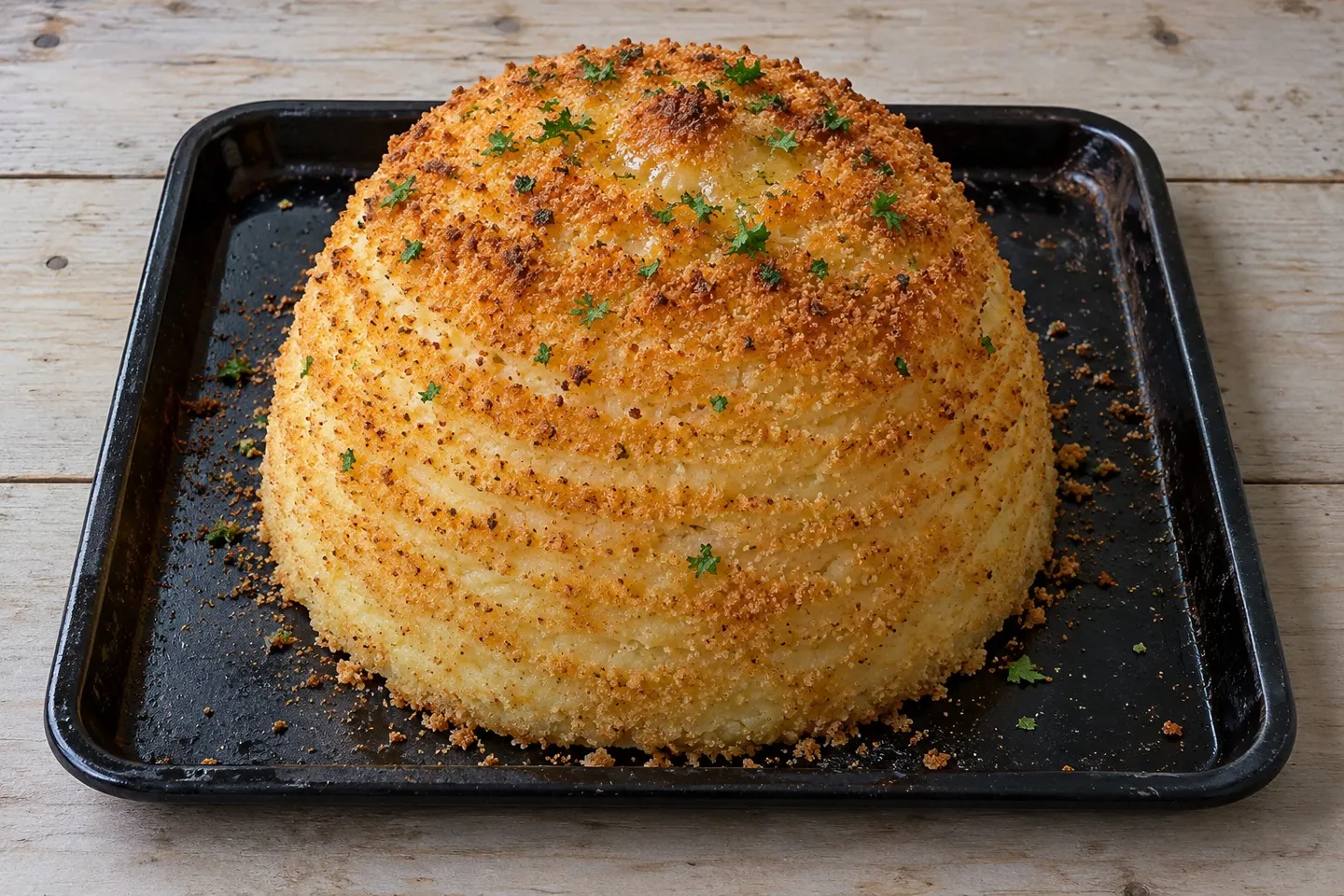
Reader ratingsAgnes Marshall’s mashed potatoes baked, about 1894: buttery mash piled into a beehive, coated with crumbs from baked crusts, dotted with butter and browned in the oven.
- Recipe makes
- One beehive of about 1.3 kg, 6 servings
- Prep
- Cook
- Total
The crusts bake while the potatoes boil, so the crumbs are ready when the mash is. The beehive then needs about 20 minutes in the oven.
Mashed potato shaped into a beehive, crumbed and browned in the oven.
The story behind the recipe
“Potatoes” on a menu of the 1890s could mean almost anything, and Agnes Marshall hoped it meant something better than plain boiled. Her Cookery Book of about 1894 quotes an unnamed authority on the English houses, hotels and clubs where the boiled potato appeared daily “with a regularity which drives a diner to despair.” Her own book offers page after page of other ways, and this is one of the plainest: mash, shaped into a beehive, crumbed and browned in the oven. Fulham’s card for the King’s Dinner of 5 July 1902 gave potatoes a line to themselves and said nothing about how they were cooked.
Where did the potatoes go on a menu?
In Marshall’s chapter on menus, the vegetables could be named on the card or left off it. When they were named, they were usually printed or written a little to the right, under the name of the joint they came with, and she counted two vegetables enough for an ordinary dinner party. A borough’s card had no such layout to follow. On Fulham’s, “Potatoes” sits on its own line between the beef and the bread.
Read more about this recipe
What else did Marshall do with mash?
She built with it. Her “Potato Border” is sieved potato bound with butter and a yolk, shaped into a ring, glazed with egg and baked golden, and across the book one entrée after another is dished up “on a border of potato.” The beehive is the same purée made the center of attention, with its French name, Purée de Pommes de Terre au Four, and a coat of browned crumbs that she made at home from crusts of bread, baked and rubbed through a sieve.
Making it today
The method is Marshall’s step by step. A ricer stands in for her wire sieve, and we chose the oven setting, which she leaves out. The beehive is a side for the Roast Beef with Horseradish Sauce (1894) from the same book, and the dinner it belongs to is told in What Did London’s Poor Eat at the King’s Dinner in 1902?
Boil some peeled potatoes, with a little salt in the water, till they are tender; then drain them, and when quite dry pass them through a wire sieve, or mash them in the saucepan; season with a little pepper and salt, a little warm butter and a little milk, to make them moist; when these are well mixed roll the mixture into a ball, place it on a buttered tin, and draw it up into a loaf or beehive shape with a knife or a fork; sprinkle it over with browned breadcrumbs, made from crusts of bread baked, crushed up, and rubbed through a sieve. Cook the potatoes in the oven for about twenty minutes with a few little pieces of butter placed here and there on them. When a pretty colour dish up, lightly sprinkle a little parsley over, and serve while hot.
Recipe makes: One beehive of about 1.3 kg, 6 servings
Ingredients
For One beehive of about 1.3 kg, 6 servings. Quantities are shown as written.
Quantities as written here, for One beehive of about 1.3 kg, 6 servings.
- Floury potatoes, such as Maris Piper or russet1.2 kg
- Salt, for the water2 tsp
- Bread crusts, for the crumbs40 g
- Butter, for the mash45 g
- Whole milk100 ml
- Salt, for the mash1/2 tsp
- Ground white pepper1/4 tsp
- Butter, for the tin5 g
- Butter, for the top15 g
- Chopped parsley1 tbsp
Measurement notes
Ingredients as written here
- 1.2 kg floury potatoes, such as Maris Piper or russet
- 2 tsp salt, for the water
- 40 g bread crusts, for the crumbs
- 45 g butter, for the mash
- 100 ml whole milk
- 1/2 tsp salt, for the mash
- 1/4 tsp ground white pepper
- 5 g butter, for the tin
- 15 g butter, for the top
- 1 tbsp chopped parsley
Equipment
 Large saucepan
- Potato masher or ricer
- Baking sheet for the crusts
- Rolling pin and sieve
- Buttered baking tin or ovenproof plate
 Instant-read thermometer
Instructions
Heat the oven to 400°F (200°C). Peel the potatoes, cut them into even chunks and put them in the saucepan with cold water to cover and the salt for the water.
Bring the potatoes to a boil and simmer for about 20 minutes, until a knife slides through the largest piece with no resistance.
While they cook, spread the bread crusts on the baking sheet and bake for 12 to 15 minutes, until dry, crisp and golden. Let them cool for a few minutes, crush them with the rolling pin and rub them through the sieve.
Drain the potatoes and return them to the hot pan over low heat for a minute or two, shaking the pan, until they look dry and floury. Mash them, or press them through the ricer back into the pan.
Warm the butter for the mash with the milk until the butter melts, and beat it into the potatoes with the salt for the mash and the white pepper until smooth and moist.
Rub the baking tin with the butter for the tin. Pile the mash in the middle, roll it into a ball with a spoon and draw it up into a tall beehive with a knife or fork, marking ridges round it as you go.
Sprinkle the crumbs all over the beehive and dot it with small pieces of the butter for the top.
Bake for about 20 minutes, until the crumbs are a deep golden brown and a thermometer pushed into the center reads 165°F (74°C), the temperature USDA gives for reheated casseroles.
Lift it onto a warm dish, scatter over the parsley and serve hot.
Nutrition
260calories per serving
- Recipe makes
- One beehive of about 1.3 kg, 6 servings
- Servings
- 6
Estimated per serving (6) from USDA FoodData Central values for boiled potatoes, butter, whole milk and white bread crust.
Recipe notes
When adjusting quantities
Halve everything for a smaller beehive; it browns in about the same time.
Notes
Quantities mentioned in these notes don’t change when you adjust the servings.
Marshall measures nothing. We settled on the 1.2 kg of potatoes, the butter, milk, salt and pepper, the weight of crusts and the oven temperature. The crusts come from any plain white loaf, and a day-old one dries fastest. White pepper is our choice for her “pepper”; she names white pepper in the two potato purées on the next page. She allows mashing in the saucepan or rubbing through a sieve; a ricer does the sieve’s job.
The beehive can be shaped up to a day ahead, covered and kept in the refrigerator, then crumbed and baked for longer, until the center reaches 165°F (74°C). Chill leftovers within 2 hours. Contains milk and wheat.
Scaling changes the ingredients only; pan sizes and cooking times need their own judgment. To adapt this recipe further, try the recipe tool at TuneMyRecipe (opens in a new tab), our sister site.
Sources and attribution
After Mrs. A. B. Marshall’s Cookery Book (London, about 1894), Mashed Potatoes Baked; potatoes as printed on the Fulham King’s Dinner card of 5 July 1902
See the original pages (scan at Internet Archive) (opens in a new tab)
Recipe details
- Course
- Side dish
- Dish family
- Vegetables & Sides
- Region
- British
- Era
- 19th century
- Source decade
- 1890s
- Event
- King’s Dinner, 1902
- Main ingredient
- Vegetables
- Difficulty
- Easy
- Season
- Summer