Plum Pudding (1894)
Reader ratingsAgnes Marshall’s plum pudding of suet, raisins, currants, sultanas, chopped apple, almonds and peel, raised with baking powder and steamed in a basin, about 1894.
- Recipe makes
- One 1.4-liter pudding, 8 servings
- Prep
- Cook
- Total
Mixing takes half an hour, then the pudding steams for 5 hours and stands for 5 minutes before it is turned out. Keep a kettle hot for topping up the pot.
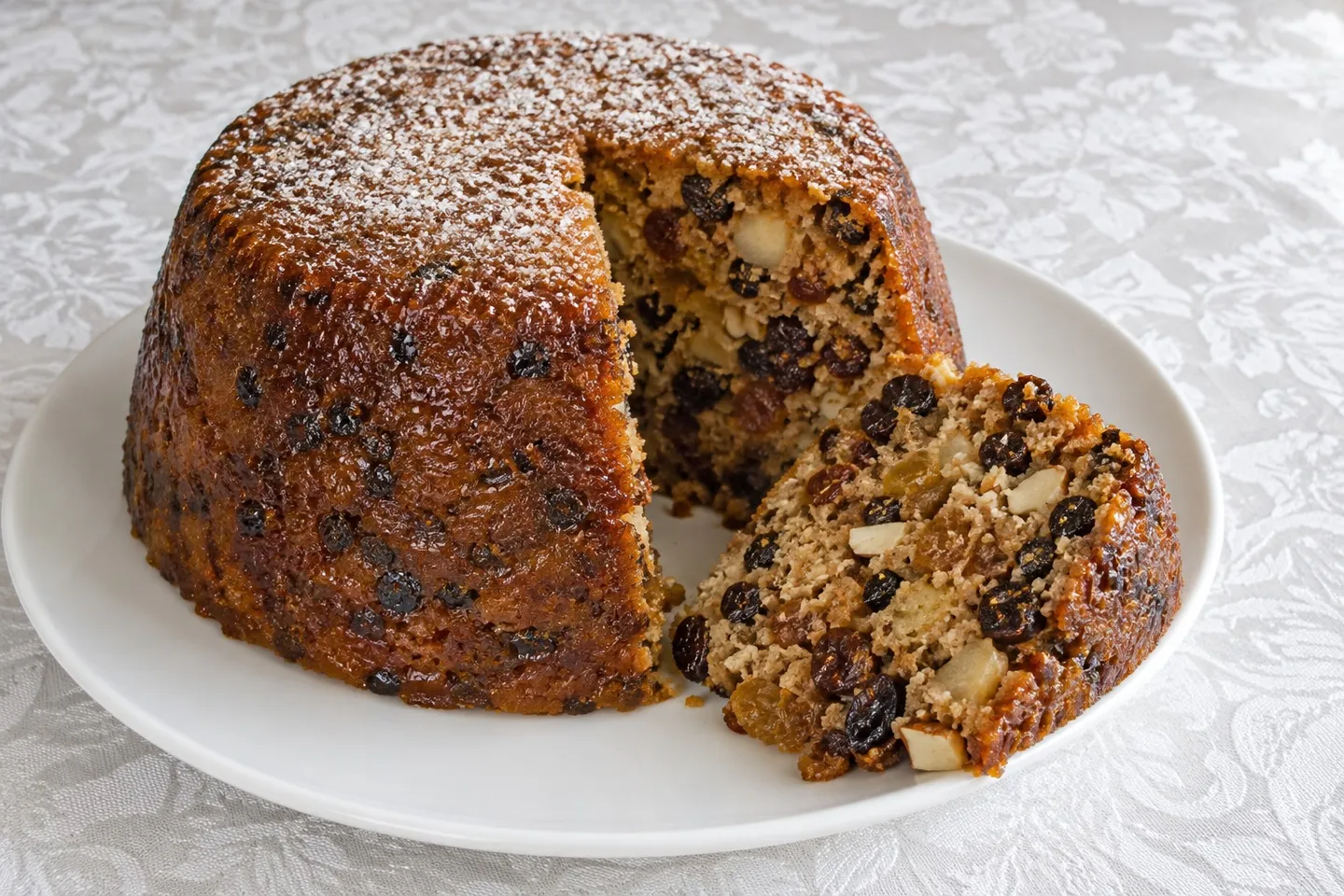
Steamed plum pudding with apple and almonds, dusted with sugar, one wedge cut.
The story behind the recipe
Agnes Marshall’s plum pudding began with one and a quarter pounds of beef suet, came to more than four kilograms of mixture by our arithmetic, and boiled for about twelve hours. Her Cookery Book, printed in London in about 1894, gives it a French name that is more candid than the English one, Pouding aux Raisins à l’Anglaise, English raisin pudding: there are no plums in it, only raisins, currants and sultanas. Plum pudding was the sweet on Fulham’s card for the King’s Dinner of 5 July 1902. The card has no recipe, so this one is Marshall’s.
What made Marshall’s pudding different?
More goes into it. Mrs. Beeton’s Christmas Plum Pudding (1861) has no sugar or flour, and holds together on breadcrumbs, suet and eggs. Marshall adds flour, cornflour, a pound of moist sugar and two ounces of baking powder to raise it, plus a pound of chopped apples and a quarter pound of almonds. She names her brands, too: Brown and Polson’s cornflour and Cowan’s baking powder. At the table she dusted the pudding with castor sugar and served it with brandy or rum butter.
She gave two ways to cook it. One was a pudding cloth, dusted with flour and brown sugar and dropped into boiling water. The other was a buttered basin dusted inside with Demerara sugar, with a cloth tied over the top.
Read more about this recipe
Making it today
This is a quarter of Marshall’s pudding, enough for eight, so her full mixture would have served about thirty. The King’s Dinner was reported at about half a million guests across London; at thirty to a pudding, that would have taken more than fifteen thousand of hers, each boiling for twelve hours. The quarter is made in her sugared basin and steamed in a covered pot, with far less baking powder than her proportion, about what modern steamed puddings use. We steam it for five hours and check it with a thermometer, since a pudding with eggs in it should reach 160°F (71°C) in the center. On Fulham’s card it came after the beef, potatoes and bread, and What Did London’s Poor Eat at the King’s Dinner in 1902? reads the rest of that menu.
Ingredients: One and a quarter pounds of chopped beef suet, three quarters of a pound of freshly made white breadcrumbs, six ounces of flour, a quarter of a pound of Brown and Polson’s cornflour, three quarters of a pound of stoned raisins, a quarter of a pound of chopped almonds, three quarters of a pound of currants washed and dried, three quarters of a pound of sultanas, one pound of chopped apples, half a pound of chopped mixed peel, one pound of moist sugar, the juice of two lemons, the peel of two lemons cut fine and chopped, one nutmeg grated, half a pint of milk, six whole eggs, and two ounces of Cowan’s baking powder.
Mix these ingredients well together in a basin, then tie them up tightly in a clean pudding cloth that is dusted over with flour and brown sugar, put it into boiling water, and boil for about twelve hours. The pudding may also be boiled in a basin, in which case the basin should be buttered and then dusted over inside with Demerara sugar, and the ingredients put in and a cloth tied over. When the pudding is cooked, turn it out, dust it over with a little castor sugar, and serve brandy or White Cane Rum butter with it.
Recipe makes: One 1.4-liter pudding, 8 servings
Ingredients
For One 1.4-liter pudding, 8 servings. Quantities are shown as written.
Quantities as written here, for One 1.4-liter pudding, 8 servings.
- Butter, for the basin10 g
- Demerara sugar, for the basin15 g
- Shredded beef suet140 g
- Fresh white breadcrumbs85 g
- Plain flour45 g
- Cornflour (cornstarch)30 g
- Baking powder1 1/2 tsp
- Seedless raisins85 g
- Currants85 g
- Sultanas85 g
- Chopped almonds30 g
- Cooking apple, peeled, cored and chopped115 g
- Chopped mixed peel55 g
- Soft light brown sugar115 g
- Finely chopped lemon peel2 tsp
- Grated nutmeg1/2 tsp
- Beaten egg75 g
- Whole milk70 ml
- Lemon juice1 1/2 tbsp
- Caster sugar, for dusting1 tsp
Measurement notes
Ingredients as written here
- 10 g butter, for the basin
- 15 g Demerara sugar, for the basin
- 140 g shredded beef suet
- 85 g fresh white breadcrumbs
- 45 g plain flour
- 30 g cornflour (cornstarch)
- 1 1/2 tsp baking powder
- 85 g seedless raisins
- 85 g currants
- 85 g sultanas
- 30 g chopped almonds
- 115 g cooking apple, peeled, cored and chopped
- 55 g chopped mixed peel
- 115 g soft light brown sugar
- 2 tsp finely chopped lemon peel
- 1/2 tsp grated nutmeg
- 75 g beaten egg
- 70 ml whole milk
- 1 1/2 tbsp lemon juice
- 1 tsp caster sugar, for dusting
Equipment
- 1.4-liter heatproof pudding basin
- Large pot with a lid, deep enough to hold the basin
- Trivet or folded cloth for the bottom of the pot
- Parchment paper, foil and kitchen string
 Instant-read thermometer
Instructions
Rub the inside of the basin thickly with the butter for the basin, add the Demerara sugar for the basin and turn the basin so the sugar coats the bottom and sides. Tip out any loose sugar.
Set the trivet in the pot, add water to come about halfway up the basin, and bring it to a simmer while you mix.
In a large bowl, mix the suet, breadcrumbs, plain flour, cornflour and baking powder. Add the raisins, currants, sultanas, almonds, apple, mixed peel, brown sugar, lemon peel and nutmeg, and stir until the fruit is coated.
Whisk the beaten egg with the milk and lemon juice, pour it over the dry mixture and stir thoroughly until every crumb is moist.
Spoon the mixture into the basin and level the top; it should come no higher than 3 cm (just over 1 inch) below the rim, to leave room for it to rise. Cover with a sheet of parchment and a sheet of foil, both folded with a pleat across the middle, and tie them on tightly under the rim with string.
Stand the basin on the trivet. The water should come halfway up its side. Cover the pot and keep the water at a steady simmer for 5 hours, topping it up with boiling water from the kettle whenever it drops.
Lift out the basin and push the thermometer through the covers into the center of the pudding: it should read at least 160°F (71°C). If it doesn’t, cover it again and steam for another 30 minutes before checking again.
Let the pudding stand for 5 minutes, remove the covers, run a knife around the edge and turn it out onto a warm plate. Dust it with the caster sugar for dusting and serve hot.
Nutrition
450calories per serving
- Recipe makes
- One 1.4-liter pudding, 8 servings
- Servings
- 8
Estimated per serving (8) from USDA FoodData Central values for beef suet, white bread, flour, cornstarch, raisins, currants, almonds, apple, candied peel, brown sugar, egg and milk.
Recipe notes
When adjusting quantities
A quarter of Marshall’s quantity. Double it for a 2.5-liter basin and allow about 2 hours more steaming; the thermometer decides.
Notes
Quantities mentioned in these notes don’t change when you adjust the servings.
The amounts are a quarter of Marshall’s, rounded to the nearest 5 g, with her pounds and ounces read as avoirdupois and her half pint as an imperial half pint of about 284 ml. A quarter of her six eggs is one and a half, given here by weight. Her two ounces of baking powder would be about 14 g at this size; we use 1½ teaspoons (about 6 g) of modern baking powder, close to the 2 teaspoons River Cottage uses for two puddings of 1.2 liters each. A quarter of her grated nutmeg is read as ½ teaspoon, and of her chopped lemon peel as 2 teaspoons. “Moist sugar” is soft brown sugar. Steaming in a covered pot replaces her boiling in water, and parchment and foil replace her cloth.
Marshall served brandy or White Cane Rum butter with it; brandy butter or cream both suit it. The fresh apple makes this a pudding to eat the day it is made: chill leftovers within 2 hours, use them within 4 days and steam slices again until hot through, 165°F (74°C). Contains wheat, egg, milk and almonds.
Scaling changes the ingredients only; pan sizes and cooking times need their own judgment. To adapt this recipe further, try the recipe tool at TuneMyRecipe (opens in a new tab), our sister site.
Sources and attribution
After Mrs. A. B. Marshall’s Cookery Book (London, about 1894), Plum Pudding; the dish as printed on the Fulham King’s Dinner card of 5 July 1902
See the original pages (scan at Internet Archive) (opens in a new tab)
Recipe details
- Course
- Dessert
- Dish family
- Desserts & Sweets
- Region
- British
- Era
- 19th century
- Source decade
- 1890s
- Event
- King’s Dinner, 1902
- Main ingredient
- Fruit
- Difficulty
- Intermediate
- Season
- Summer