The King’s Dinner to the poor of London, Borough of Fulham · Fulham, London
What Did London’s Poor Eat at the King’s Dinner in 1902?
Roast beef and sauce, potatoes, bread ad lib. and plum pudding: Fulham’s card for the King’s Dinner to London’s poor, 5 July 1902, and what it leaves out.
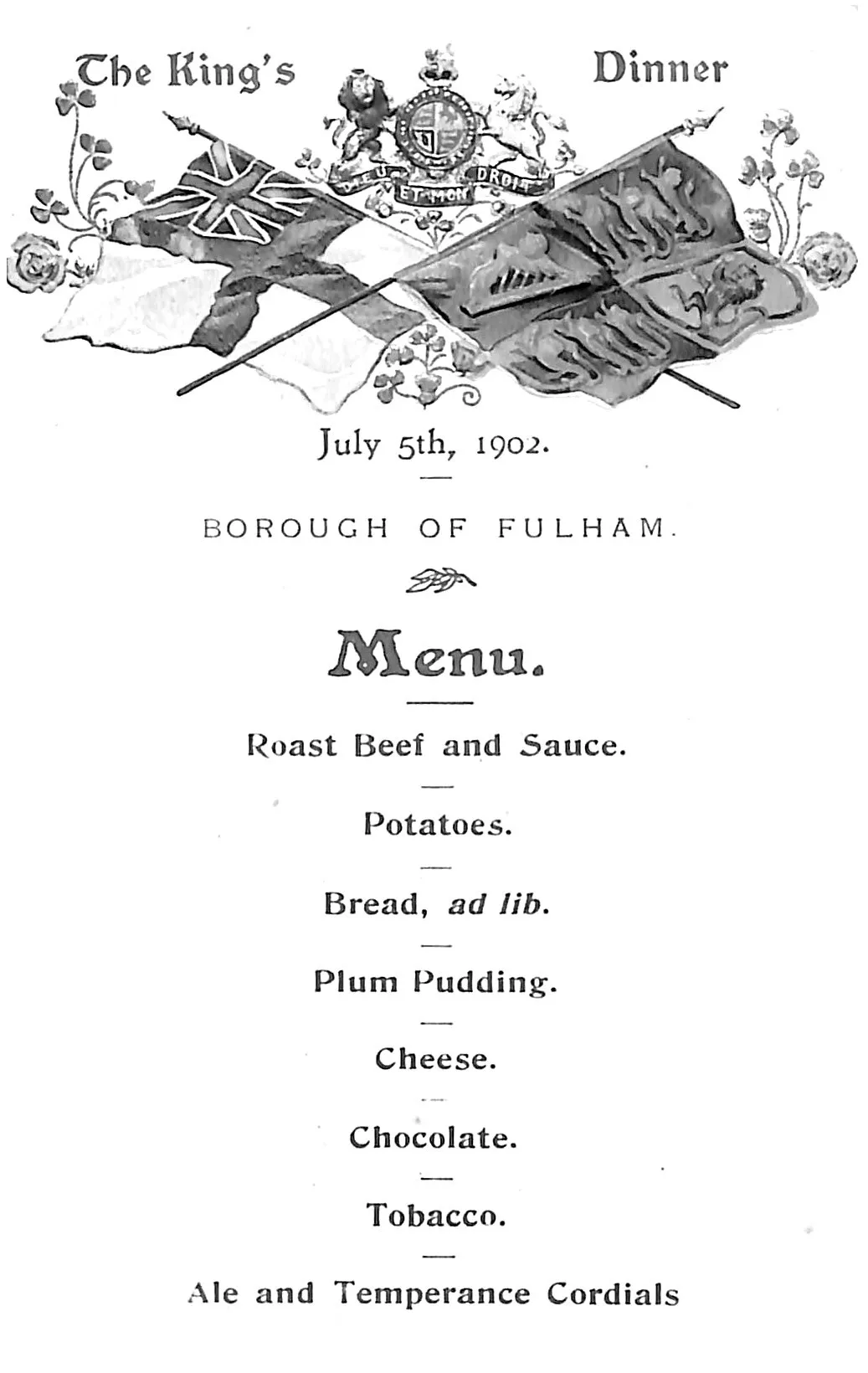
In Fulham, London’s poor were promised roast beef at the King’s Dinner of 5 July 1902: the borough’s printed card lists roast beef and sauce, potatoes, bread “ad lib.,” plum pudding, cheese, chocolate, tobacco, and ale or temperance cordials. Fulham’s was one of several hundred dinners held across the capital that Saturday in Edward VII’s name, while the King was still recovering from the operation that had put off his coronation. A report a week later says the menus differed from one local committee to the next, so the card shows what one borough offered its guests. It can’t show what each of them ate.
A dinner without a coronation
Edward VII and Queen Alexandra were to be crowned at Westminster Abbey on 26 June 1902. A few days before, the King came down with appendicitis, which turned to peritonitis, and his surgeons told him he would die unless he had an operation at once and put the ceremony off. He gave way, and 9 August became the new date.
The dinner for the poor went ahead in between. The historian Ben Roberts, writing on the crowded holiday calendar of that year, describes it as organized by the Lord Mayor and the local mayors, one of several large celebrations in the weeks after the postponement, and a cause of real disruption across London. His wider argument is that a summer of events, put off and rearranged, left the public tired of them.
The size of the thing depends on who counted. The Hospital, a London hospital journal, reported in its nursing section on 12 July 1902 that half a million guests dined at 700 centers. The Royal Collection’s catalogue entry for a photograph of a queue on the day gives 500,000 dinners at 800 locations. A press cable printed in New Zealand three days after the dinner, as transcribed by Papers Past, put the diners at 560,000. All three are reported figures, and they don’t agree.
The Fulham card
The card is small, 9 by 14 centimeters, and printed in color. Across the top runs “The King’s Dinner” in black-letter type, broken by the royal arms with the lion, the unicorn and “Dieu et mon droit.” Under them a white ensign and the royal standard cross on their staffs, framed by roses and shamrocks. The reverse, according to the TuckDB Ephemera catalogue, carries a verse of “God Save the King.” Below the flags the card gives the date and “Borough of Fulham,” and then the menu, one item to a line:
Roast Beef and Sauce. / Potatoes. / Bread, ad lib. / Plum Pudding. / Cheese. / Chocolate. / Tobacco. / Ale and Temperance Cordials
“Ad lib.” is short for ad libitum, as much as you like, so the bread had no ration on paper. The sauce has no name. Cheese, chocolate and tobacco follow the pudding, and the drink comes last, with ale and temperance cordials offered on the same line.
The card is a promise made in print. It doesn’t say whether the beef came hot or cold, how much each guest got, or whether the last to sit down found everything still on the tables. The Hospital reported that the Prince and Princess of Wales visited Fulham, among the members of the royal family who went round the centers in the King’s place, and went on to Poplar in the afternoon. The New Zealand cable has the Prince of Wales at Fulham in the forenoon and puts the borough’s diners at 14,000.
The other tables
The Hospital gave a general picture of the day. In most places the guests had cold beef, mutton and ham, hot potatoes and plum pudding, followed by tobacco or cigarettes and sometimes chocolate. Some centers supplied beer or cider. Others offered only non-alcoholic drinks. It is one summary of hundreds of halls, and no single hall’s menu need have matched it.
Set against it, Fulham’s card stands out in small ways. It names roast beef where the summary speaks of cold meats of three kinds. It offers ale and the cordials side by side, where elsewhere a committee picked one or the other. Neither the bread nor the cheese appears in the journal’s list. Lambeth’s archives keep a photograph of the King’s Dinner to the Poor at the Queen’s Place Mission Hall in Wandsworth Road; its guests and Fulham’s both ate the King’s Dinner, and they need not have eaten the same one.
The palace leftovers
One story about 1902 has the poor eating the coronation banquet. The postponement is documented, and so is the problem it left in the palace kitchens: a banquet planned for 26 June could not wait until 9 August.
What became of the food is less certain. A modern magazine piece by Alexander Larman, for the London restaurant group Boisdale, says the wines and spirits were kept for August, and it quotes the royal cook Gabriel Tschumi on jellies melted down and stored in champagne magnums. The perishable dishes, it says, went to a Whitechapel charity, the Sisters of the Poor. It names no contemporary record for the gift. Tschumi’s own memoir, Royal Chef, came out in 1954, half a century later.
Even if the gift happened, it was a different event from the King’s Dinner. The dinners on 5 July were run by the mayors and local committees across London. Fulham’s card lists plain roast beef and plum pudding, with no trace of the dishes a banquet for kings and princes would have carried. As an account of the King’s Dinner, the palace leftovers belong to legend.
A London cookbook of the 1890s
The Fulham caterers left no recipes. A London cookbook of the decade shows how dishes of these names were made. Agnes B. Marshall ran a cookery school in Mortimer Street, and her Mrs. A. B. Marshall’s Cookery Book, here in its “Twenty-fifth Thousand” printing of about 1894, gave her pupils and readers roast beef with horseradish sauce, a chapter of dressed vegetables that opens with page after page of potatoes, and a plum pudding of suet, fruit, apples and almonds that boiled for twelve hours.
Her menu advice was written for dinner parties, but she had views on the very line that sits second on the Fulham card. Vegetables, she wrote in her chapter on menus, “may or may not appear upon the menu card,” though naming them was “coming more and more into vogue.” She quoted an unnamed authority on the English habit of serving the potato plain, day after day, “with a regularity which drives a diner to despair.” Her answer was to dress an old potato “in some tasty and appetising manner.”
Her horseradish sauce shows what a single word on a card can hide. It needs grated root, two mustards, sugar, vinegar, raw egg yolks and half a pint of whipped cream. Whether Fulham’s sauce was anything like it, the card doesn’t say.
The recipes
The three recipes come from Marshall’s book and follow the order of the Fulham card. They are what a London cookery school taught in the 1890s for dishes of these names; none is the borough caterers’ own.
- Roast Beef with Horseradish Sauce (1894): a joint roasted under greased paper, with Marshall’s sauce of grated horseradish, mustard and whipped cream, here made with a pasteurized yolk.
- Mashed Potatoes Baked (1894): mash shaped into a beehive, coated with crumbs from baked crusts and browned in the oven.
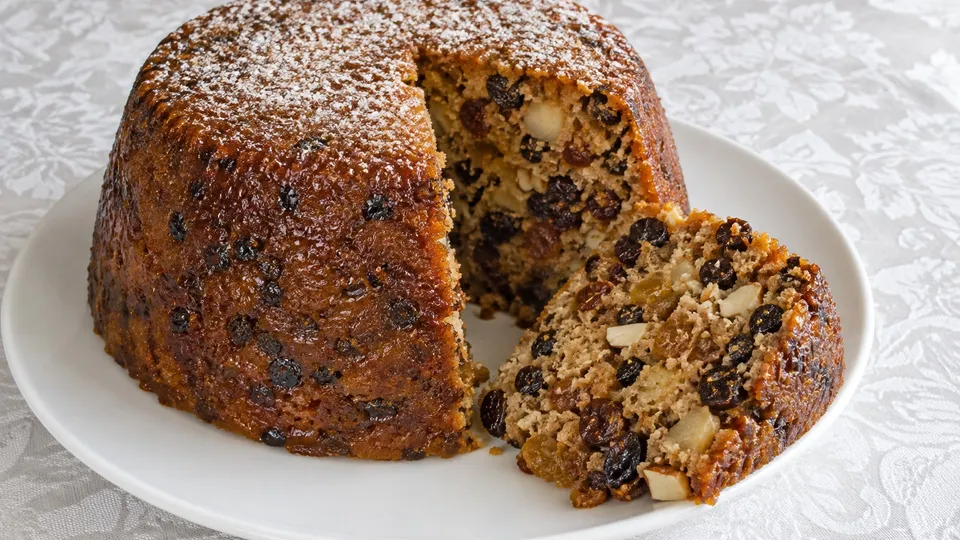
- Plum Pudding (1894): a pudding of suet, raisins, currants, sultanas, chopped apple and almonds, raised with baking powder and steamed in a basin dusted with Demerara sugar.
London had fed its poor on a large scale before. A century earlier the subscription soup houses sold them soup at a penny a quart, about 70p today by UK consumer prices (Bank of England), as What Was in London’s Penny Soup in 1799? tells.
Cooking it
Start the Plum Pudding (1894) first: it steams for five hours, long enough to roast the beef and bake the potatoes before it comes out of the pot. The beef, the potatoes and the pudding all date from the 1890s and sit among our Victorian recipes. The temperance side of the card’s last line has its own London history, and Forgotten Drink, our sister site, follows it into the coffee taverns and cocoa rooms of the 1870s (opens in a new tab).
 Cook it todayPlum Pudding (1894)
Sources
- “The King’s Dinner, Borough of Fulham,” printed menu card, 5 July 1902. TuckDB Ephemera, item 24101 (opens in a new tab).
- “The King’s Dinner to the Poor,” The Hospital, Nursing Section, vol. 32, no. 824 (12 July 1902), pp. 195–208. PubMed Central, PMC5268586 (opens in a new tab).
- “The King,” Manawatu Herald (New Zealand), 8 July 1902, p. 2, press cable. Papers Past (opens in a new tab).
- Lambeth Archives, “King’s Dinner to the Poor, Clapham, 1902,” Ideal Homes: A History of South-East London Suburbs. ideal-homes.gre.ac.uk (opens in a new tab).
- Royal Collection Trust, The King’s Coronation Dinner to the People, 5 July 1902, photograph, RCIN 2301735. rct.uk (opens in a new tab).
- Westminster Abbey, “Edward VII.” westminster-abbey.org (opens in a new tab).
- Ben Roberts, “The Complex Holiday Calendar of 1902: Responses to the Coronation of Edward VII and the Growth of Edwardian Event Fatigue,” Twentieth Century British History 28, no. 4 (2017): 489–515. Author manuscript (opens in a new tab).
- Alexander Larman, “A Meal Fit for a King,” Boisdale magazine. boisdale.co.uk (opens in a new tab).
- Mrs. A. B. Marshall’s Cookery Book, Twenty-fifth Thousand (London: Simpkin, Marshall, Hamilton, Kent & Co.; Marshall’s School of Cookery, undated, catalogued 1894), pp. 27, 158, 227, 338–339, 394–395. McGill University Library copy, Internet Archive (opens in a new tab).