Children’s food in America and Britain, 1900 to 1949 · United States and Britain
What Did Children Eat, 1900 to 1949?
Bread for the poorest and milk for those who could pay for it: Lambeth in 1913, a 1921 soda fountain’s children’s menu and Aunt Sammy’s lunch boxes.
In the first half of the twentieth century the poorest children in Britain and America lived mostly on bread, and the people who advised their parents kept saying they ought to have milk. The advice hardly moved in fifty years: plain food, no coffee, and about a quart of milk a day. What a child actually got depended on who was paying. A Lambeth family of 1913 bought bread and a tin of skimmed milk. A child whose mother followed the Department of Agriculture’s radio cookbook in the late 1920s carried a lunch box with two sandwiches, an apple and a piece of plain cake. From October 1934 a London schoolchild could buy a third of a pint of milk at school for a halfpenny, and by 1945 British schools were serving 1,850,000 dinners a day.
What the experts asked for
Ellen H. Richards, an instructor in sanitary chemistry at the Massachusetts Institute of Technology, set out the case in The Cost of Food in 1901. A child’s digestion was delicate, she wrote, so hard, coarse and spiced foods were out, and a taste for them could be fixed by “a very little unwise indulgence.” Her line on drink was short: “no sane mother would give her child coffee or wine.” The child should keep to a simple, well-cooked diet until fifteen or sixteen.
She was as firm about the school lunch. High-school pupils, she complained, spent ten cents a day at a lunch counter (about $4 today, by US consumer prices from the Minneapolis Fed), when “just as good food could be served for five cents.” She wanted hot milk, soup or cocoa, bread and butter, and plenty of dried fruit. And she gave way, a little, on sweets: “American children will not be satisfied without some sweet, and, right or wrong, they will have it.” Gingerbread and cookies would do for variety, she allowed, but the most attractive dish of all would be ice cream, properly made. Thirty years later the government’s own radio cookbook printed one, a Strawberry Ice Cream (1931) of crushed berries and light cream.
Bread in Lambeth
In London, Maud Pember Reeves spent five years visiting working families in Lambeth who lived on round about a pound a week, and published what she found in 1913. In her chapter on food the men come first. Meat was bought for them, and the Sunday joint was eaten cold by the father the next day; the children got “a pound of pieces stewed for them during the week,” with plenty of potatoes and gravy.
“Bread, however, is their chief food,” she wrote. It was cheap, it came into the house ready cooked, and it needed no plate and spoon. Spread with butter, jam or margarine, whichever the mother could afford, it made the whole of two meals a day.
Seebohm Rowntree, surveying working-class York, had heard the same thing a dozen years before. In one laborer’s family he followed in June 1901, with four children from a boy of six to a baby of eleven months, the mother and children had no meat at breakfast, but her husband, she explained, “must have a bit of bacon to take with him for his breakfast, or else all the others would talk so.” Bread was the rest of it: she was, she told him, “dead sick of bread and butter.”
Milk was the gap, and Reeves put a price on it. It cost 4d. a quart in Lambeth, the same as in Mayfair (about £1.70 today, by UK consumer prices from the Bank of England). “A healthy child ought to be able to use a quart of milk a day,” she wrote, and that came to 2s. 4d. a week for one child, when the whole family’s food might have to come out of 8s. or 9s. So the only milk most laborers’ children got was separated milk in tins, sold from a penny to fourpence. The tins bore, in red letters, “This milk is not recommended as food for infants.” It went into the tea, and sometimes onto the breakfast bread in place of butter or jam.
A Nutriment Menu at the soda fountain
In America, the soda fountain found its own angle on the underfed child. The Soda Fountain, a trade magazine, ran a piece in January 1921 on making a small-town fountain pay, and told it through one dealer, Jones Blakiston of Blakeville. His first chance came when a visitor from the State Department of Health “declared a very large number of the children to be suffering from malnutrition.”
He lost no time, the magazine says, in “featuring a Nutriment Menu especially adapted for children”: milk shakes, egg and milk shakes, hot and cold malted milk, simple ice cream combinations, sandwiches, and hot broths and bouillons. He advertised it to parents as an investment, worked out the cost per month, and opened charge accounts for children whose parents signed an order blank handed out through the schools. Business, the article reports, picked up. It names no state, and its town and dealer read as a model for other fountain men; what the piece does show is a trade that saw children’s nourishment as something it could sell.
The lunch box
For children who carried their lunch, the United States Department of Agriculture had advice of its own. Its Bureau of Home Economics broadcast menus and recipes in the radio Housekeepers’ Chats, spoken as Aunt Sammy, and sent them to listeners as loose-leaf pages for a notebook. A covering letter says the pages hold what was broadcast from October to February, and the printer’s job marks on them carry the year ’27. Among the October pages are six menus for the school lunch box.
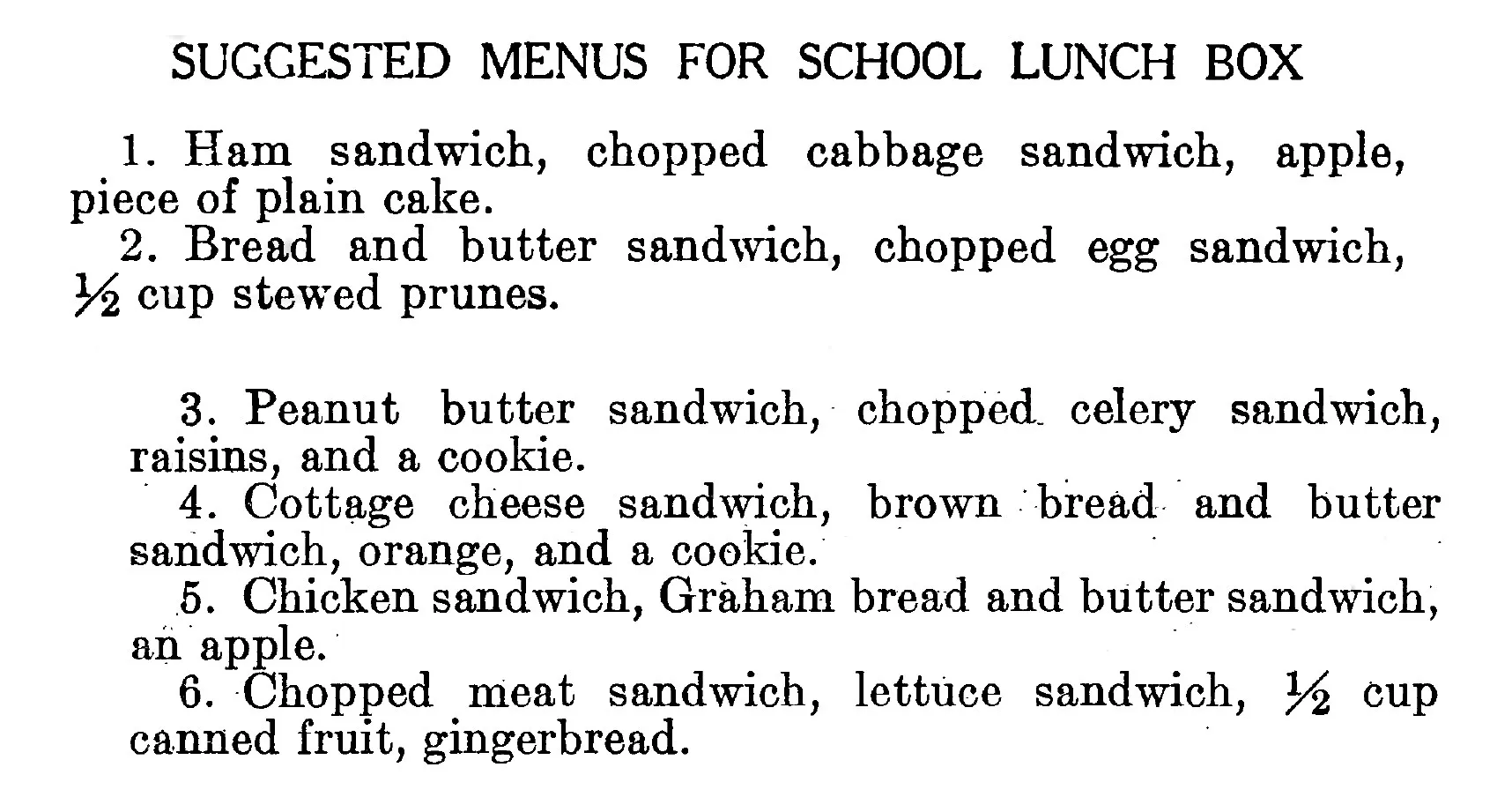 Suggested Menus for School Lunch Box, from Aunt Sammy’s Radio Recipes (Washington: Government Printing Office, 1927), pp. 9–10.
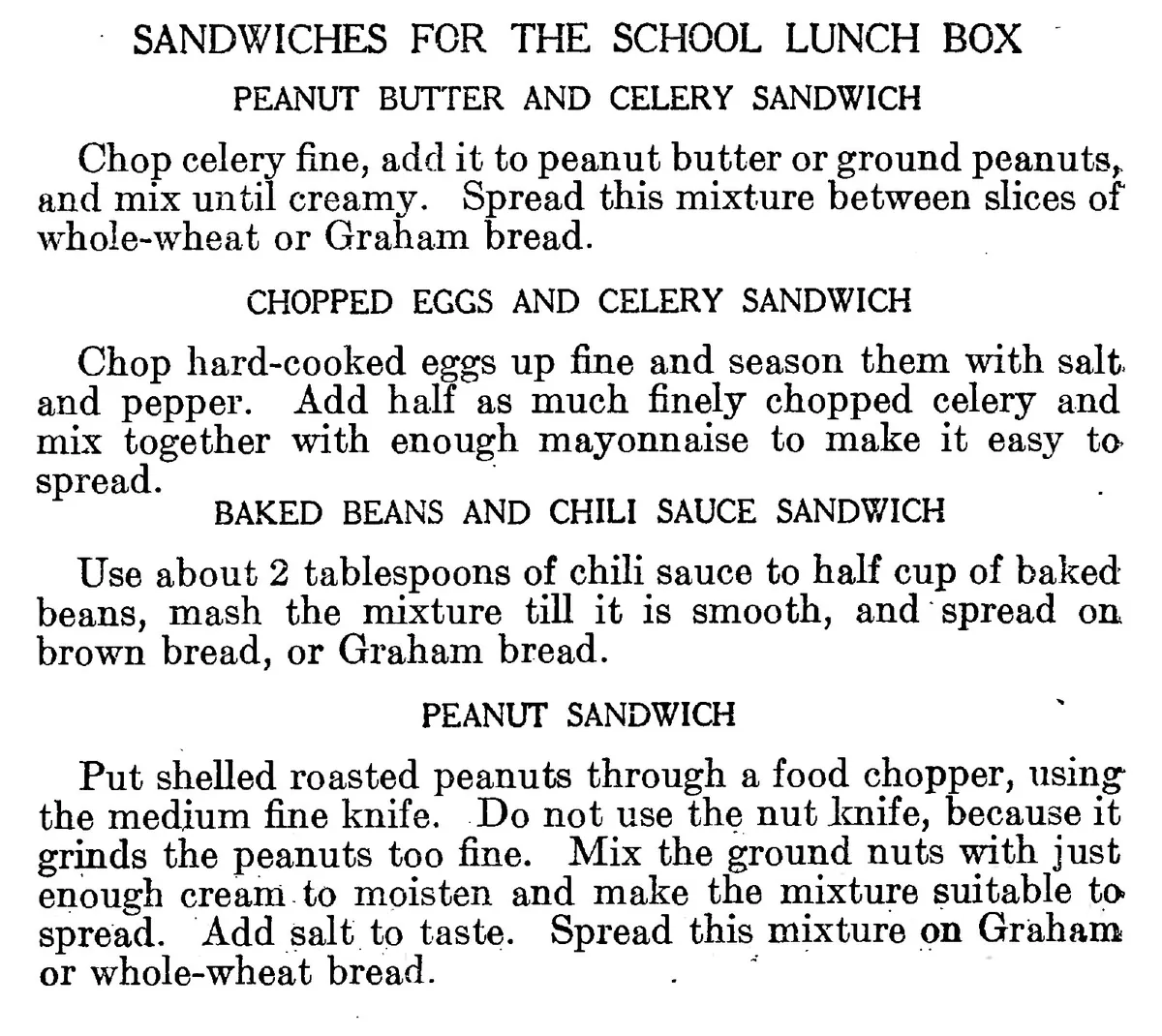
Every menu follows the same pattern: one filling sandwich, one plain or vegetable one, and fruit or something sweet. A ham sandwich goes with a chopped cabbage sandwich, an apple and a piece of plain cake; a peanut butter sandwich with a chopped celery sandwich, raisins and a cookie; a chopped meat sandwich with a lettuce sandwich, half a cup of canned fruit and gingerbread. Further on, a page of “Sandwiches for the School Lunch Box” gives the fillings, among them peanut butter and celery mixed together on whole-wheat bread. The same pages plan the breakfast table with “coffee or tea for the grown-ups and milk for the children,” the rule Richards had asked for, written into the menu.
Aunt Sammy kept coming back to children. When she toured her revised cookbook on the air in July 1931, the script closed with a promise of “a Menu for the Children” the next day, as What Did Aunt Sammy Tell Listeners to Cook in July 1931? tells.
The recipes
The two lunch-box recipes come from those 1927 pages and the soup from the department’s radio script of 1933. The sandwich filling is printed for the lunch box and the soup for a family with children; the cake is our pick from the same book for the menu’s plain cake, and nothing in either source records which families packed what.
- Peanut Butter and Celery Sandwich (1927): the first of the book’s lunch-box fillings, finely chopped celery beaten into peanut butter and spread on whole-wheat bread.
- Foundation Cake (1927): the book’s plain butter cake, for the “piece of plain cake” in the first menu, baked as cup cakes.
- Cream of Raw Spinach Soup (1933): a milk soup from the department’s low-cost menus, with the spinach chopped raw and cooked in the thickened milk.
A quart of milk a day
By the 1930s the quart had become official advice. On Wednesday, 24 May 1933, the department’s Housekeepers’ Chat turned to “Milk Soups for Low-Cost Meals,” which it counted among the best dishes “especially in a family with children.” The typed script gives the target with the word child underlined: “Nutritionists say that your child needs a quart of milk a day and you yourself a pint.” Its answer to the cost was to cook the milk into soups, sauces, gravies and desserts, since nobody had to drink all of it.
Reeves had priced the same daily quart in Lambeth twenty years before, in Britain’s larger imperial measure. In London the help arrived by the third of a pint. According to the London County Council’s annual report for 1934, the Milk in Schools scheme began there on 1 October 1934 under that year’s Milk Act, selling one-third-pint bottles with straws for a halfpenny each (about 13p today), and earlier milk clubs had already supplied more than 100,000 London children.
School dinners and the war
The school dinner was older than the school milk. Since 1906, local education authorities in England and Wales had been allowed to serve meals free or cheaply to “necessitous children,” but for thirty years the meals stayed few. According to the Ministry of Food’s own account of the war, How Britain Was Fed in War Time (1946), some 250,000 were served a day shortly before 1939, mostly to the poorest children. The war changed that. From October 1941, as more women were called up for war work, the scheme was widened, with allowances that included 2d. worth of meat for each main meal (about 36p today), and by February 1945 schools in Great Britain were serving 1,850,000 dinners a day. The target was three and three-quarter million, enough for three children in four.
The milk went the same way. The third of a pint that reached London’s schools in 1934 went to about half of all elementary schoolchildren in Britain by 1939, and to 3,768,000 children by February 1945, 72 per cent of those who could have it. Younger children had their own priorities. From July 1940 every child under five could have a pint of milk a day for 2d. (about 40p), or free in a poor family, and when oranges reached a greengrocer, for the first five days they could be sold only to children holding the child’s ration book, the one issued for the under-fives. The rest of the family’s book, from the bacon to the sweets, is in What Was a Week’s Food Ration in Britain, 1940 to 1954?.
Cooking it
Bake the Foundation Cake (1927) as cup cakes the evening before: the book’s hotter oven for small cakes, 375°F (190°C), has them out in about twenty minutes, and one fits in a lunch box beside a sandwich and an apple, as the first menu has it. For what went in the children’s glass, Forgotten Drink, our sister site, follows it from cambric tea to the Shirley Temple in What Did Children Drink in the 1800s? (opens in a new tab)
 Cook it todayFoundation Cake (1927)
Sources
- Ellen H. Richards, The Cost of Food: A Study in Dietaries (New York: John Wiley and Sons, 1901), pp. 21, 33–35. Internet Archive (opens in a new tab).
- Mrs. Pember Reeves (Maud Pember Reeves), Round About a Pound a Week (London: G. Bell and Sons, 1913; second edition 1914), pp. 97–100. Internet Archive (opens in a new tab).
- “The Soda Fountain in the Small Town,” The Soda Fountain (New York: D. O. Haynes), January 1921, p. 29. Internet Archive (opens in a new tab).
- U.S. Department of Agriculture, Bureau of Home Economics, Aunt Sammy’s Radio Recipes (Washington: Government Printing Office, 1927; loose-leaf issue), pp. 9–10, 20, 26, 33–34.
- U.S. Department of Agriculture, Radio Service, Office of Information, Housekeepers’ Chat, “Milk Soups for Low-Cost Meals,” Wednesday, May 24, 1933 (typed script, “For broadcast use only”), pp. 1–2. Internet Archive (opens in a new tab).
- B. Seebohm Rowntree, Poverty: A Study of Town Life (London: Macmillan, 1901), p. 281. Internet Archive (opens in a new tab).
- Ministry of Food, How Britain Was Fed in War Time: Food Control 1939–1945 (London: HMSO, 1946), pp. 44, 56 and 61.
- London County Council, Annual Report of the Council, 1934, vol. 3, part 2 (Public Health), p. 140, via the Wellcome Collection’s London’s Pulse reports.