Peanut Butter and Celery Sandwich (1927)
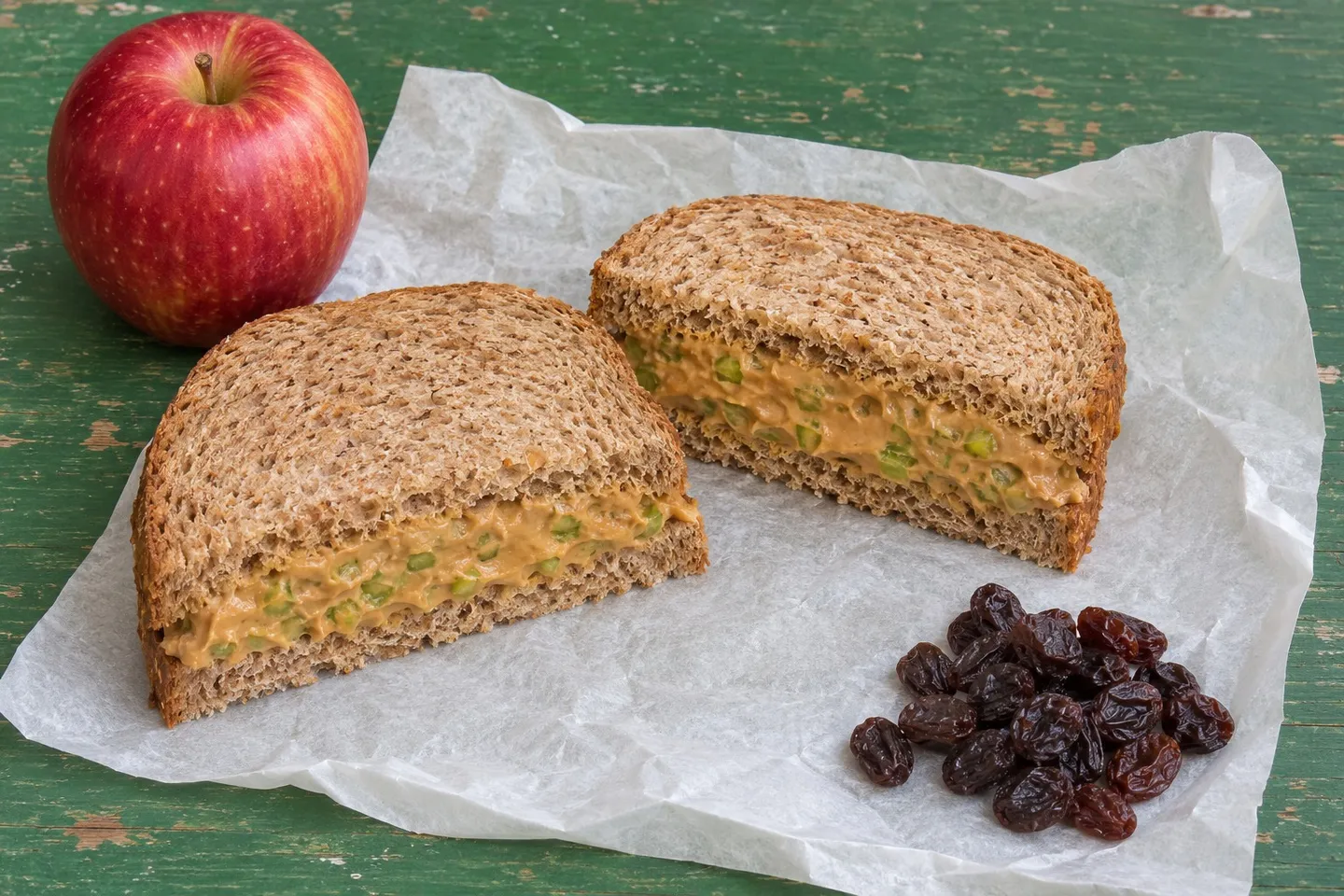
Reader ratingsThe first filling on Aunt Sammy’s 1927 page of school lunch-box sandwiches: finely chopped celery beaten into peanut butter, spread on whole-wheat bread.
- Recipe makes
- 4 sandwiches
- Prep
- Total
A whole-wheat peanut butter and chopped celery sandwich, cut in half, with an apple and raisins.
The story behind the recipe
Peanut butter beaten with chopped celery until creamy heads the page of “Sandwiches for the School Lunch Box” in the loose-leaf radio cookbook the Department of Agriculture sent to listeners and printed in 1927. One of the six lunch-box menus a few pages earlier pairs a peanut butter sandwich with a chopped celery sandwich, raisins and a cookie.
Two sandwiches, one filling
On the menu they are two separate sandwiches. On the recipe page they have become one: “Chop celery fine, add it to peanut butter or ground peanuts, and mix until creamy.” The bread is whole-wheat or Graham. The same page carries a plain Peanut Sandwich for families who ground their own roasted nuts, with a warning about the household food chopper: use the medium knife, it says, and not the nut knife, “because it grinds the peanuts too fine.” The other fillings beside them are chopped eggs with celery, and baked beans mashed with chili sauce.
Celery already had a place in advice on school food. Ellen Richards, writing on the child at school in 1901, put it with asparagus and lettuce among the foods that “owe their popularity and efficiency” to flavor, and judged them worth their high price if used with discretion. A quarter century later celery had a regular place in the government’s lunch box, in two of the four fillings on one page. The lunch box and what children ate in the years around it are the subject of What Did Children Eat, 1900 to 1949?.
Read more about this recipe
Making it today
The book gives no amounts, so the proportions here are ours: enough celery to fleck the peanut butter all through, chopped very fine so the filling still spreads. The book allows ground peanuts in place of peanut butter. Pack it the menu’s way, with a handful of raisins and a cookie, such as the Vanilla Wafers (1931) from the department’s later cookbook.
Chop celery fine, add it to peanut butter or ground peanuts, and mix until creamy. Spread this mixture between slices of whole-wheat or Graham bread.
Recipe makes: 4 sandwiches
Ingredients
For 4 sandwiches. Quantities are shown as written.
Quantities as written here, for 4 sandwiches.
- Smooth peanut butter1/2 cup
- Finely chopped celery1/3 cup
- Whole-wheat bread8 slices
Measurement notes
Ingredients as written here
- ½ cup smooth peanut butter
- ⅓ cup finely chopped celery
- 8 slices whole-wheat bread
Equipment
 Knife and board
 Small bowl and spoon
 Butter knife
Instructions
Trim the celery and chop it very fine on the board, until the pieces are no bigger than a grain of rice.
Put the peanut butter in the small bowl, add the celery and beat them together with the spoon until the mixture is creamy and evenly flecked with green.
Spread the mixture thickly over half the slices of whole-wheat bread, right to the edges, and close each with a second slice.
Cut each sandwich in half and wrap it for the lunch box, or serve it at once.
Nutrition
350calories per serving
- Recipe makes
- 4 sandwiches
- Servings
- 4
Estimated per sandwich from USDA FoodData Central values for peanut butter, celery and whole-wheat bread.
Recipe notes
When adjusting quantities
The book gives no amounts; ours make four sandwiches.
Notes
Quantities mentioned in these notes don’t change when you adjust the servings.
The filling and the bread are the book’s; every amount is ours, since the book gives none. Graham bread, which the book allows, is a whole-wheat bread made with coarse Graham flour. Contains peanuts, celery and gluten. Many schools ask families not to send peanut foods, so check before packing it.
Scaling changes the ingredients only; pan sizes and cooking times need their own judgment. To adapt this recipe further, try the recipe tool at TuneMyRecipe (opens in a new tab), our sister site.
Sources and attribution
After U.S. Department of Agriculture, Bureau of Home Economics, Aunt Sammy’s Radio Recipes (Washington, 1927), Peanut Butter and Celery Sandwich
Recipe details
- Course
- Main course
- Region
- American
- Era
- Interwar
- Source decade
- 1920s
- Difficulty
- Easy
- Occasion
- Everyday meal