Foundation Cake (1927)
Reader ratingsThe plain butter cake of Aunt Sammy’s 1927 radio cookbook, baked as cup cakes at 375°F (190°C) for the plain cake on its first school lunch-box menu.
- Recipe makes
- 24 cup cakes
- Prep
- Cook
- Total
Both pans bake together for about 20 minutes. The total includes 30 minutes for the cakes to cool on the rack before they are wrapped.
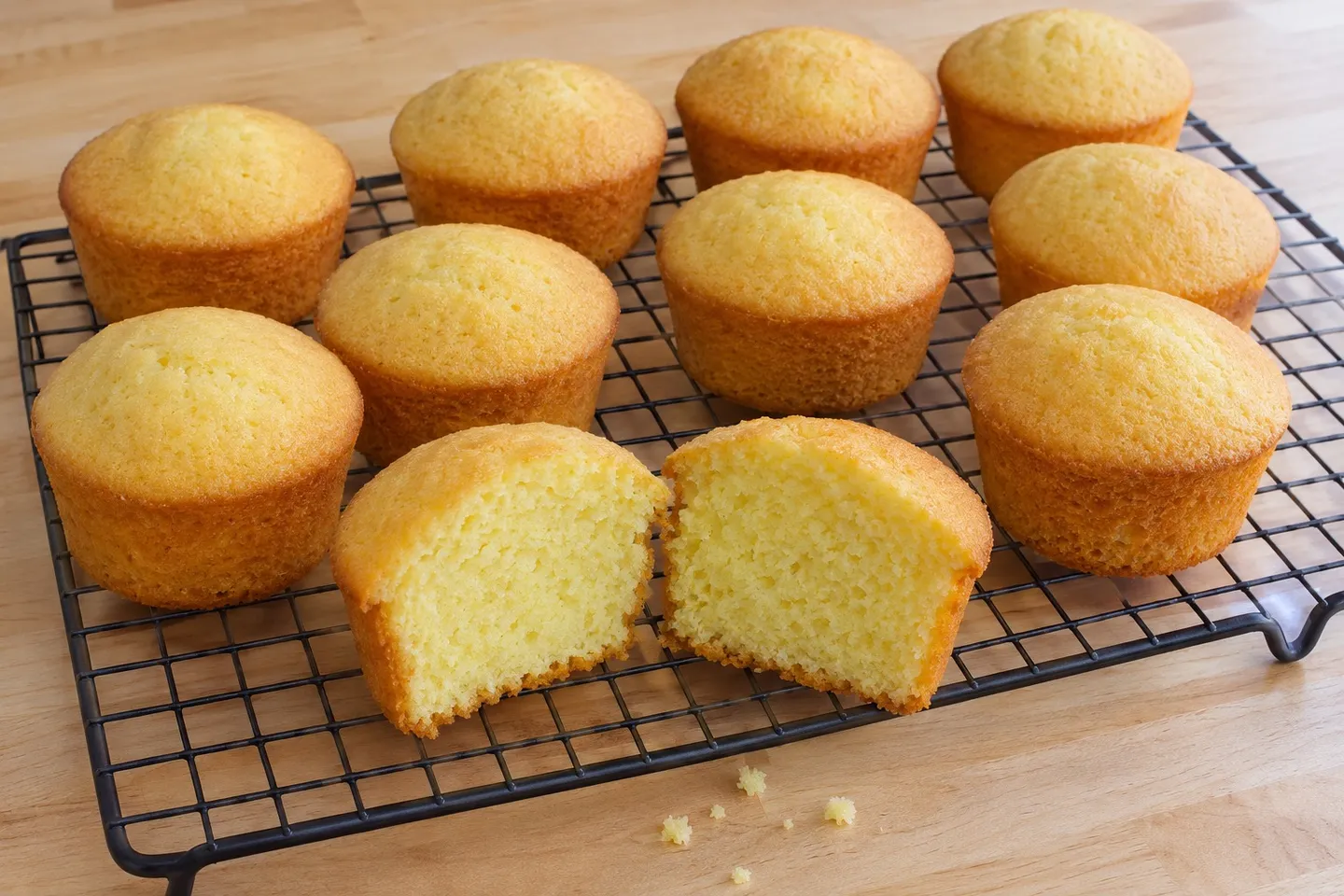
Plain butter cup cakes, unfrosted, cooling on a rack.
The story behind the recipe
The first of Aunt Sammy’s six school lunch-box menus ends with “piece of plain cake,” and the basic cake of the same loose-leaf radio cookbook is its Foundation Cake: a butter, sugar, egg and milk batter that the book bakes as a thick loaf, as layers or as cup cakes. It sits among the November pages, a little after the Thanksgiving turkey.
A cake to build on
A foundation cake was a base to be dressed up, and the page shows how: the recipe that follows it is an Uncooked Orange Icing of confectioners’ sugar, butter and orange juice. For the lunch box the cake goes plain. Ellen Richards, who wrote on school lunches in 1901, wanted pastry, doughnuts and custards kept out of a child’s noon meal altogether, though in winter, for “the robust ones who demand strong food,” she thought “even frosting on the cake may be permissible.”
The method takes its time. The yolks go into the creamed fat and sugar, then flour and milk by turns, with a warning against hurrying the milk: “If too much is added it will dissolve the sugar, and the fat will separate.” The beaten whites are folded in last for lightness. The book sets two ovens: a very moderate 325°F (160°C) for a thick loaf, and about 375°F (190°C) for cup cakes or thin layers.
The page also dates the book. At its foot the Government Printing Office printed its job mark, “31517°—27,” the year these loose sheets went to press. More on the lunch box, and on what children ate from 1900 to 1949, is in What Did Children Eat, 1900 to 1949?
Read more about this recipe
Making it today
Cup cakes are our choice among the book’s three shapes, since a cup cake goes into a lunch box whole; the oven is the one the book gives for them. The book’s “soft-wheat flour” is the flour sold today as cake flour, and of its “2 to 3 eggs” we use three. With butter as the fat, the book adds about a tablespoon and a half to the half cup, which is the weight given here. The first menu packs it with an apple and two sandwiches; the book’s Peanut Butter and Celery Sandwich (1927) is one of the fillings it offers for the box.
1 cup milk. 3 cups sifted soft-wheat flour. ½ cup fat 2 to 3 eggs. 4 teaspoons baking powder. 1½ cups sugar. ¼ teaspoon salt. ½ teaspoon flavoring.
If butter or other fat containing water is used, allow about 1½ tablespoons more.
Combine fat and sugar. Stir in the beaten egg yolks and add alternately the dry ingredients, which have been mixed and sifted together, and the liquid. Add only a small quantity of liquid at first. If too much is added it will dissolve the sugar, and the fat will separate. Add the flavoring. Fold in the well-beaten egg whites. Pour the batter into lightly greased, floured pans, taking care that it is spread evenly. If the cake is baked in a thick loaf, the oven temperature should be very moderate, about 325° F. If baked as cup cakes or in thin layers, the oven should be about 375° F. This recipe makes two thick or three thin layers.
Recipe makes: 24 cup cakes
Ingredients
For 24 cup cakes. Quantities are shown as written.
Quantities as written here, for 24 cup cakes.
- Sifted cake flour3 cups
- Baking powder4 tsp
- Salt1/4 tsp
- Unsalted butter, softened4.75 oz
- Sugar1 1/2 cups
- Large eggs, separated3
- Whole milk1 cup
- Vanilla extract1/2 tsp
- Butter for the pans, melted1 tbsp
- Flour for the pans1 tbsp
Measurement notes
Ingredients as written here
- 3 cups sifted cake flour
- 4 tsp baking powder
- ¼ tsp salt
- 4.75 oz unsalted butter, softened
- 1½ cups sugar
- 3 large eggs, separated
- 1 cup whole milk
- ½ tsp vanilla extract
- 1 tbsp butter for the pans, melted
- 1 tbsp flour for the pans
Equipment
 Sifter or fine sieve
 Two mixing bowls
 Electric mixer or rotary egg beater
 Rubber spatula
 Pastry brush
 Two 12-cup standard muffin pans
 Instant-read thermometer
 Wire rack
Instructions
Heat the oven to 375°F (190°C). Brush the cups of both muffin pans with the butter for the pans, dust them with the flour for the pans and tap out the excess.
Sift the cake flour, baking powder and salt together into one bowl.
In the second bowl, beat the softened butter with the sugar until well combined and pale.
Separate the eggs. Beat the yolks lightly and stir them into the butter and sugar.
Add the sifted dry ingredients and the milk by turns, starting and ending with the dry ingredients and adding only a little milk the first time. Stir after each addition until just smooth. Stir in the vanilla.
With clean beaters, beat the egg whites until they hold stiff peaks, then fold them gently into the batter with the spatula until no streaks of white remain.
Spoon the batter into the cups, filling each about two-thirds full, and level the tops.
Bake both pans on the middle rack for 18 to 20 minutes, until the cakes have risen and turned golden, the tops spring back when pressed and a skewer in the center of one comes out clean, with the center at about 205°F (96°C) on the thermometer.
Let the cakes stand in the pans for 5 minutes, then turn them out onto the rack and let them cool completely, about 30 minutes, before you wrap them.
Nutrition
155calories per serving
- Recipe makes
- 24 cup cakes
- Servings
- 24
Estimated per cup cake (24) from USDA FoodData Central values for cake flour, butter, sugar, eggs and whole milk.
Recipe notes
When adjusting quantities
For 12 cup cakes, halve everything and use 1 large egg plus the yolk of a second, or 2 small eggs.
Notes
Quantities mentioned in these notes don’t change when you adjust the servings.
The ingredients, the order of mixing, the greased and floured pans and the 375°F (190°C) oven for cup cakes are the book’s. Ours: cup cakes among its three shapes, three eggs from its “2 to 3,” butter as the fat, vanilla as the flavoring, cake flour for its soft-wheat flour, the filling level, the bake time and the yield. For a loaf, the book’s oven is 325°F (160°C); it gives no time for either shape. Don’t taste the raw batter: it holds raw egg and flour. Contains dairy, egg and gluten.
Scaling changes the ingredients only; pan sizes and cooking times need their own judgment. To adapt this recipe further, try the recipe tool at TuneMyRecipe (opens in a new tab), our sister site.
Sources and attribution
After U.S. Department of Agriculture, Bureau of Home Economics, Aunt Sammy’s Radio Recipes (Washington, 1927), Foundation Cake
Recipe details
- Course
- Bread & baking
- Dish family
- Breads & Cakes
- Region
- American
- Era
- Interwar
- Source decade
- 1920s
- Main ingredient
- Eggs
- Difficulty
- Easy
- Occasion
- Everyday meal