Aunt Sammy’s Housekeepers’ Chat, “A Bigger and Better Radio Cookbook” · USDA Radio Service, Washington, D.C.
What Did Aunt Sammy Tell Listeners to Cook in July 1931?
On 7 July 1931 the USDA’s radio aunt read out creamed mushrooms and toured her new cookbook, whose July dinner ran from broiled chicken to strawberry ice cream.
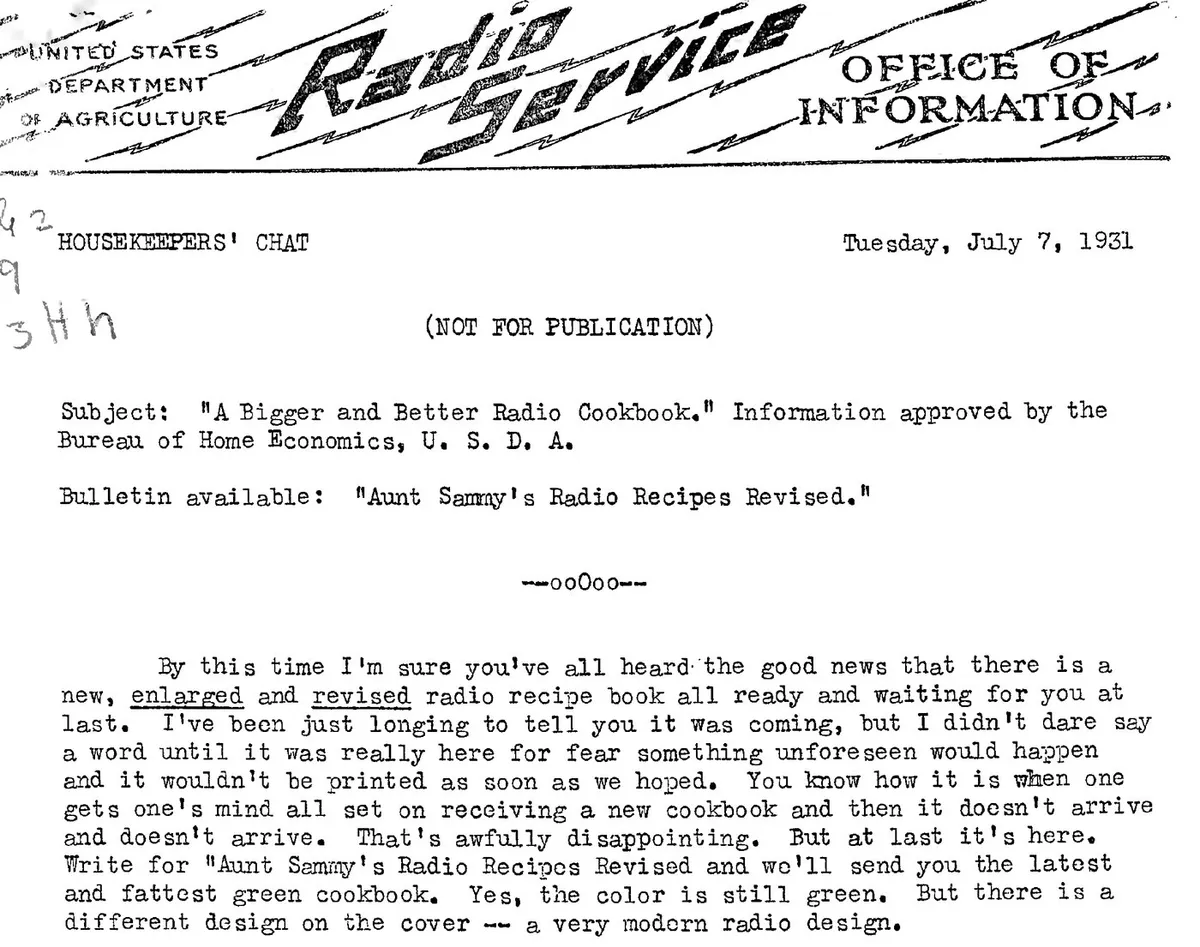
On Tuesday, 7 July 1931, Aunt Sammy told America’s housekeepers to cook mushrooms two ways, broiled on buttered toast and creamed on crisp toast, and to send for her new cookbook. That day’s script, written by the United States Department of Agriculture for its radio character, spent most of its few minutes walking listeners through Aunt Sammy’s Radio Recipes Revised, a green-covered book of 400 recipes and 90 menus issued that May. Its dinner menus for July include a summer meal of fried or broiled chicken, new potatoes, peas and currant jelly, with strawberry ice cream and vanilla wafers to follow. Between the script and the book, the government was answering two questions at once, which the script itself put in plain words: “What shall we have to eat?” and “How shall we prepare it?”
The government’s aunt
Aunt Sammy belonged to the USDA’s Bureau of Home Economics. According to the National Archives, the Bureau created her as the wife of Uncle Sam, she first came on the air in the Housekeepers’ Chat on 4 October 1926, and women at local stations read the department’s scripts under her name. The 7 July script itself shows the department’s side of that arrangement: it went out on the letterhead of the USDA’s Radio Service, marked “Not for publication.”
The listeners wrote back. The book’s foreword says that demand for copies of the recipes came “immediately with the start of this radio service for women in 1926.” The July script tells the same story in its own voice: housekeepers “all over the country began to write for copies,” and so the first radio cookbook was printed. “It first came out in loose-leaf form,” the script goes on, and later “the bulletin form seemed more convenient.” The copy on the speaker’s desk, it says, came out in 1927, with 70 menus and about 300 recipes.
An undated loose-leaf issue of Aunt Sammy’s Radio Recipes shows what that first form looked like. Its punched pages open with a letter to “Dear Radio Friend,” signed “Aunt Sammy,” that sends the menus and recipes broadcast from October to February and adds: “A couple of notebook rings will hold the pages together nicely.” The letter says the recipes were printed immediately after they were broadcast, promises more pages to complete the cookbook, and ends with a schedule of the 25 stations carrying the chats, each at its own hour. A recipe from that loose-leaf issue, its Potato and Corn Milk Chowder (opens in a new tab), is on our sister site TuneMyRecipe.
A tour of the green book
By May 1931 the loose sheets had grown into a fourth, enlarged edition. Its title page names two members of the Bureau’s staff as its authors: Ruth Van Deman, “Formerly Associate Specialist in Charge of Information,” and Fanny Walker Yeatman, “Junior Specialist in Foods.” The script keeps the fiction going and lets the secret out in the same breath. “Of course, you have guessed who the authors are,” Aunt Sammy says. “Quite right. The Recipe Lady and the former Menu Specialist.” The script does not say which of the two women was which.
The script opens with a sigh of relief. Aunt Sammy had not dared mention the book before it was printed, she says, and now she could offer “the latest and fattest green cookbook,” with “a very modern radio design” on the cover. A copy stamped by the department’s library bears it out: a green cover with a black lightning bolt zigzagging down from the title to the Bureau’s name at the foot. The foreword and the script make the same modest claim, that even in this fourth enlarged edition the book “makes no claim to being a complete cookbook.” It was meant to sit beside the department’s leaflets and bulletins, free on request.
Then she takes the listener on “a little journey” through the pages. The menus come first: breakfasts, lunches or suppers, dinners for each month of the year, and special dinners for New Year’s, Easter, Thanksgiving and Christmas. Next comes “a useful little in-between page” of oven temperatures and measures, where a reader would find that “a moderate oven is 325 to 375 degrees Farenheit,” and that sixteen tablespoons make a cup. The recipes follow in roughly the order they would be served, soups first and sweets last. The vegetables run alphabetically, and the script recites them like a primer: “A is for artichokes and asparagus.”
The tour has one slip in it. It sends listeners to page 6 for the oven table, but in the May 1931 printing the table is on page 8. The other page number in the script is right: the ice creams it points to do begin on page 122.
Two ways with mushrooms
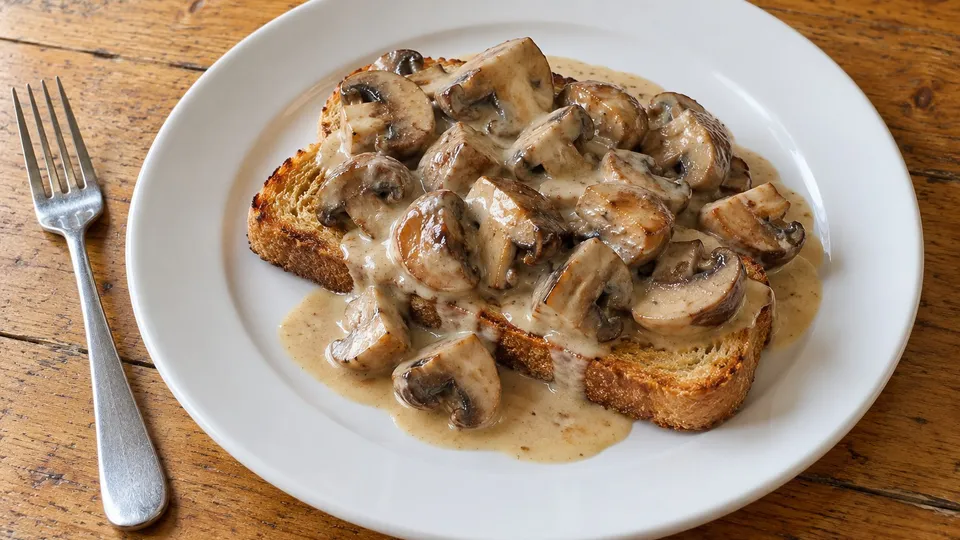
The day before, Aunt Sammy had promised two mushroom recipes, and she kept her word at the end of the tour. They were suited, she said, to mushrooms gathered “on some early morning walk with the dew still on them,” or to the cultivated kind, which “should be inexpensive at this time of year.” Then came the warning: unless you know the edible kinds from the poisonous ones, leave the wild ones alone. “Neither of these recipes will be successful if made with poisonous toadstools.” Listeners who wanted to learn were pointed to a department bulletin, Some Common Mushrooms and How to Know Them.
The script shows how a recipe was shaped for the ear. Broiled mushrooms needed no list at all: caps under the flame, salt, pepper and a piece of butter in each, served on hot buttered toast. For the creamed mushrooms the speaker counts the ingredients aloud, six of them, reads them out, and then follows a typed stage direction: “I’ll repeat that list. (Repeat.)” Only then does the method begin. A listener copying it down heard the list twice.
The same two recipes appear in the new book, on page 51, almost word for word. Of the dishes on this page, only the Creamed Mushrooms (1931) came from the broadcast itself.
 Cook it todayCreamed Mushrooms (1931)
The script ends with a trailer for the next day’s chat: “Tomorrow: ‘Home-Made Fears.’ And a Menu for the Children.” It gives no hint of what those fears were.
A dinner for July
“At this time of year,” the script told listeners, “you’ll be interested in what appears on page 122”: ice creams, ices and sherbets for the hand-turned freezer. Ice cream was on the book’s July menus too, and one of them puts a strawberry ice cream at the end of a plain family dinner.
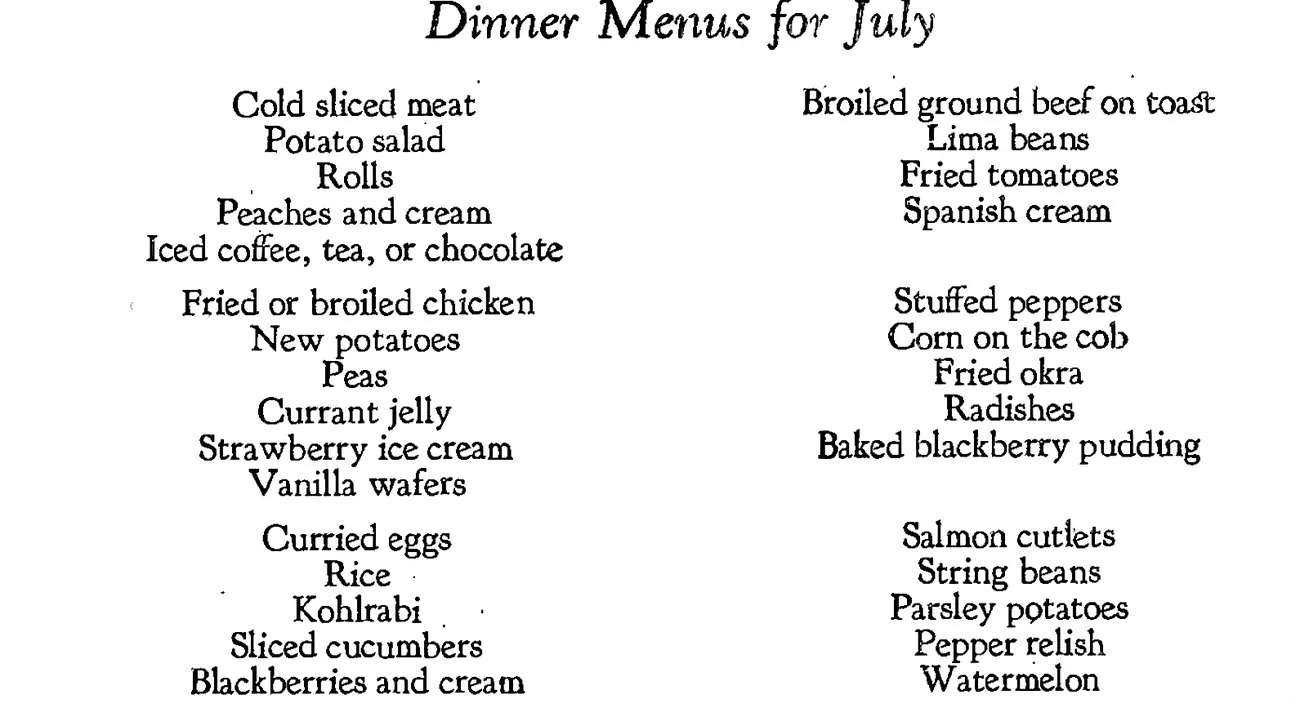 Dinner Menus for July, from Ruth Van Deman and Fanny Walker Yeatman, Aunt Sammy’s Radio Recipes Revised (Washington, May 1931), p. 4.
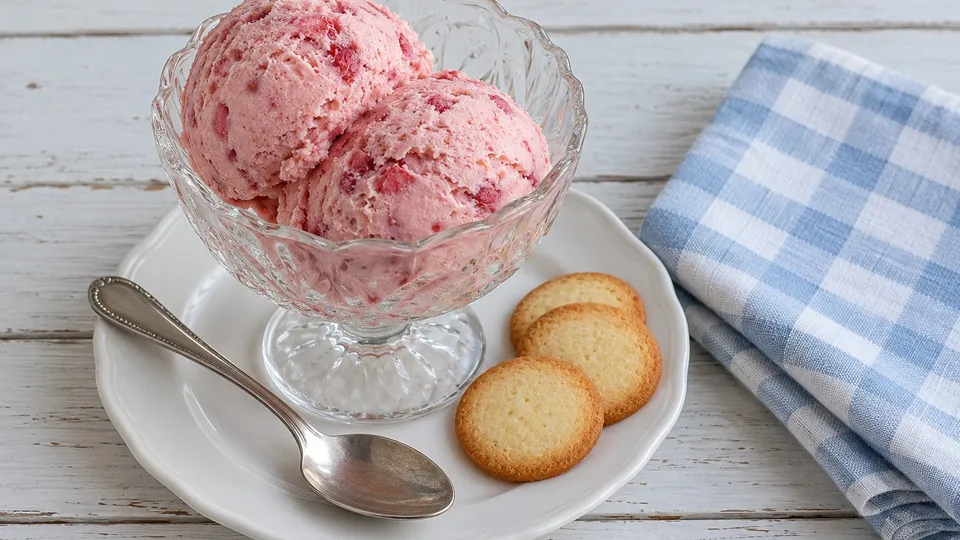
The menu is a short one: chicken, a starch, a green vegetable, a jelly for the meat, then the ice cream and something crisp beside it. The other July dinners are as plain, cold sliced meat with potato salad, or salmon cutlets with string beans and watermelon. The book’s chicken could be fried in a heavy skillet or broiled under the flame, and its broiled version finishes in a moderate oven, 350°F (175°C). The strawberry ice cream uses no eggs and no cooking: chopped berries stand in sugar for two or three hours, go through a colander, and are frozen with single cream, lemon juice and salt in a freezer packed with “1 part salt and 4 to 6 parts ice,” its crank turned slowly. The vanilla wafers are dropped from a half teaspoon and baked about ten minutes, tiny crisp rounds to eat with the ice cream.
The menu is the book’s suggestion for a July evening, and nothing on the page says who cooked it.
The recipes
The creamed mushrooms come from the 7 July script itself and appear again in the book. The other three come from the book’s July dinner menu, in its order, with new potatoes, peas and currant jelly left to the cook.
- Creamed Mushrooms (1931): the broadcast’s own recipe, mushrooms floured and browned in butter, then simmered in cream with their own juice and served on toast.
- Broiled Chicken (1931): a young chicken split down the back, buttered, floured, broiled and finished in the oven, with the drippings poured over.
- Strawberry Ice Cream (1931): sugared fresh berries pressed through a colander and churned with light cream.
- Vanilla Wafers (1931): tiny drop cookies, baked until the edges turn golden.
The same green book’s boiled ham stands in for the Virginia ham at another table on this site, the Roosevelts’ hot dog picnic for the King and Queen at Hyde Park in 1939.
Cooking it
Start the Strawberry Ice Cream (1931) right after lunch: the berries want two hours in their sugar before they go through the colander, and the churned cream an hour in the freezer to firm, which leaves time to bake the wafers and broil the chicken before dinner. The strawberry is the youngest of our old-fashioned ice cream recipes, which go back to Eliza Leslie’s vanilla of 1840. The book’s first Christmas dinner opens with a tomato cocktail, and Forgotten Drink, our sister site, tells how the department sold that alcohol-free first course (opens in a new tab) to radio listeners.
 Cook it todayStrawberry Ice Cream (1931)
Sources
- U.S. Department of Agriculture, Radio Service, Office of Information, Housekeepers’ Chat, “A Bigger and Better Radio Cookbook,” Tuesday, July 7, 1931 (typed script, “Not for publication”; information approved by the Bureau of Home Economics), pp. 1–3.
- Ruth Van Deman and Fanny Walker Yeatman, Aunt Sammy’s Radio Recipes Revised (Washington: U.S. Department of Agriculture, Bureau of Home Economics, issued May 1931), cover, title page, foreword p. v, pp. 4, 8, 24, 51, 119, 122, 124. Internet Archive (opens in a new tab).
- U.S. Department of Agriculture, Bureau of Home Economics, Aunt Sammy’s Radio Recipes (Washington: Government Printing Office, undated loose-leaf issue), letter “Dear Radio Friend,” p. 2.
- Alexis N. Hill, “Aunt Sammy and Her Radio Recipes,” The Unwritten Record, National Archives, 17 March 2022. archives.gov (opens in a new tab).