Thanksgiving dinner, from a surgeon’s letter of 1862 to Fannie Farmer’s menu of 1896 · United States
What Was on a Thanksgiving Menu in the 1800s?
Oyster soup, roast turkey, a chicken pie and three kinds of pie: a Union surgeon’s letter of 1862 and two cookbook menus of 1867 and 1896.
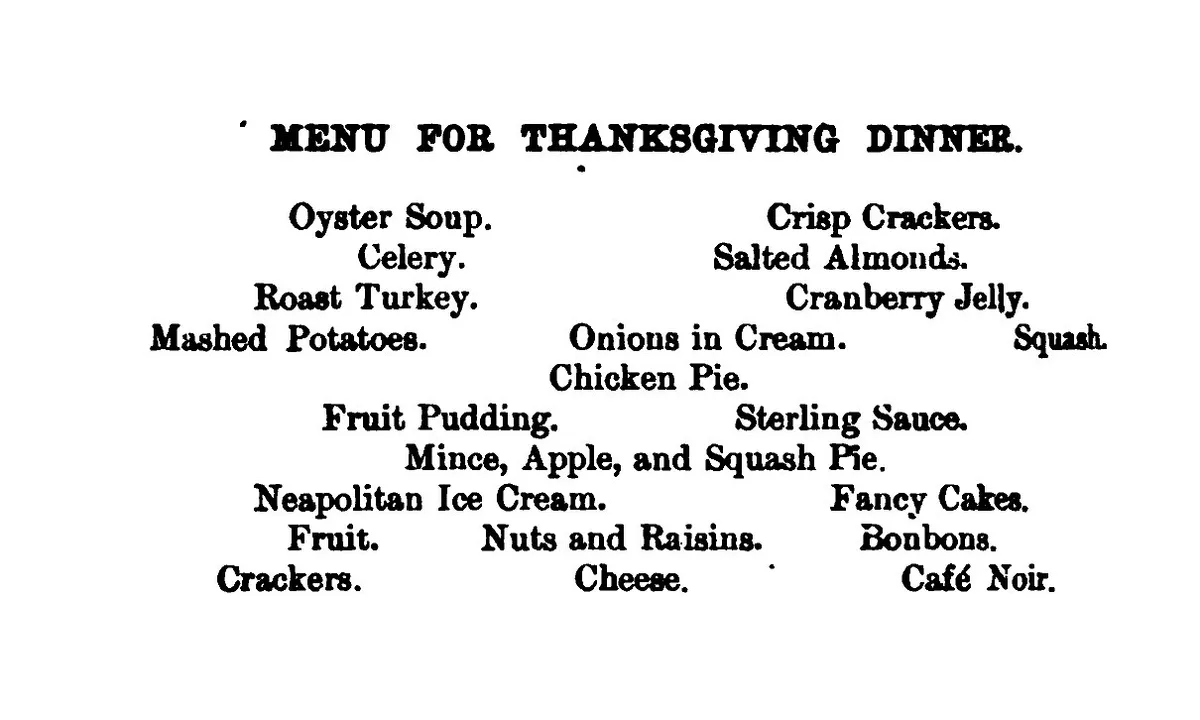
Oyster soup to begin, then roast turkey with cranberry, a chicken pie beside the turkey, then mince pie and pumpkin or squash pie, and fruit, nuts and raisins at the end. Those dishes appear on both of the Thanksgiving menus printed in two American cookbooks a generation apart, Jennie June’s of 1867 and Fannie Farmer’s of 1896, and the turkey and the oysters turn up again in a letter a Union Army surgeon wrote on Thanksgiving Day 1862.
Read together, the three show how much of the holiday table held still between the Civil War and the 1890s, and what a cooking-school principal in Boston added to it.
A hospital dinner in Frederick, 1862
Asa Bean was an Ohio physician serving as a Union Army surgeon at a hospital in Frederick, Maryland, in the autumn of 1862. He began a letter to his wife and family there on November 25 and took it up again on the 27th, a day he marked as Thanksgiving. A party of ladies, he wrote, had given the soldiers and nurses a surprise: they arrived before noon with a Thanksgiving dinner of roast turkey, chicken, pigeon and stewed oysters, and it put the hospital’s ordinary dinner entirely in the shade.
Bean set down his own dinner too: baked chicken and pudding, boiled potatoes, turnip, apple butter, cheese and butter, with tea. Then the letter turns to money. He had not received a dollar since he arrived, which was why he had sent none home, and he hoped pay day, and a visit home, would come before long.
The letter is in the Bean family papers at the University of Iowa Libraries, which have put it online with a transcription. Bean did not get home. He died of disease on a hospital ship near Memphis on April 26, 1863, while his wife was on her way to him.
When was Thanksgiving in the 1800s?
Bean’s Thanksgiving came a year before the holiday had a fixed national day. George Washington proclaimed Thursday, November 26, 1789, a day of public thanksgiving, and later presidents issued proclamations of their own, but their dates, and even the months, varied. Lincoln’s proclamation, dated October 3, 1863, named the last Thursday of November, and from then on the day was kept every year.
The date moved again in 1939. That year the last Thursday fell on November 30, and Franklin Roosevelt brought Thanksgiving forward a week; 32 states followed him and 16 kept the old day. Congress settled it with a resolution Roosevelt signed on December 26, 1941, making the holiday the fourth Thursday of November.
None of this reaches back to Plymouth. Edward Winslow’s account of the 1621 harvest gathering names fowl and five deer, and what else may have been eaten is weighed in What Was Really Eaten at the 1621 Harvest Feast? The menus below are the cooking of their own decades.
Jennie June’s Thanksgiving dinner, 1867
Jennie June’s American Cookery Book came out in New York in 1867, its title page signed “By Mrs. J. C. Croly, (Jennie June.)” and naming her the author of “Talks on Women’s Topics.” Near the back, Jane Cunningham Croly prints bills of fare for dinner month by month. November has six other dinners, such as “Chicken pot-pie, mashed potatoes, celery, pickled cauliflower, and squash or pumpkin pie.” Then comes the seventh.
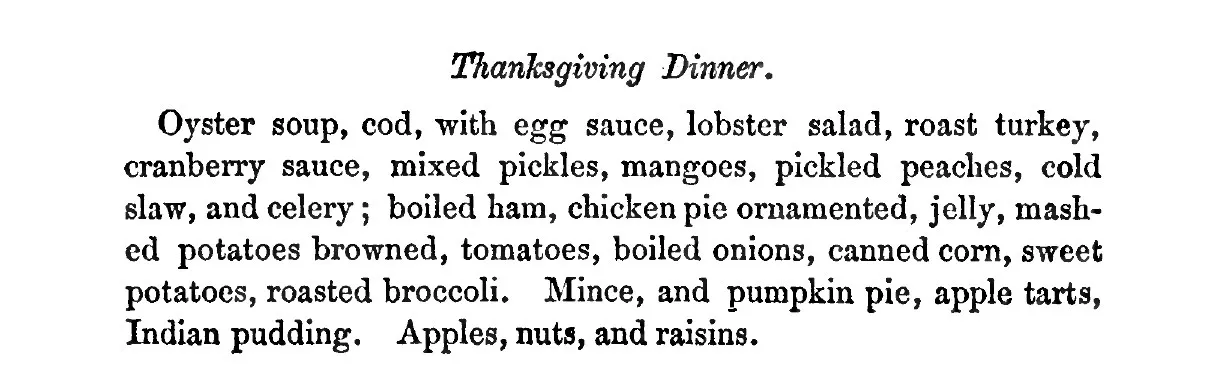
The Thanksgiving dinner in Jennie June’s American Cookery Book (New York, 1867), p. 263.
It is one long sentence, and it marks no courses. Oyster soup leads, then fish with “cod, with egg sauce,” lobster salad, the turkey and its cranberry sauce, and a run of sharp things to go with them: mixed pickles, mangoes, pickled peaches, cold slaw and celery. After a semicolon come boiled ham, “chicken pie ornamented,” a jelly and the vegetables, among them canned corn and roasted broccoli. Then the sweets: “Mince, and pumpkin pie, apple tarts, Indian pudding.” The other November dinners have one dessert each. This one has four before the fruit.
Croly had views on that part of the meal. “The dessert is the holiday part of the dinner,” she wrote on the first page of her pastry chapter, and on the next page she gave a rule her menu keeps: “Nuts, with apples, are excellent in winter; but nuts should never be put on the table alone.” Her Thanksgiving dinner ends with “Apples, nuts, and raisins.”
Her book also has a recipe headed “Thanksgiving Chicken Pie,” made with veal and ham under the chicken and hard-boiled eggs tucked round it, under a puff paste lid ornamented with pastry leaves. The menu says only “chicken pie ornamented” and doesn’t point to a page. The same three words turn up on her bill for a birthday breakfast, and two of her other chicken pies are finished with pastry ornaments too, so the ornament doesn’t single out this recipe; the Thanksgiving pie is simply the only one in the book named for the day.
Fannie Farmer’s menu, 1896
Fannie Merritt Farmer, “Principal of the Boston Cooking-School” on her title page, printed her “Menu for Thanksgiving Dinner” on page 520 of The Boston Cooking-School Cook Book, just above the one for Christmas; it is the page shown at the top of this story.
Farmer lays her dishes out in lines, and the lines read like courses. Oyster soup comes with crisp crackers, and celery with salted almonds. Roast turkey has cranberry jelly, mashed potatoes, onions in cream and squash, and chicken pie follows on a line of its own. Then fruit pudding with sterling sauce; “Mince, Apple, and Squash Pie”; Neapolitan ice cream and fancy cakes; fruit, nuts and raisins, and bonbons; and at the very end crackers, cheese and café noir, the black after-dinner coffee she made with twice the usual coffee to the water.
The salted almonds beside the celery are Farmer’s own recipe, blanched almonds fried in olive oil and salted. It reappears word for word in her revised edition of 1918, and that version is on this site as Salted Almonds (1918).
Farmer opens her pastry chapter with the holiday: “Pastry cannot be easily excluded from the menu of the New Englander. Who can dream of a Thanksgiving dinner without a pie!” The next sentence says the pie was losing ground on the everyday table: “The last decade has done much to remove pies from the daily bill of fare.” Her squash pie is a custard of steamed squash, egg and milk in one crust, and her pumpkin pie, she notes, is “made same as Squash Pie, using pumpkin in place of squash.”
What held and what changed
Across the thirty-four years from Bean’s letter to Farmer’s book, the oysters held. The ladies who surprised Bean’s hospital brought them stewed; both cookbooks put oyster soup first. The turkey held, with cranberry on both menus, and so did the chicken pie, which stands beside the turkey in 1867 and in 1896 alike. So did mince pie, and a pie of pumpkin or squash.
What changed was the shape of the dinner. Croly’s menu is a loaded table: cod, lobster salad, boiled ham, pickles, a jelly and six vegetable dishes. Farmer’s has no cod, no ham and no pickles, and it ends in ice cream, fancy cakes, bonbons and black coffee, none of which are on Croly’s list.
Squash and pumpkin were close to interchangeable in both books. Croly’s November dinners offer “squash or pumpkin pie,” and Farmer gives the two a single method. How pumpkin went from a vegetable stewed and eaten with meat to the pie of the holiday, long before these menus, is told in What Did Americans Do with Pumpkin Before Pumpkin Pie?
The recipes
Two recipes come from each cookbook, each from the same book as its menu. Neither book ties its menu to a page of recipes, and a printed menu shows what a cookbook proposed for the day, not what any family served; the one dinner here that was eaten is the one in Bean’s letter.
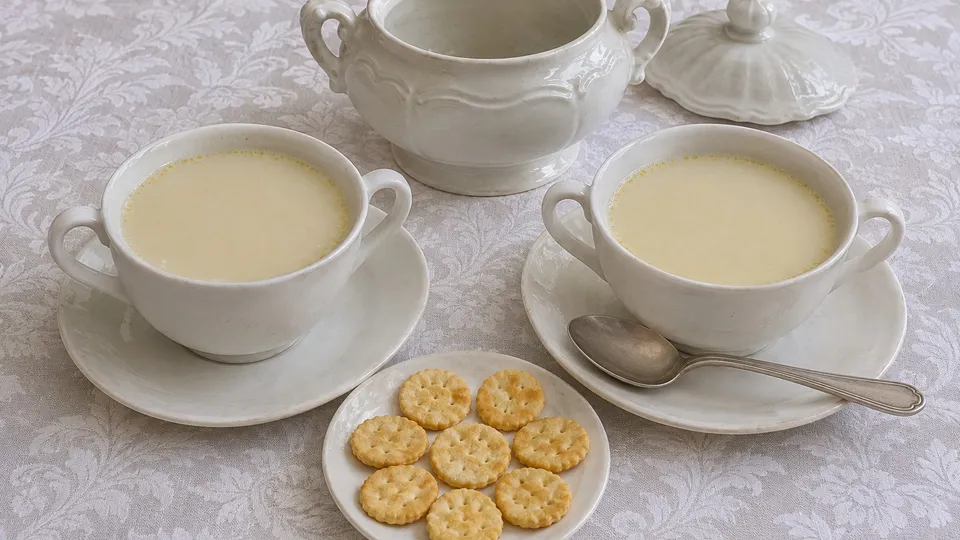
- Oyster Soup (1896): Farmer’s first course, oysters heated in their own liquor and strained out, the liquor thickened and joined with milk scalded with mace, celery, onion and bay.
- Thanksgiving Chicken Pie (1867): Croly’s pie of the holiday’s name, chicken over veal and ham with hard-boiled eggs and mushrooms, under puff paste leaves, for her “chicken pie ornamented.”
- Squash Pie (1896): Farmer’s one-crust pie of steamed winter squash, egg, milk and a little spice, the third pie of her menu line.
- Baked Indian Pudding (1867): Croly’s cornmeal and molasses pudding with ginger and cinnamon, set with a single egg.
Begin where both cookbooks begin, with the Oyster Soup (1896): the oysters give their flavor to the liquor and are strained out, so it is ready in about forty minutes and can wait on the back of the stove while the turkey rests. For the cider, currant wine and ginger beer of a temperance Thanksgiving earlier in the century, Forgotten Drink, our sister site, has What People Drank at Thanksgiving in the 1800s (opens in a new tab).
 Cook it todayOyster Soup (1896)
Sources
- Asa Bean, letter to Mary Bean and family, Frederick, Maryland, November 25–27, 1862, in the Bean family papers, University of Iowa Libraries, Special Collections. Transcription, DIY History, University of Iowa Libraries (opens in a new tab); collection guide (opens in a new tab); catalogue record, Iowa Heritage Digital Collections (opens in a new tab).
- Mrs. J. C. Croly (Jennie June), Jennie June’s American Cookery Book (New York: The American News Company, 1867), pp. 141–142 and 263, and “Thanksgiving Chicken Pie,” p. 90. Internet Archive (opens in a new tab).
- Fannie Merritt Farmer, The Boston Cooking-School Cook Book (Boston: Little, Brown, and Company, 1896), pp. 43, 382, 395 and 520. Internet Archive (opens in a new tab).
- Abraham Lincoln, Proclamation of Thanksgiving, October 3, 1863, National Archives, General Records of the United States Government (RG 11), National Archives Identifier 299960. DocsTeach, National Archives (opens in a new tab).
- National Archives, “Congress Establishes Thanksgiving.” National Archives (opens in a new tab).