Squash Pie (1896)
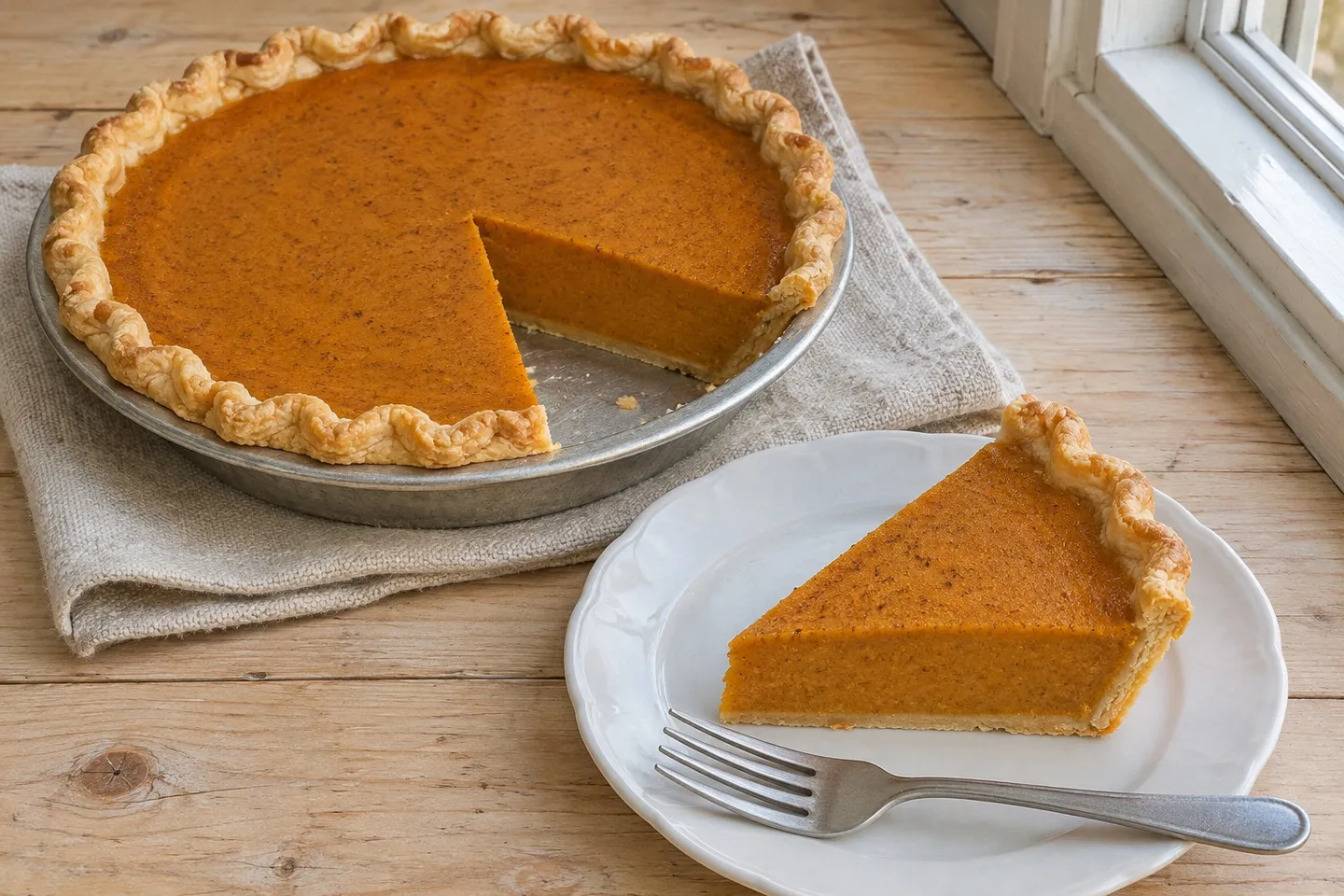
Reader ratingsFannie Farmer’s squash pie of 1896, one of the three pies on her Thanksgiving menu: steamed winter squash pressed through a sieve, mixed with sugar, spice, one egg and milk, and baked as a custard in a single crust of her plain paste.
- Recipe makes
- One 8-inch pie, 6 servings
- Prep
- Cook
- Total
Prep time includes the hour the baked pie needs to cool and set. The squash steams for about 30 minutes while you make the paste, and the pie bakes for about 50 minutes. The squash can be steamed and sieved a day ahead and kept in the refrigerator.
Squash pie with a fluted rim, one slice served.
The story behind the recipe
One egg sets Fannie Farmer’s squash pie, and steamed winter squash does the rest: a cup and a quarter of sieved squash to that single egg and less than a cup of milk, with sugar and a little spice, baked as a custard in one crust. On her Thanksgiving menu of 1896 it shares a line with mince and apple pie.
Marrow, Turban and Hubbard
Farmer’s market had its own squashes. The winter kinds, she wrote, came in “as early as the middle of August,” and the commonest were “Marrow, Turban, and Hubbard.” Turban and Hubbard were “usually drier than Marrow,” which mattered for a pie, and Hubbard had “a very hard shell, which must be split” before it could be cooked. Her advice for choosing one: “see that it is heavy in proportion to its size.” For the pie she steams it, pared and in pieces, in a strainer over boiling water for about thirty minutes, then presses it through a sieve.
The squash pie points to her Custard Pie for the baking, and that recipe gives the reason for her oven: start it quick “to set rim,” then turn it down, “as egg and milk in combination need to be cooked at low temperature.” For a richer pie she suggests a cup of squash, half a cup each of milk and cream, and an extra egg yolk. The crust is her Plain Paste, lard worked into the flour and butter folded in as for puff paste, which she called “superior paste and quickly made.”
Read more about this recipe
Making it today
Butternut squash is the easiest dry squash to find now, and its thin skin pares off before cooking, as Farmer said Marrow and Turban could. Her spice line reads “¼ teaspoon cinnamon, ginger, nutmeg, or ½ teaspoon lemon extract”; we take it as a quarter teaspoon of each spice, and the lemon extract is the other choice. She gives no oven heats, so ours start at 425°F (220°C) and drop to 325°F (160°C), with a thermometer for the center.
What Was on a Thanksgiving Menu in the 1800s? sets her whole menu, from the oyster soup to the café noir, beside Jennie June’s of 1867. For a pumpkin pie of 1832, sweetened with molasses, make Pumpkin Pie (1832).
SQUASH PIE.
1¼ cups steamed and strained squash. ¼ cup sugar. ½ teaspoon salt. ¼ teaspoon cinnamon, ginger, nutmeg, or ½ teaspoon lemon extract. 1 egg. ⅞ cup milk.
Mix sugar, salt, and spice or extract, add squash, egg slightly beaten, and milk gradually. Bake in one crust, following directions for Custard Pie. If a richer pie is desired, use one cup squash, one-half cup each of milk and cream, and an additional egg yolk.
CUSTARD PIE.
... Line plate with paste, and build up a fluted rim. Strain in the mixture and sprinkle with few gratings nutmeg. Bake in quick oven at first to set rim, decrease the heat afterwards, as egg and milk in combination need to be cooked at low temperature.
Recipe makes: One 8-inch pie, 6 servings
Ingredients
For One 8-inch pie, 6 servings. Quantities are shown as written.
Quantities as written here, for One 8-inch pie, 6 servings.
Plain paste
- All-purpose flour1 1/2 cups
- Salt, for the paste1/2 tsp
- Cold lard1/4 cup
- Cold unsalted butter1/4 cup
- Cold water4 tbsp
- Flour, for dusting2 tbsp
Filling
- Steamed and strained winter squash1 1/4 cups
- Sugar1/4 cup
- Salt, for the filling1/2 tsp
- Ground cinnamon1/4 tsp
- Ground ginger1/4 tsp
- Grated nutmeg1/4 tsp
- Large egg1
- Whole milk7/8 cup
Measurement notes
Ingredients as written here
- 1½ cups all-purpose flour
- ½ tsp salt, for the paste
- ¼ cup cold lard
- ¼ cup cold unsalted butter
- 4 tbsp cold water
- 2 tbsp flour, for dusting
- 1¼ cups steamed and strained winter squash
- ¼ cup sugar
- ½ tsp salt, for the filling
- ¼ tsp ground cinnamon
- ¼ tsp ground ginger
- ¼ tsp grated nutmeg
- 1 large egg
- ⅞ cup whole milk
Equipment
 Large saucepan with a lid
 Colander
- Sieve
 Rubber spatula
 Bowl
 Table knife
 Rolling pin
 8-inch pie plate
 Whisk
 Rimmed baking sheet
 Instant-read thermometer
 Wire rack
Instructions
Peel a piece of raw winter squash large enough to give the sieved squash in the list (the notes give a weight), scrape out the seeds and stringy part, and cut it into 2-inch pieces. Bring an inch of water to a boil in the large saucepan, set the colander in it above the water, add the squash, cover and steam for 25 to 30 minutes, until a knife slides in easily.
Meanwhile, make the paste. Mix the all-purpose flour and the salt, for the paste in the bowl, and work in the cold lard with your fingertips or the table knife until it looks like coarse meal.
Stir in the cold water a spoonful at a time with the knife, just until the dough holds together. Turn it onto a board dusted with some of the flour, for dusting, pat it flat and roll it into a rectangle about ¼ inch thick.
Cut the cold unsalted butter into thin slices and lay them over two-thirds of the paste. Fold the bare third over the middle and the buttered third over that, making three layers. Turn the paste half way round, pat and roll it out again, fold in three, turn and roll once more.
Heat the oven to 425°F (220°C), with the rimmed baking sheet on a shelf in the lower third.
Roll the paste into a round about 2 inches wider than the pie plate and line the plate with it. Fold the overhang under to make a raised edge, and pinch it into a fluted rim. Chill it while you make the filling.
Press the steamed squash through the sieve with the rubber spatula and measure the steamed and strained winter squash. Let it cool for a few minutes.
Whisk the sugar, the salt, for the filling, the ground cinnamon, ground ginger and grated nutmeg in the bowl. Whisk in the squash and the large egg, slightly beaten, then the whole milk, a little at a time, until smooth.
Pour the filling into the lined plate and set it on the hot baking sheet. Bake for 10 minutes to set the rim.
Turn the oven down to 325°F (160°C) and bake for 35 to 45 minutes more, until the filling is set at the edge, only the center still trembles slightly, and the center reads 175°F (79°C).
Cool the pie on the wire rack for an hour, then slice and serve it, or refrigerate it and serve it cold later. Don’t leave it out for more than 2 hours in all.
Nutrition
345calories per serving
- Recipe makes
- One 8-inch pie, 6 servings
- Servings
- 6
Estimated per serving (6) from USDA FoodData Central values for all-purpose flour, lard, butter, cooked butternut squash, sugar, egg and whole milk.
Recipe notes
When adjusting quantities
Farmer’s own amounts for one pie: 1¼ cups of squash to 1 egg and ⅞ cup of milk. Her paste is 1½ cups of flour to ¼ cup each of lard and butter, which lines one 8-inch plate with a built-up rim.
Notes
Quantities mentioned in these notes don’t change when you adjust the servings.
Farmer’s own amounts are kept for the filling and the paste. Ours: reading her spice line as a quarter teaspoon each of cinnamon, ginger and nutmeg (half a teaspoon of lemon extract can replace all three), the water for the paste, skipping her washing of the butter, which modern unsalted butter doesn’t need, the oven heats, the times, the thermometer, the hot baking sheet and chilling the shell. Her Custard Pie strains its filling into the shell; this one is smooth from the sieve, so it is poured. She used pastry flour; all-purpose flour gives a firmer, slightly less tender crust.
About 1½ lb of raw butternut gives the 1¼ cups of sieved squash with a little to spare. Hubbard is too hard to pare; Farmer splits it and cooks the pieces in the shell, so steam it that way and scrape it out before sieving. Leftover squash keeps in the refrigerator for 3 to 4 days.
For her richer pie, use 1 cup of squash, ½ cup each of whole milk and heavy cream, the egg and an extra egg yolk.
A custard pie holds egg and milk: keep it in the refrigerator once it has cooled, covered, and eat it within 3 to 4 days.
Contains egg, milk and wheat (gluten).
Scaling changes the ingredients only; pan sizes and cooking times need their own judgment. To adapt this recipe further, try the recipe tool at TuneMyRecipe (opens in a new tab), our sister site.
Sources and attribution
After Fannie Merritt Farmer, The Boston Cooking-School Cook Book (Boston, 1896), Squash Pie, baked as her Custard Pie, in her Plain Paste, with squash steamed as her Steamed Winter Squash
See the original pages (scan at Internet Archive) (opens in a new tab)
Recipe details
- Course
- Dessert
- Dish family
- Desserts & Sweets
- Region
- American
- Era
- 19th century
- Source decade
- 1890s
- Main ingredient
- VegetablesSpices
- Difficulty
- Intermediate
- Occasion
- Thanksgiving
- Season
- Autumn