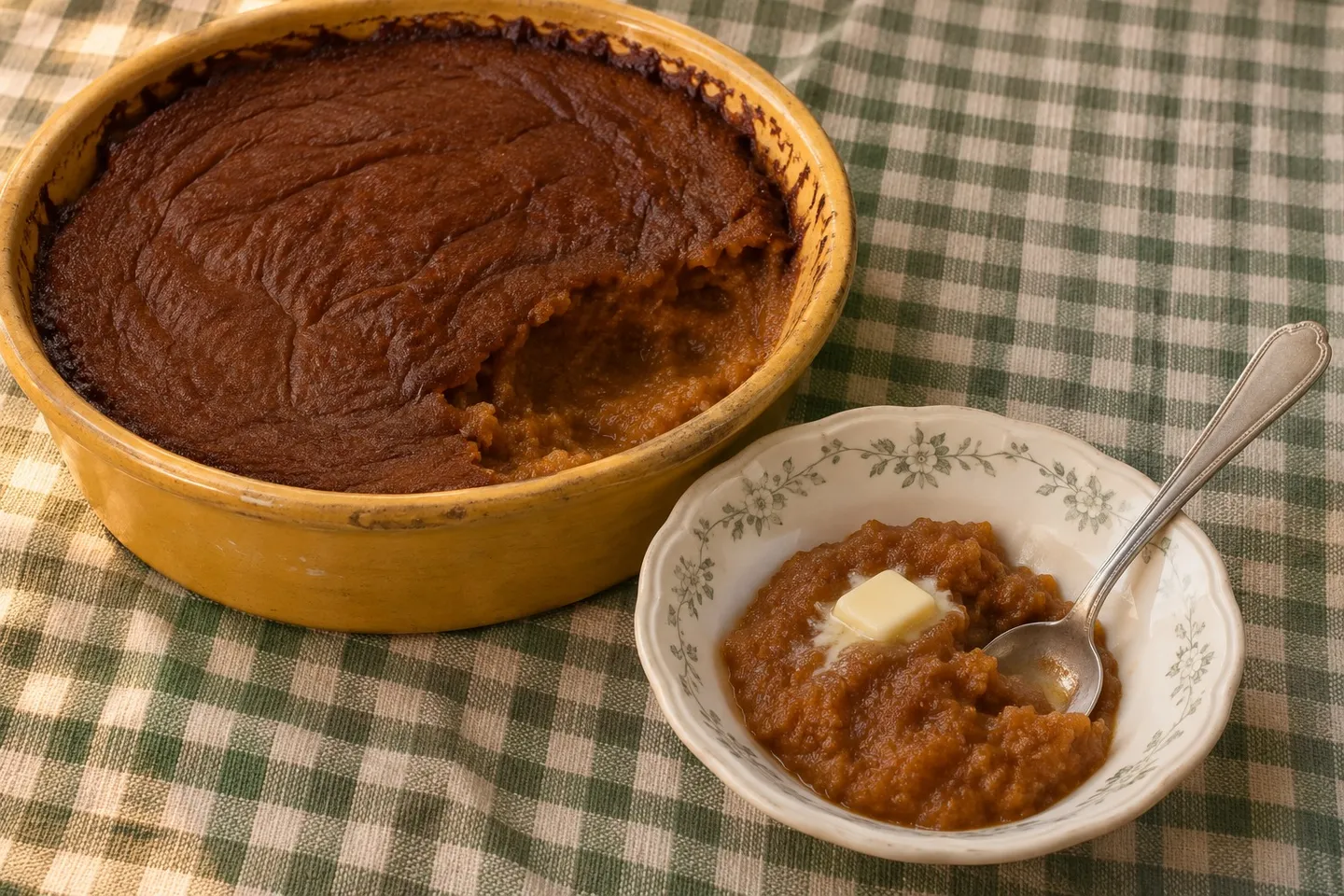
Baked Indian Pudding (1867)
Reader ratingsJennie June’s baked Indian pudding of 1867: cornmeal scalded with boiling milk, sweetened with molasses, spiced with ginger and cinnamon, set with a single egg and baked an hour and a half.
- Recipe makes
- About 5 cups, 8 servings
- Prep
- Cook
- Total
Prep time includes about 45 minutes of cooling the scalded meal before the egg goes in. The pudding bakes an hour and a half, as Croly directs, and rests 15 minutes before serving.
Baked Indian pudding in a yellow dish, a serving with butter in a small bowl.
The story behind the recipe
Indian pudding is cornmeal and milk, sweetened and baked slowly until it turns soft, brown and spoonable, and Jennie June’s of 1867 is a plain one: a quart of milk poured boiling onto a cup of meal, half a cup of molasses, butter, salt, ginger and cinnamon, and one egg stirred in when the mixture is cold. Her Thanksgiving menu lists “Indian pudding” with the mince and pumpkin pies and apple tarts.
Six puddings from one meal
“Indian meal” was cornmeal (one of Croly’s own recipes calls it “corn meal” outright), and her pudding chapter makes six puddings of it. The first two are boiled in a cloth or a bag, with sweet apples or huckleberries; this one, an hour and a half in the oven, is the first she bakes. Three more follow: The Deacon’s Apple Indian Pudding, with six sweet apples sliced thin into the meal and baked three hours; a Boiled Indian Pudding of sour milk, raisins and chopped suet; and a Plain Indian Pudding with four eggs, baked slowly for three hours and eaten “with butter.” The menu says only “Indian pudding,” so we chose this one.
Croly was a defender of the pudding course. “We always suspect a man who does not like pie or pudding,” she wrote in her pastry chapter, “just as we would a woman that did not love children.” Solid flour puddings, on the other hand, she called “always doubtful,” too heavy for the climate “unless made a very important part of the dinner.” A pudding of meal, milk and molasses, with one egg to a quart of milk, is a softer thing.
Read more about this recipe
Making it today
Croly pours the boiling milk on and leaves the rest to the oven, and the meal tends to sink; for her Plain Indian Pudding she stirs it up from the bottom after half an hour, “as that is apt to thicken at first.” Here the scalded meal goes back on the stove for ten minutes, until it thickens like a thin porridge, so it bakes evenly from the start. Her “piece of butter the size of an egg” is a quarter cup, and her small and large teaspoonfuls are read as three-quarters and one and a half. She gives no oven heat; we bake it slowly at 325°F (160°C).
What Was on a Thanksgiving Menu in the 1800s? reads Croly’s whole bill of fare against Fannie Farmer’s of 1896. A wartime Indian pudding of 1918, made with suet and raisins and no egg, is Baked Indian Pudding (1918).
BAKED INDIAN PUDDING.
One quart of milk scalding hot, one cup of Indian mea[l], one half cup of molasses, a piece of butter the size of an egg, a small tea-spoonful of salt, a small tea-spoonful of ginger, a large tea-spoonful of cinnamon. Wet the meal with cold water, and pour the boiling milk on it to scald it. Add one egg when cold, before baking. Bake one hour and a half.
Recipe makes: About 5 cups, 8 servings
Ingredients
For about 5 cups, 8 servings. Quantities are shown as written.
Quantities as written here, for about 5 cups, 8 servings.
- Cold water1/2 cup
- Yellow cornmeal1 cup
- Whole milk4 cups
- Molasses1/2 cup
- Unsalted butter1/4 cup
- Salt3/4 tsp
- Ground ginger3/4 tsp
- Ground cinnamon1 1/2 tsp
- Large egg1
- Soft butter, for the dish
Measurement notes
Ingredients as written here
- ½ cup cold water
- 1 cup yellow cornmeal
- 4 cups whole milk
- ½ cup molasses
- ¼ cup unsalted butter
- ¾ tsp salt
- ¾ tsp ground ginger
- 1½ tsp ground cinnamon
- 1 large egg
- Soft butter, for the dish
Equipment
 Bowl
 Medium saucepan
 Wooden spoon
- Small bowl
 Fork
 2-quart baking dish
 Instant-read thermometer
Instructions
Stir the cold water into the yellow cornmeal in the bowl to make a smooth, wet paste.
Bring the whole milk to a boil in the saucepan. Pour it onto the wet meal a little at a time, stirring hard with the wooden spoon so no lumps form.
Pour the mixture back into the saucepan and cook over low heat for 10 minutes, stirring often and scraping the bottom, until it thickens like a thin porridge.
Take it off the heat and stir in the molasses, unsalted butter, salt, ground ginger and ground cinnamon until the butter melts.
Let it cool, stirring now and then, for about 45 minutes, until it is no more than lukewarm. Meanwhile, heat the oven to 325°F (160°C) and grease the baking dish with the soft butter.
Beat the large egg with the fork in the small bowl and stir it into the cooled mixture. Pour it into the dish.
Bake for 1½ hours, until the top is deep brown, the edge is set and the middle is soft but no longer liquid, and the center reads at least 160°F (71°C).
Let it rest for 15 minutes; it firms a little as it cools. Serve it warm, spooned from the dish.
Nutrition
260calories per serving
- Recipe makes
- About 5 cups, 8 servings
- Servings
- 8
Estimated per serving (8) from USDA FoodData Central values for whole milk, yellow cornmeal, molasses, butter and egg.
Recipe notes
When adjusting quantities
Croly’s own batch: a quart of milk to a cup of meal and half a cup of molasses, with one egg. Keep the pudding about 2 inches deep in the dish whatever the amount.
Notes
Quantities mentioned in these notes don’t change when you adjust the servings.
Croly gives the milk, meal, molasses, butter, spices, the single egg added when cold, and the hour and a half. Added here: the half cup of water for wetting the meal, the ten minutes on the stove, cooling to lukewarm instead of cold, the oven heat, the dish size and the thermometer. A piece of butter the size of an egg is read as 2 ounces (¼ cup), the figure American cookbooks of the 1880s to 1910s give; Croly’s book prints none. Her “small” teaspoonfuls are read as ¾ teaspoon and her “large” as 1½.
Croly gives no sauce for this pudding; her Plain Indian Pudding is eaten with butter, and a little butter on each warm serving suits this one too.
Don’t leave the pudding out for more than 2 hours. Refrigerate leftovers, covered, eat them within 3 to 4 days, and reheat them to 165°F (74°C).
Contains milk and egg.
Scaling changes the ingredients only; pan sizes and cooking times need their own judgment. To adapt this recipe further, try the recipe tool at TuneMyRecipe (opens in a new tab), our sister site.
Sources and attribution
After Mrs. J. C. Croly (Jennie June), Jennie June’s American Cookery Book (New York, 1867), Baked Indian Pudding
See the original pages (scan at Internet Archive) (opens in a new tab)
Recipe details
- Course
- Dessert
- Dish family
- Desserts & Sweets
- Region
- American
- Era
- 19th century
- Source decade
- 1860s
- Main ingredient
- Grains & riceMilk & cream
- Difficulty
- Easy
- Occasion
- Thanksgiving
- Season
- Autumn