Oyster Soup (1896)
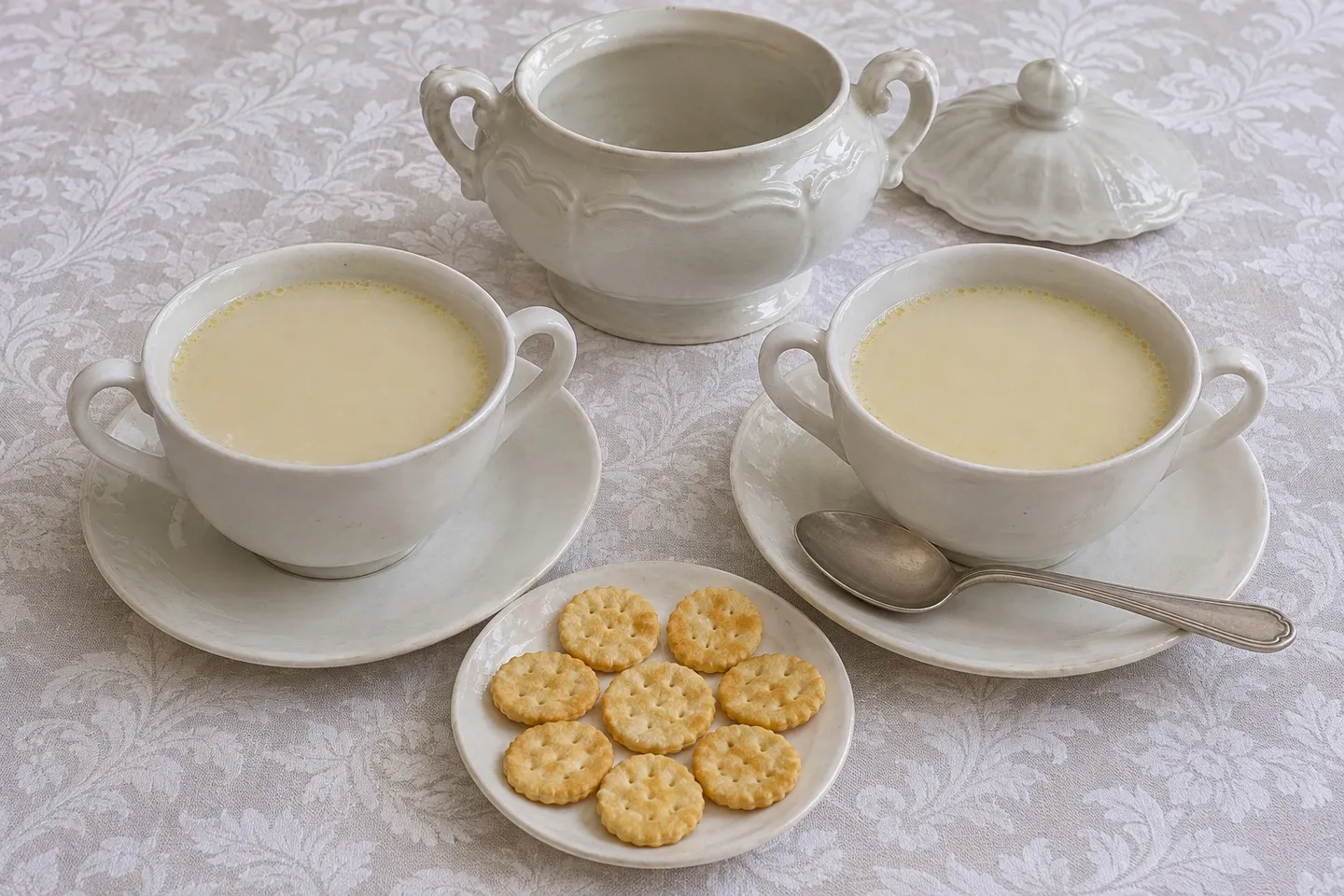
Reader ratingsFannie Farmer’s oyster soup of 1896, the first course of her Thanksgiving menu: oysters heated in their liquor and strained out, the liquor thickened and joined with milk scalded with onion, celery, mace and bay.
- Recipe makes
- About 6 cups, 8 small cups as a first course
- Prep
- Cook
- Total
Scald the milk while the oysters heat in their liquor, and the two parts are ready together. The soup can be held hot, below a boil, for half an hour.
Two cups of strained oyster soup with a tureen and a plate of small crackers.
The story behind the recipe
Fannie Farmer’s oyster soup is a soup of oyster liquor, not of oysters. She heats the oysters slowly in their own liquor, strains it through cheesecloth and leaves them in the cloth, then thickens the liquor with butter and flour and pours in milk that has been scalded with onion, celery, mace, parsley and bay. It is the dish that opens her Thanksgiving menu of 1896, served with crisp crackers.
Two soups from one quart
The recipe sits directly under her Oyster Stew on page 118, and the two are built from the same quart of oysters and the same four cups of milk. The stew keeps the oysters whole, cooked only “until oysters are plump and edges begin to curl,” and serves them in the tureen. The soup chops them first, boils them and strains them out. For the cleaning, the soup simply says “as for Oyster Stew”: pour three-quarters of a cup of cold water over the oysters in a colander, pick them over for shell, and keep the liquor. Below the soup comes a richer French Oyster Soup, finished with egg yolks and garnished with fish quenelles.
Jennie June’s cookbook of 1867, whose Thanksgiving menu also starts with oyster soup, offers four oyster soups of its own, and every one keeps the oysters in the bowl. The first is built on a shin of veal boiled for three hours and takes “one gallon of oysters.” Farmer’s is the plainer, paler soup of a cooking school.
Read more about this recipe
Making it today
Farmer brings the oysters only “slowly to boiling point.” We hold them at a simmer for three minutes, until the edges curl, which is the FDA’s advice for cooking shucked oysters. Her “bit of bay leaf” is half a leaf here, and the salt and white pepper follow her stew’s proportions, kept light because oyster liquor is salty. The strained oysters are cooked and good to eat; Farmer doesn’t say what became of them.
The menu that begins with this soup, and the hospital Thanksgiving of 1862 where stewed oysters came to the table, are in What Was on a Thanksgiving Menu in the 1800s? For oysters in a richer sauce from the same year, try Chafing-Dish Oysters (1896).
1 quart oysters. 4 cups milk. 1 slice onion. 2 stalks celery. 2 blades mace. Sprig of parsley. Bit of bay leaf. ⅓ cup butter. ⅓ cup flour. Salt and pepper.
Clean and pick over oysters as for Oyster Stew; reserve liquor, add oysters slightly chopped, and heat slowly to boiling point. Strain through cheese cloth, reheat liquor, and thicken with butter and flour cooked together. Scald milk with onion, celery, mace, parsley, and bay leaf; remove seasonings, and add to oyster liquor. Season with salt and pepper.
Recipe makes: About 6 cups, 8 small cups as a first course
Ingredients
For about 6 cups, 8 small cups as a first course. Quantities are shown as written.
Quantities as written here, for about 6 cups, 8 small cups as a first course.
- Shucked oysters with their liquor4 cups
- Cold water3/4 cup
- Whole milk4 cups
- Onion1 slice
- Celery, cut in pieces2 stalks
- Blades mace2
- Parsley1 sprig
- Bay leaf1/2
- Butter1/3 cup
- All-purpose flour1/3 cup
- Salt1/2 tsp
- White pepper1/8 tsp
- Crisp crackers, to serve
Measurement notes
Ingredients as written here
- 4 cups shucked oysters with their liquor
- ¾ cup cold water
- 4 cups whole milk
- 1 slice onion
- 2 stalks celery, cut in pieces
- 2 blades mace
- 1 sprig parsley
- ½ bay leaf
- ⅓ cup butter
- ⅓ cup all-purpose flour
- ½ tsp salt
- ⅛ tsp white pepper
- Crisp crackers, to serve
Equipment
 Colander
 Bowl
 Cutting board and knife
 2 medium saucepans
- Sieve lined with muslin or cheesecloth
 Slotted spoon
 Whisk
 Instant-read thermometer
Instructions
Set the colander over the bowl and tip in the shucked oysters with their liquor. Pour the cold water over them, then pick over each oyster with your fingers and remove any bits of shell. Keep everything that drains into the bowl.
Chop the oysters coarsely, into two or three pieces each.
Pour the liquor and water from the bowl into one of the saucepans, leaving any grit at the bottom of the bowl behind, and add the chopped oysters. Heat slowly over medium-low heat until it boils, then lower the heat and simmer for 3 minutes, until the oysters are firm and their edges have curled and a piece reads 145°F (63°C).
Meanwhile, put the whole milk in the second saucepan with the onion, celery, mace, parsley and bay leaf. Heat over medium-low heat until small bubbles form at the edge and the milk reaches 180°F (82°C); don’t let it boil. Take it off the heat and lift out the seasonings with the slotted spoon.
Rinse the bowl and strain the oyster liquor through the lined sieve into it. Set the oysters aside, and refrigerate them if they will not be eaten within 2 hours.
Rinse the first saucepan, melt the butter in it over medium-low heat, and stir in the all-purpose flour. Cook for 2 minutes, stirring, without letting it brown.
Whisk in the hot oyster liquor a little at a time and cook, whisking, until it boils and thickens, about 2 minutes.
Whisk in the hot milk and heat until steaming, about 180°F (82°C), without letting it boil. Season with the salt and white pepper, tasting first, since the liquor is already salty.
Serve hot in small cups, with the crisp crackers.
Nutrition
165calories per serving
- Recipe makes
- About 6 cups, 8 small cups as a first course
- Servings
- 8
Estimated per serving (8) from USDA FoodData Central values for whole milk, butter and all-purpose flour, with a little for the oyster liquor; the strained-out oysters and the crackers are not included.
Recipe notes
When adjusting quantities
Farmer’s own batch: a quart of oysters to four cups of milk, with butter and flour in equal measure, a third of a cup each. Halve everything for four cups.
Notes
Quantities mentioned in these notes don’t change when you adjust the servings.
Farmer’s own changes from the stew: the oysters are chopped and boiled, then strained out. Ours: the 3-minute simmer and the temperatures, the half bay leaf for her “bit,” the salt and pepper amounts (from her Oyster Stew, which uses half a tablespoon of salt and an eighth of a teaspoon of pepper to the same quart), white pepper so the soup stays pale, and the slotted spoon for lifting out the seasonings.
Buy shucked oysters in a labeled container kept on ice or refrigerated, keep them in the fridge and cook them within two days. Raw or undercooked oysters can carry Vibrio bacteria, a particular risk for people with liver disease, diabetes or weakened immunity; the FDA advises boiling or simmering shucked oysters for at least 3 minutes, or until the edges curl. Don’t leave the soup out for more than 2 hours; refrigerate it and reheat it to 165°F (74°C), stirring, without letting it boil hard.
The cooked oysters left in the cloth can be stirred back into the soup just before serving or eaten on the crackers; that is our suggestion, not Farmer’s.
Contains shellfish, milk and wheat (gluten, in the flour and crackers).
Scaling changes the ingredients only; pan sizes and cooking times need their own judgment. To adapt this recipe further, try the recipe tool at TuneMyRecipe (opens in a new tab), our sister site.
Sources and attribution
After Fannie Merritt Farmer, The Boston Cooking-School Cook Book (Boston, 1896), Oyster Soup, with the cleaning from her Oyster Stew
See the original pages (scan at Internet Archive) (opens in a new tab)
Recipe details
- Course
- Soup
- Dish family
- Fish & Seafood
- Region
- American
- Era
- 19th century
- Source decade
- 1890s
- Main ingredient
- Shellfish
- Difficulty
- Easy
- Occasion
- Thanksgiving
- Season
- Autumn