Grand supper at the Ismailia ball, opening of the Suez Canal · Ismailia, Egypt
What Was on the Menu at the Suez Canal Opening in 1869?
The Suez Canal opening supper at Ismailia, November 18, 1869: a fish named for two seas, English roast beef, Suez shrimps and Russian salad. Three recipes.
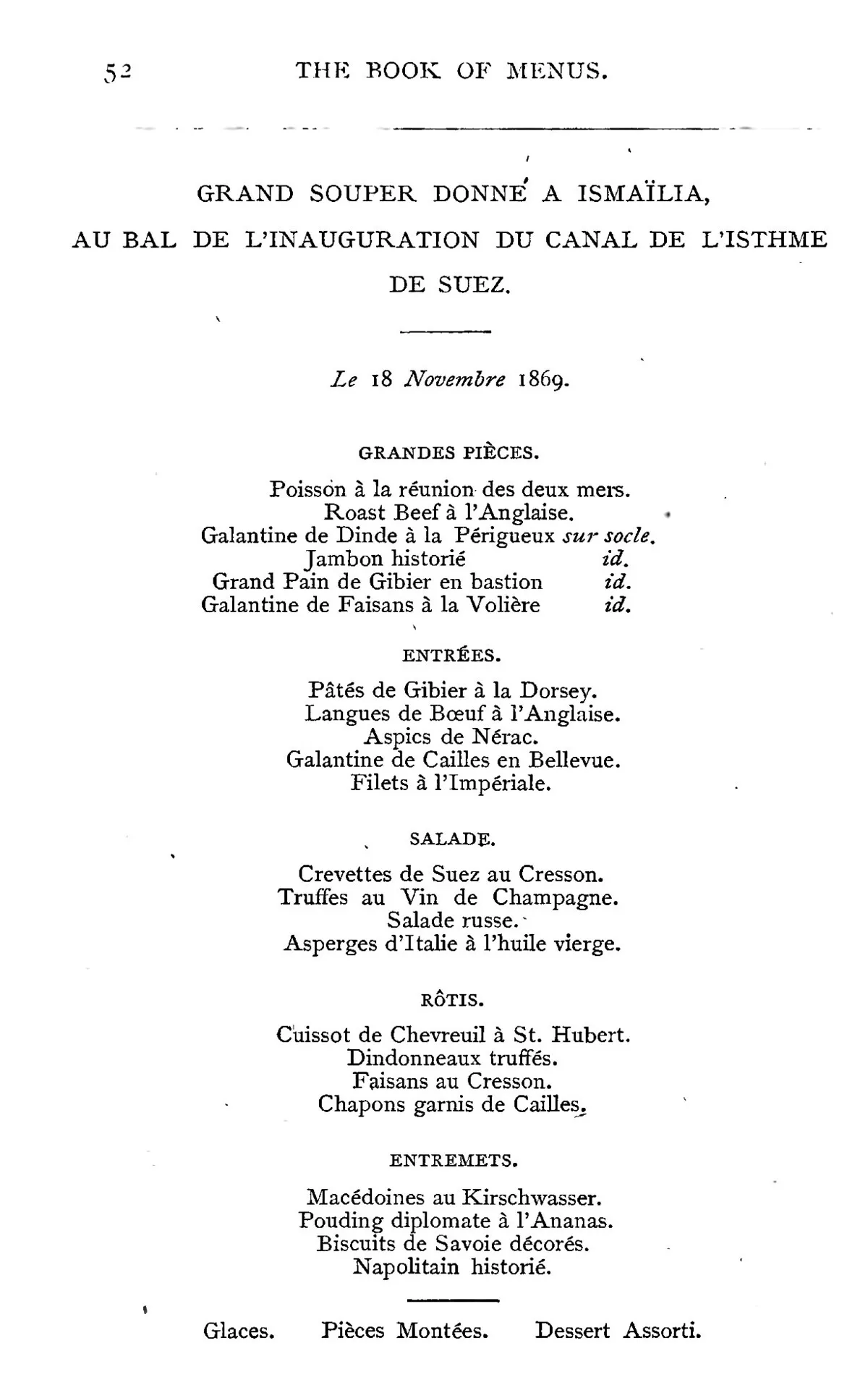
The menu of the grand supper at the Ismailia ball on November 18, 1869, given for the opening of the Suez Canal, begins with a fish named for the occasion: Poisson à la réunion des deux mers, fish in the manner of the joining of the two seas. Then come English roast beef, galantines of turkey and pheasant, a decorated ham and a great game loaf, all raised on stands; pâtés, ox tongues and aspics; a salad course of Suez shrimps with cress, truffles in Champagne, Russian salad and Italian asparagus with virgin oil; four roasts, four sweet dishes, ices and set pieces. That list reaches us in print: a London food writer who signed himself Fin-Bec set it in type for his Book of Menus in 1876, seven years after the night.
A dinner, a ball and a supper
The canal opened over several days. A set of watercolors drawn on the spot, the Album de l’Impératrice, follows the celebrations from the religious ceremonies of November 16 to the passage of the ships through the canal from November 17 to 20. One of them, reproduced as a color lithograph after Édouard Riou for Ferdinand de Lesseps, whose company built the canal, shows the dinner and ball at Ismailia, about halfway along the canal, on November 18.
The Fondation Napoléon’s caption to that picture names the people at the sovereigns’ table: the Empress Eugénie, the Emperor of Austria, the Crown Prince of Prussia, the British and Russian ambassadors and their wives, the Prince and Princess of the Netherlands, de Lesseps and Ismail, the Khedive of Egypt. It counts thousands of visitors from around the world, among them sixty French guests whom the Khedive had invited in person.
Riou drew a dinner at one table. The menu Jerrold printed belongs to a grand souper at the ball, and nothing in either source says whether the sovereigns ate from the same list as the rest of the room, or how many sat down to it.
Fin-Bec’s calendar
Fin-Bec was the pen name of William Blanchard Jerrold, and the title page of his Book of Menus (1876) presents him as the author of The Epicure’s Year-Book. The same page carries a French couplet that suits a canal opening well: “Tout se fait en dînant dans le siècle où nous sommes, / Et c’est par les dîners qu’on gouverne les hommes.” In this century everything is done over dinner, and it is by dinners that men are governed.
The book is laid out as a calendar of memorable meals, a month at a time. Against November 18 it records: “Grand Supper given at Ismaïlia, on the opening of the Isthmus of Suez, 1869.” Three days on, against the 21st, comes “M. Jules Gouffé’s Dinner to his colleagues, in Paris, on the completion of his great cookery book.”
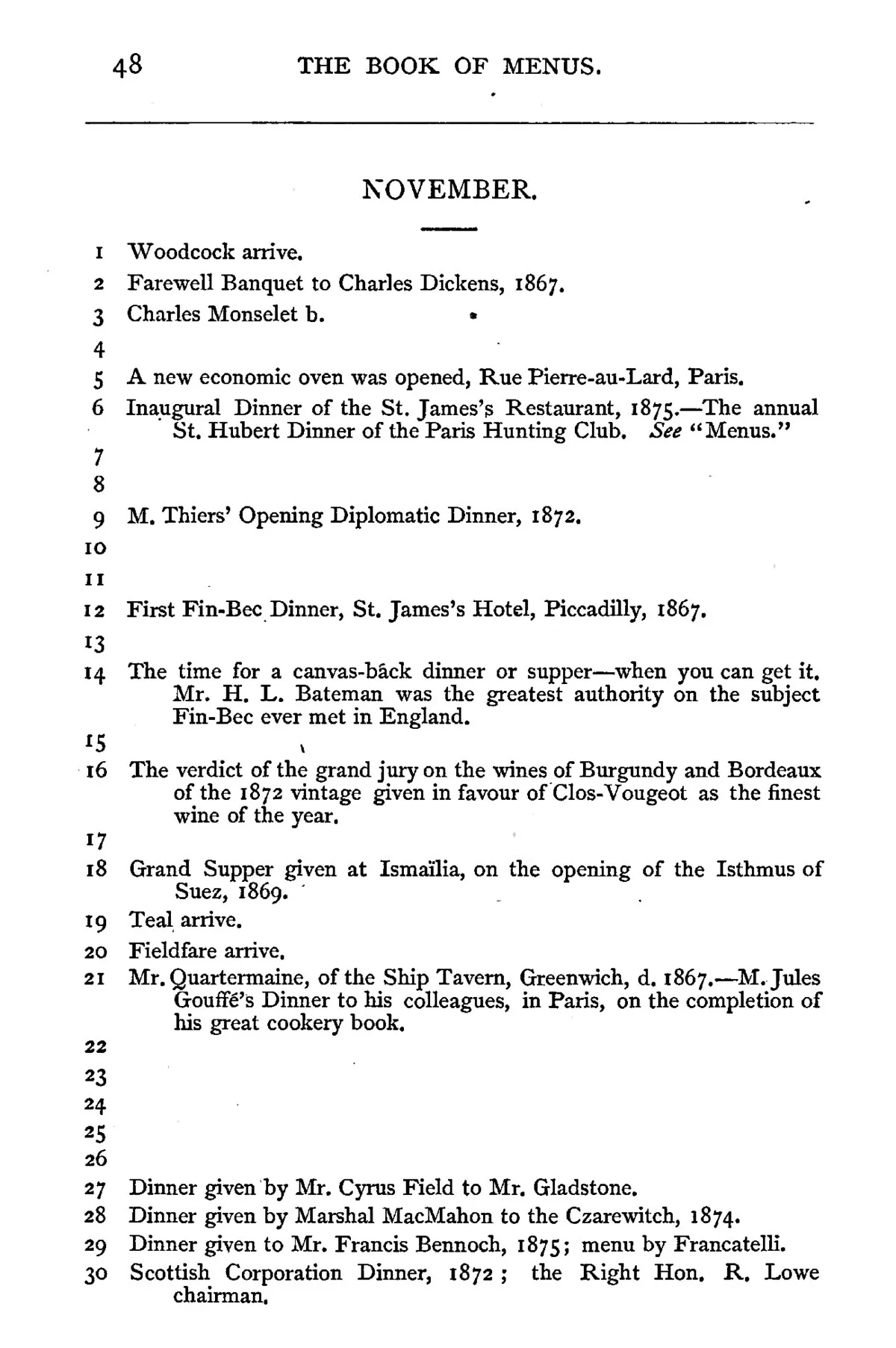 The November calendar in Fin-Bec, The Book of Menus (London, 1876), p. 48.
Four pages on, Jerrold prints the Ismailia menu in full, in French, under the heading Grand souper donné à Ismaïlia, au bal de l’inauguration du canal de l’isthme de Suez and the date. It is the page at the top of this article.
What the menu lists
The headings are those of a formal French supper, and each holds four to six dishes.
- Grandes pièces, the large pieces: the fish of the two seas; Roast Beef à l’Anglaise; a galantine of turkey à la Périgueux; a decorated ham, jambon historié; a great game loaf en bastion; and a galantine of pheasants à la Volière. The last four are marked sur socle, set on a stand.
- Entrées: game pâtés à la Dorsey, ox tongues in the English style, aspics de Nérac, a galantine of quails en Bellevue and filets à l’Impériale.
- Salade: Suez shrimps with cress, truffles in Champagne, Russian salad, and Italian asparagus with virgin oil.
- Rôtis: a haunch of roe deer à la St. Hubert, truffled young turkeys, pheasants with cress, and capons garnished with quails.
- Entremets: macédoines with kirsch, a diplomat pudding with pineapple, decorated Savoy biscuits and a decorated Napolitain. Then ices, pièces montées and an assorted dessert.
Two lines on the menu belong to the place: the fish named for the meeting of the Mediterranean and the Red Sea, and the shrimps of Suez. The rest names France (Périgueux, Nérac), England (the roast beef, written in English, and the tongues), Italy, Russia, Savoy and Naples. The menu does not say where any ingredient came from; “Italian asparagus” is a name on a menu, and it tells us nothing of a shipment.
Three pages earlier, the same book prints the opening dinner of the St. James’s Restaurant in Piccadilly on November 6, 1875, and that menu has its own Asperges en Branches and Salade à la Russe. Both dishes could stand on a grand November menu in London as well as at Ismailia.
Raised on stands of fat
Galantines, a decorated ham, aspics, game pâtés and a course of salads are dishes made in advance and served cold. A good guide to what a French kitchen meant by them in these years is Jules Gouffé, the cook in Jerrold’s calendar. He was chef de cuisine of the Paris Jockey Club, and his Livre de cuisine came out in London in 1868 as The Royal Cookery Book, translated by Alphonse Gouffé, “Head Pastry-cook to Her Majesty the Queen.”
Gouffé opens his chapter of cold dishes with a defense of decoration. Some admirers of service à la Russe, which brought dishes to the table already carved, wanted decoration done away with; to him “the decline of ornamentation is to be regretted.” His first large cold dish is a turkey galantine, the dish third on the Ismailia menu. And the stands under it have their own recipe. “These socles or stands are used to raise the Removes and Entrées; to give them a better appearance; and to allow of more room for garnishing,” he writes, and the ones for large cold dishes “are made of fat”: mutton-kidney suet melted with an equal quantity of lard, whipped smooth and shaped over a block of wood.
In Gouffé’s kitchen, that is what sur socle meant. Gouffé is no witness to the kitchen at Ismailia, and none of these sources names the cooks who worked there. His book shows what the words on the menu asked of a cook at the time.
The porcelain card
An original card may survive. In December 2023 the auction house Alde offered the gastronomic library of Daniel Morcrette, and lot 357 was a menu du grand souper at the Ismailia ball of November 18, 1869, on porcelain card, 34 by 17 centimeters. Porcelain cards, the catalogue explains under another lot, were Bristol board glazed with ceruse, a lead white, to look like china, and their manufacture stopped because the coating was toxic.
The card carries a handwritten line: “Carte placée près du couvert de S.M. l’Impératrice Eugénie et rapportée par elle.” The card was placed by the Empress Eugénie’s cover, it says, and she brought it back. The catalogue traces the card to the dealer and collector Saint-Hélion, who wrote a long note about it dated March 1938. It does not picture the card, and it gives neither the date of the inscription nor whose hand wrote it. Until the card itself is published, its wording cannot be checked against Jerrold’s page, and the card’s link to the Empress rests on that one line.
The recipes
Three dishes on the menu have close counterparts in Gouffé’s Royal Cookery Book, printed a year before the supper. They are his, from a book for English kitchens, and none of them is documented as cooked at Ismailia.
- Roast Sirloin of Beef (1868), for the Roast Beef à l’Anglaise: Gouffé’s sirloin, which he roasted on a spit with no seasoning at all.
- Russian Salad (1868), for the Salade russe: chicken, partridge, salmon and anchovy with small vegetables and herbs, built up to a point.
- Asparagus with Oil and Vinegar (1868), for the Asperges d’Italie à l’huile vierge: boiled, chilled, and served with its dressing in a boat.
The same book fed a very different Paris ten months later, when the city was under siege and the Empire whose Empress sat at the Ismailia table had fallen; What Did Paris Eat Under Siege in 1870? cooks from it again.
The Russian salad is the one to plan for: the chicken, partridge, salmon and vegetables must all be cooked and quite cold before they meet the oil and vinegar, so cook them in the morning and build the salad just before supper. The supper’s three dishes are among our 19th-century recipes.
Sources
- Fin-Bec [William Blanchard Jerrold], The Book of Menus. 1876 (London: Grant & Co., 1876), title page and pp. 48, 49, 52. Internet Archive (opens in a new tab). Pen name identified by Wellcome Collection (opens in a new tab).
- Jules Gouffé, The Royal Cookery Book (Le Livre de Cuisine), translated and adapted by Alphonse Gouffé (London: Sampson Low, Son, and Marston, 1868), title page and pp. 553, 555, 557. Internet Archive (opens in a new tab).
- Fondation Napoléon, “The sovereigns’ dinner in Ismailia,” colour lithograph by Sirouy after Édouard Riou, 1869, Association du Souvenir de Ferdinand de Lesseps et du Canal de Suez. napoleon.org (opens in a new tab).
- Alde, Bibliothèque gastronomique Daniel Morcrette, sale of December 4, 2023, lots 354 and 357, p. 130.