Asparagus with Oil and Vinegar (1868)
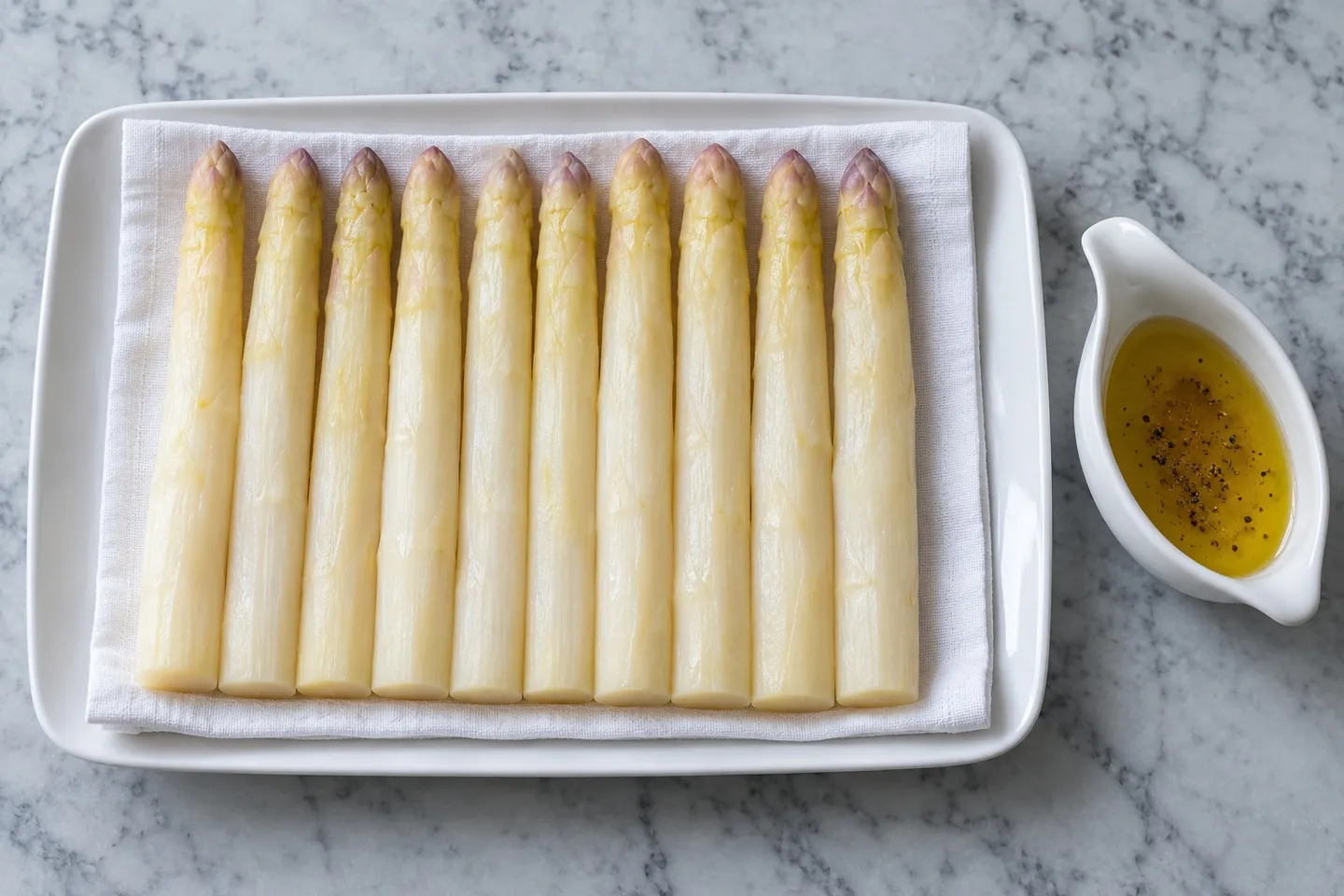
Reader ratingsGouffé’s cold asparagus with oil and vinegar, 1868: spears scraped, tied in bundles, boiled in salted water, chilled and served on a napkin with the dressing in a boat.
- Recipe makes
- 4 servings as a salad course
- Prep
- Cook
- Total
After boiling, the asparagus needs at least an hour in the fridge to get thoroughly cold, as Gouffé asks; that chilling is not counted here.
Cold white asparagus on a folded napkin with a sauce boat of oil and vinegar.
The story behind the recipe
Asparagus belonged to spring in Jules Gouffé’s kitchen. “Asparagus is in season in April and May,” he told his readers, and he wanted it “with fresh purple points, and white stalks.” Yet the supper at Ismailia on November 18, 1869, given for the opening of the Suez Canal, closes its salad course with Asperges d’Italie à l’huile vierge, Italian asparagus with virgin oil, in the menu Fin-Bec printed in 1876. The menu does not say how asparagus came to be on a November table, whether grown out of season, brought from far away or kept in some way.
How did a Paris chef serve asparagus cold?
Gouffé served it plain on a napkin, with the dressing in a sauce boat beside it. In The Royal Cookery Book (1868), the English edition of his Livre de cuisine, he first boils asparagus to serve hot with melted butter or Dutch sauce, and the cold version follows in a single sentence: boil it the same way, let it get “thoroughly cold,” lay it on a napkin and send the pepper, salt, oil and vinegar to the table in a boat.
He takes more trouble over the boiling. The stalks are scraped with the knife held slanting and tied in bundles of eight or ten, and the water is salted at a quarter of an ounce to the quart. Then comes his warning: as soon as the spears give under the fingers they come out, “else it will become flabby and spongy,” and the same goes for every boiled vegetable left in its water.
Read more about this recipe
Making it today
Thick white asparagus with purple tips is the closest to his choice; the recipe also gives times for thick green spears. The one choice of ours that matters is the dressing: Gouffé names oil and vinegar with no proportions, and we mix about three parts oil to one of vinegar, using extra virgin olive oil for the menu’s huile vierge.
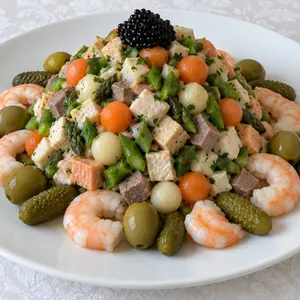
Gouffé’s Russian Salad (1868) sits next to it in the salad course and uses asparagus too, cut small enough to pass for peas.
Asparagus is in season in April and May; it should be chosen with fresh purple points, and white stalks.
Cut ¹⁄₁₆ of an inch off the points, and scrape the asparagus all along, holding the knife in a slanting position; then throw the asparagus into cold water; tie in bundles of 8 or 10, according to size.
Have a large saucepan of boiling water; add ¼ oz. of salt for each quart of water; put the asparagus in, and boil for ten minutes; when done take it out; dip in cold water, and drain immediately; dish up on a napkin, keeping the points very even; serve with a boat of Melted Butter or Dutch Sauce.
Observation.—As soon as the asparagus is done, which is ascertained by pressing with the fingers, take it out of the water at once,—else it will become flabby and spongy.
All boiled vegetables allowed to remain in water after cooking will be spoilt in the same way.
ASPARAGUS WITH OIL AND VINEGAR
After boiling as above, let the asparagus get thoroughly cold; dish it up, on a napkin; and serve with it a seasoning of pepper and salt, oil and vinegar, in a boat.
Recipe makes: 4 servings as a salad course
Ingredients
For 4 servings as a salad course. Quantities are shown as written.
Quantities as written here, for 4 servings as a salad course.
- Thick white or green asparagus1 kg
- Water, for boiling3 l
- Salt, for the water18 g
- Extra virgin olive oil4 tbsp
- White wine vinegar1 1/2 tbsp
- Salt, for the dressing1/2 tsp
- Ground black pepper1/4 tsp
Measurement notes
Ingredients as written here
- 1 kg thick white or green asparagus
- 3 l water, for boiling
- 18 g salt, for the water
- 4 tbsp extra virgin olive oil
- 1½ tbsp white wine vinegar
- ½ tsp salt, for the dressing
- ¼ tsp ground black pepper
Equipment
- Vegetable peeler or small knife
- Kitchen string
- Wide saucepan or deep frying pan
- Bowl of cold water
- Clean dish towel
- Long serving dish and a white linen napkin
- Small sauce boat or jug
Instructions
Snap or cut off the woody ends of the asparagus. Peel white asparagus all the way from just below the tip to the base, holding the peeler or knife at a slant; for green asparagus, peel only the lower half. Drop the spears into cold water as you go.
Tie the spears in bundles of 8 to 10, with the tips level, using string in two places.
Bring the water for boiling to a full boil, 212°F (100°C), in the wide pan and add the salt for the water.
Lay the bundles in the water and boil until a spear gives when pressed with a finger and a knife slides easily into the thick end: about 10 to 12 minutes for thick white asparagus, 4 to 6 for thick green.
Lift the bundles straight out, dip them in the bowl of cold water and drain them at once on the dish towel. Cut the strings.
Lay the spears on a plate, cover and refrigerate until thoroughly cold, at least an hour.
To serve, fold the napkin on the long dish and lay the asparagus on it with the tips all pointing the same way and level.
Whisk the extra virgin olive oil, white wine vinegar, salt for the dressing and black pepper together, pour into the sauce boat and serve it beside the asparagus.
Nutrition
160calories per serving
- Recipe makes
- 4 servings as a salad course
- Servings
- 4
Estimated per serving (4) from USDA FoodData Central values for boiled asparagus and olive oil.
Recipe notes
When adjusting quantities
Gouffé ties 8 to 10 spears to a bundle; allow about one bundle a head. Keep the salt at his strength of about 6 g to each liter of water.
Notes
Quantities mentioned in these notes don’t change when you adjust the servings.
Gouffé’s “cut ¹⁄₁₆ of an inch off the points” is unclear; we trim the woody base, which any cook does, and leave the tips whole. His ten minutes’ boiling suits thick white asparagus; we supply the green times, the knife test for doneness and the amounts and proportions of the dressing, which he leaves out. His salt, a quarter ounce to the quart, comes to about 6 g a liter, and the 18 g here keeps that strength for 3 liters. The cooked, chilled spears keep a day in the fridge, covered; dress them only at the table.
Scaling changes the ingredients only; pan sizes and cooking times need their own judgment. To adapt this recipe further, try the recipe tool at TuneMyRecipe (opens in a new tab), our sister site.
Sources and attribution
After Jules Gouffé, The Royal Cookery Book, trans. Alphonse Gouffé (London: Sampson Low, 1868), Asparagus with Melted Butter and Asparagus with Oil and Vinegar; the dish as named on the Ismailia supper menu of November 18, 1869
See the original pages (scan at Internet Archive) (opens in a new tab)
Recipe details
- Course
- Side dish
- Dish family
- Vegetables & Sides
- Region
- French
- Era
- 19th century
- Source decade
- 1860s
- Main ingredient
- Vegetables
- Difficulty
- Easy
- Occasion
- Dinner partyState banquet
- Season
- Spring