Russian Salad (1868)
Reader ratingsGouffé’s 1868 Russian salad: chicken, partridge, salmon and anchovy with small carrots, turnips, asparagus and beans in oil, vinegar and herbs.
- Recipe makes
- 6 servings as a salad course
- Prep
- Cook
- Total
The cooked chicken, partridge, salmon and vegetables must be fully cold before they are mixed: allow at least an hour in the fridge after cooking, not counted here. Cooking them in the morning is easiest.
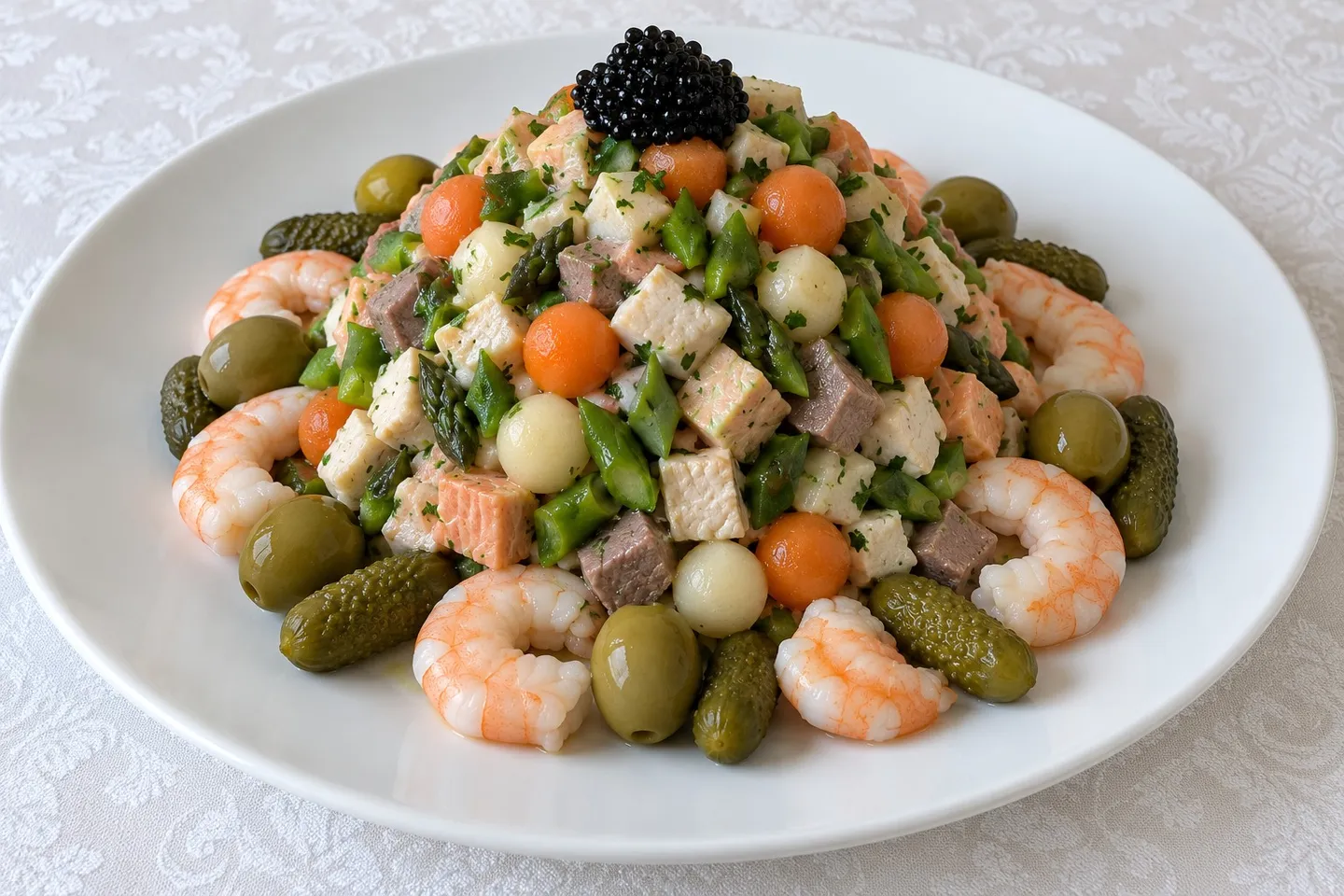
Russian salad of chicken, partridge, salmon and small vegetables, topped with caviar and ringed with prawns, olives and gherkins.
The story behind the recipe
There is no potato in Jules Gouffé’s Russian salad, and no mayonnaise. His version of 1868 mixes chicken, partridge and salmon with anchovy, small balls of carrot and turnip, asparagus cut like peas and diamonds of French bean, dresses them with oil, vinegar, cayenne and herbs, and sets the whole in layers inside a ring of aspic jelly until it rises to a point. Salade russe comes third in the salad course of the Ismailia supper of November 18, 1869, between truffles in Champagne and Italian asparagus, in the menu Fin-Bec printed in 1876.
What went into a Russian salad in the 1860s?
In Gouffé’s kitchen, meat, fish and vegetables went into one bowl. His Royal Cookery Book of 1868 files the dish in its chapter of cold dishes, right after a lobster salad also built up to a point, and the jelly border is garnished with prawns, olives and “small Indian Pickle.” Even caviar is allowed: “Caviar may be added, according to taste.”
His seasoning includes chopped ravigote, which he explains elsewhere in the book as “a mixture of chervil, tarragon, cress, and burnet.” The printed menu gives the two words Salade russe and nothing more, so Gouffé’s version shows what the Jockey Club’s chef in Paris meant by the name in those years.
Read more about this recipe
Making it today
Our one large change is the aspic. Gouffé builds the salad in layers of half-set jelly inside a turned-out border; here the dressed salad is piled to his point on a dish, and the prawns, olives and pickles that garnished his jelly go around it as a ring. Burnet is hard to find, so the herbs are chervil, tarragon and cress. Partridge breasts come from a game dealer or a good butcher; more chicken can take their place.
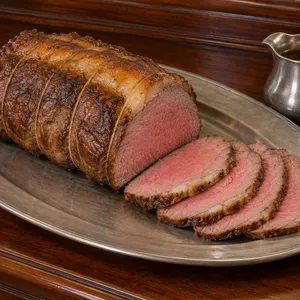
The full supper is set out in What Was on the Menu at the Suez Canal Opening in 1869?; among its large pieces is an English joint, which Gouffé tied and roasted plain: his Roast Sirloin of Beef (1868).
Cook some fillets of partridge and chicken in a sauté-pan, with a little butter; drain, and put them on a plate to cool;
Cook some thin slices of salmon in the same way;
Wash and trim 8 anchovies; and cut them into small dice, together with the partridge, chicken, and salmon;
Cut some carrots and turnips with a small round vegetable scoop; blanch, and cook them in water, with a little salt added;
Boil some asparagus peas, and some French beans, cut in diamond-shaped pieces;
Drain all the above vegetables; and, when cold, put them in a basin, with the fish, chicken, and partridge; season with salt, pepper, oil, vinegar, a little Cayenne pepper, and some chopped Ravigote;
Caviar may be added, according to taste;
Prepare a border of white Aspic Jelly, garnished with picked prawns, olives, and small Indian Pickle; when set, turn the border out on to a dish;
Add some partly-melted white Aspic Jelly to the salad, in the basin; mix, and dish it up in layers inside the border; pour a little jelly over each layer, and let it set completely before adding another; continue the layers, diminishing each one till the salad comes to a point; and serve.
Recipe makes: 6 servings as a salad course
Ingredients
For 6 servings as a salad course. Quantities are shown as written.
Quantities as written here, for 6 servings as a salad course.
Birds and fish
- Skinless chicken breast fillets250 g
- Skinless partridge breasts150 g
- Butter20 g
- Skinless salmon fillet, in thin slices200 g
- Anchovy fillets in oil, drained8
Vegetables
- Water, for the vegetables1.5 l
- Salt, for the vegetable water1 tsp
- Large carrots250 g
- Large turnips250 g
- Thin green asparagus150 g
- French beans150 g
Dressing
- Olive oil4 tbsp
- White wine vinegar1 1/2 tbsp
- Salt, for the dressing1/2 tsp
- Ground black pepper1/4 tsp
- Cayenne pepper1 pinch
- Chopped chervil, tarragon and cress3 tbsp
- Caviar or lumpfish roe, optional30 g
Garnish
- Cooked peeled prawns150 g
- Pitted green olives12
- Small gherkins60 g
Measurement notes
Ingredients as written here
- 250 g skinless chicken breast fillets
- 150 g skinless partridge breasts
- 20 g butter
- 200 g skinless salmon fillet, in thin slices
- 8 anchovy fillets in oil, drained
- 1.5 l water, for the vegetables
- 1 tsp salt, for the vegetable water
- 250 g large carrots
- 250 g large turnips
- 150 g thin green asparagus
- 150 g French beans
- 4 tbsp olive oil
- 1½ tbsp white wine vinegar
- ½ tsp salt, for the dressing
- ¼ tsp ground black pepper
- 1 pinch cayenne pepper
- 3 tbsp chopped chervil, tarragon and cress
- 30 g caviar or lumpfish roe, optional
- 150 g cooked peeled prawns
- 12 pitted green olives
- 60 g small gherkins
Equipment
- Large sauté pan with a lid
 Instant-read thermometer
- Saucepan for the vegetables
- Small melon baller
- Two shallow containers for cooling
- Mixing bowl
- Round serving dish
Instructions
Melt the butter in the sauté pan over medium heat. Add the chicken breast fillets and partridge breasts, cover and cook gently, turning once, until the thickest part of each reads 165°F (74°C), about 6 to 8 minutes for the partridge and 10 to 12 for the chicken. Lift them onto a plate.
In the same pan, cook the salmon slices for about 2 minutes a side, until opaque and 145°F (63°C) in the thickest part. Lift them onto a separate plate.
Spread the birds and salmon in a shallow container, cover and refrigerate until cold.
Bring the water for the vegetables to a boil in the saucepan with the salt for the vegetable water.
Peel the carrots and turnips and scoop them into small balls with the melon baller. Cut the asparagus into pieces about 5 mm (¼ in) long, as Gouffé does for his asparagus peas, and the French beans into diamonds about 1 cm (⅜ in) long by slicing them on a slant.
Boil the carrot and turnip balls for 6 to 8 minutes, until just tender to a knife, and lift them out with a slotted spoon. Boil the asparagus and beans in the same water for 2 to 3 minutes, until just tender. Drain everything, spread out in the second shallow container and refrigerate until cold.
When everything is cold, cut the chicken, partridge and salmon into small dice, about 1 cm (⅜ in). Chop the anchovy fillets small.
Whisk the olive oil, white wine vinegar, salt for the dressing, black pepper and cayenne in the mixing bowl. Add the chervil, tarragon and cress, the vegetables, the diced birds and salmon and the anchovies, and turn gently to coat.
Pile the salad on the serving dish in a mound that narrows to a point. Spoon the caviar, if using, over the top. Ring the base with the prawns, olives and gherkins, and serve at once, cold from the fridge.
Nutrition
380calories per serving
- Recipe makes
- 6 servings as a salad course
- Servings
- 6
Estimated per serving (6) from USDA FoodData Central values for chicken breast, game bird breast, salmon, anchovy, carrot, turnip, asparagus, green beans, olive oil, butter, shrimp and olives.
Recipe notes
When adjusting quantities
Gouffé gives amounts only for the anchovies. Keep about equal weights of the birds, the salmon and the vegetables, and dress to taste.
Notes
Quantities mentioned in these notes don’t change when you adjust the servings.
Apart from the eight anchovies, Gouffé measures nothing, so the other amounts are our estimates. He washes and trims salted anchovies, and we use eight fillets in oil, which are milder. He cooks the chicken and partridge with a little butter and the salmon “in the same way”; we add a covered pan and thermometer readings. His “asparagus peas” are green asparagus cut small, as his own recipe of that name on p. 192 does it, though there he finishes them in butter, sugar, egg yolk and cream; here they are only boiled. We leave out the white aspic border and the jelly between the layers, keep his garnish of prawns, olives and pickle around the mound, and use small gherkins for his “small Indian Pickle.” Keep the dressed salad cold and eat it the day it is made; don’t leave it out of the fridge for more than 2 hours.
Scaling changes the ingredients only; pan sizes and cooking times need their own judgment. To adapt this recipe further, try the recipe tool at TuneMyRecipe (opens in a new tab), our sister site.
Sources and attribution
After Jules Gouffé, The Royal Cookery Book, trans. Alphonse Gouffé (London: Sampson Low, 1868), Russian Salad; the dish as named on the Ismailia supper menu of November 18, 1869
See the original pages (scan at Internet Archive) (opens in a new tab)
Recipe details
- Course
- Side dish
- Dish family
- Fish & Seafood
- Region
- French
- Era
- 19th century
- Source decade
- 1860s
- Main ingredient
- Poultry & game birdsFish
- Difficulty
- Intermediate
- Occasion
- Dinner partyState banquet
- Season
- Autumn