The Soja recipe in an Amsterdam cookbook, 1769 · Amsterdam
How Did a 1769 Dutch Cookbook Make Soy Sauce Without Soy?
It roasted the juice out of a fat loin of beef with salt, cloves and Brunswick mum beer, skimmed and bottled it, and called it better than Indian soy.
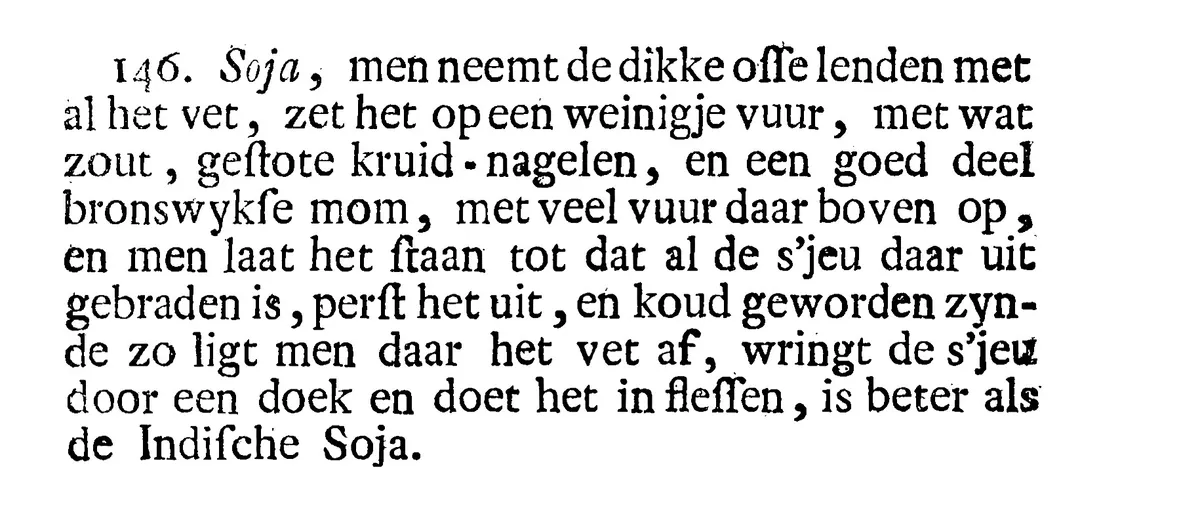
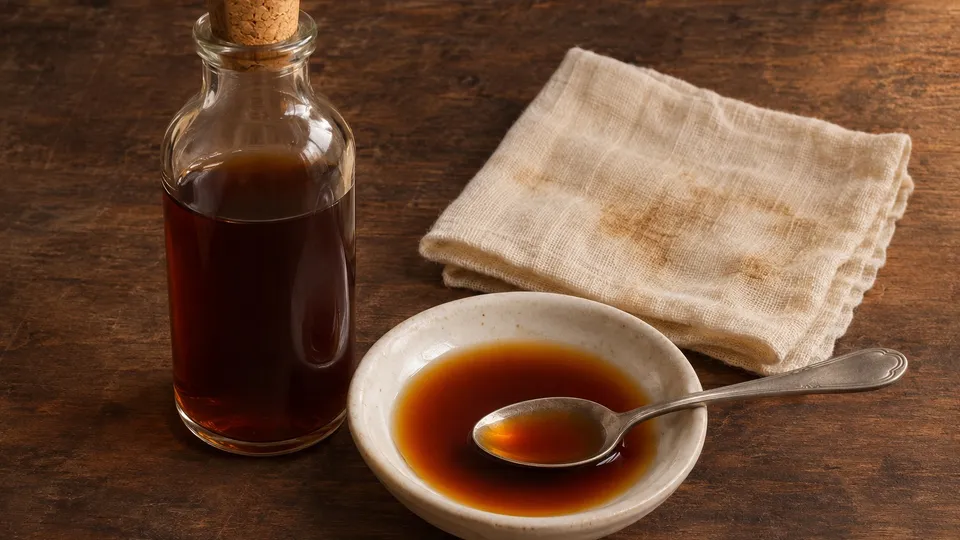
It roasted the juice out of beef. Recipe 146 in an Amsterdam cookbook of 1769 takes a thick loin of beef with all its fat, salt, ground cloves and a good measure of Brunswick mum, a German malt beer, and cooks it over a little fire below and a big one on top until the juice has run out. The cook presses the meat, lets the liquid go cold, lifts off the fat, wrings the rest through a cloth and bottles it. There is no soybean anywhere in it, yet the book calls it Soja and ends with a boast: it “is beter als de Indische Soja,” is better than the Indian soy.
Recipe 146
The book is Volmaakte grond-beginzelen der keuken-kunde, “perfect first principles of the art of cookery,” printed by the bookseller Steven van Esveldt in the Kalverstraat. Its title page names no author, only “D’Autheur van de Hollandsche Keuken-Meid,” the writer of an earlier household book that this one presents in short form and considerably enlarges. It promises cooks and kitchen maids that they can perfect themselves in the art “zonder eenige andere Boeken of onderrechtingen daar toe nodig te hebben,” without needing any other books or lessons.
Soja sits on page 67, between a dish of quinces and a way of keeping bunches of grapes through the winter. In our translation, the whole recipe reads:
Soja: take the thick loins of an ox with all the fat, set it on a little fire with some salt, pounded cloves and a good deal of Brunswick mum, with much fire on top, and let it stand until all the juice has been roasted out of it; press it out, and once it has gone cold, lift the fat off it, wring the juice through a cloth and put it in bottles. It is better than the Indian soy.
The word for juice is s’jeu, the French jus in a Dutch spelling. Everything a modern cook would want to know is missing: how much beef, how much beer, how long, how far the liquid should cook down, how long the bottles keep. What the recipe does make plain is the order of the work. The fat goes in with the meat and comes off only once the liquid is cold, and the cloth takes out whatever the cook doesn’t want in the bottle. The thing being made is the strained liquid. The beef is left over.
What was Indian soy?
Indisch meant of the Indies, and in an Amsterdam book that most likely meant the Dutch East India Company’s Asia, governed from Batavia on Java. Soy reached the Republic as Company cargo. A general letter from the Governor-General and Council at Batavia to the Company’s directors, dated 31 January 1739 and printed in 2004 in J. van Goor’s edition of the Generale missiven, lists the ships sailing home chamber by chamber, with what they carried. Under the ship Enkhuysen the clerk noted “zoya voor Hoorn en Enkhuysen,” and under the Schellag “4 kelders met zoya voor Delft en Rotterdam.” The editor’s summary of the whole return cargo, a long sentence of indigo, nutmeg, cloves, 757,975 pounds of tea and over two million pounds of Java coffee, includes “36 kelder Japans soja.”
Soy was a small line in a very large trade, shipped home thirty years before this cookbook was printed. The Company’s word for it was Japanese. The cookbook’s word was Indian, which could cover anything from that side of the world. The letter doesn’t show where the sauce went after the ships unloaded, what it cost in a shop, or whether the author of recipe 146 had ever tasted it.
The same cookbook also shows what Dutch cooks did with the Company’s spices; three of its recipes go with the story of the spice fires outside Batavia. Cloves are the one Asian ingredient in the Soja. The salt and the beer came from much nearer, and so did the habit of keeping food in salt, in a country that had salted herring and packed it in barrels for centuries, as What Happened to the Dutch Herring Fishery in the War of 1665? tells.
Brunswick mum
Mum was a beer from Braunschweig, in northern Germany. The city’s own history of its Hanseatic years calls Braunschweiger Mumme a prized product, “ein Bier mit hohem Malzgehalt,” a beer with a high malt content, whose sale is first recorded in 1390.
The same beer turns up in the same year in Manchester. Elizabeth Raffald, who had lately been housekeeper to Lady Elizabeth Warburton and now sold confectionery near the Manchester Exchange, published The Experienced English House-keeper in 1769, “Wrote purely from PRACTICE,” as its title page says. Its chapter of catchups includes this one:
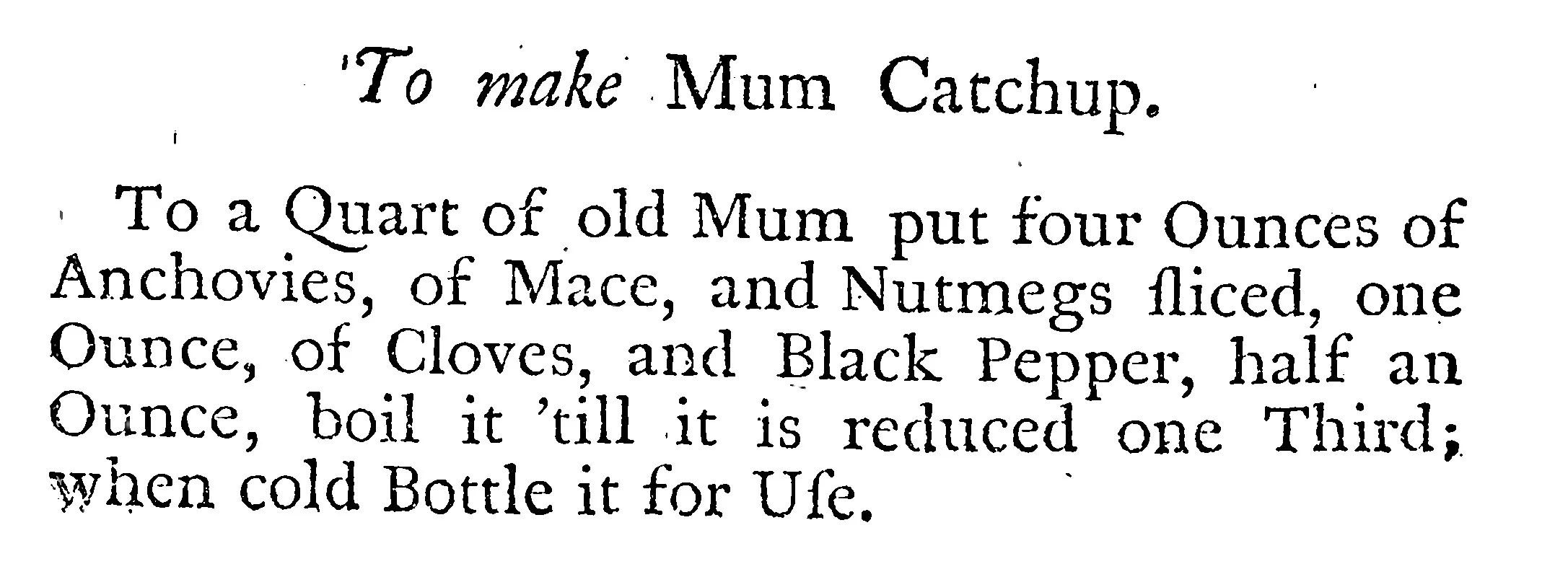 Raffald’s Mum Catchup, from The Experienced English House-keeper (Manchester, 1769), p. 317.
Old mum, anchovies and spice, boiled down by a third and bottled: an English kitchen putting the same beer into a pouring sauce, with fish where the Dutch book has beef. The recipe after it is a catchup of “the oldest strong Beer you can get” with red wine, anchovies and spice, and Raffald closes it with “it will carry to the East-Indies.” The Amsterdam author measured a beer-and-meat bottle against a sauce that came from Asia; Raffald said hers would survive the voyage there.
Raffald’s catchups
Raffald’s mushroom catchup, on the next page, makes the closer comparison, because it is also a liquid drawn out of a solid food and bottled. She crushes full-grown mushroom caps by hand, salts them and leaves them overnight, then sets them in stew pans in a quick oven for twelve hours and strains them through a hair sieve. To every gallon of that liquor go an ounce each of cloves, Jamaica pepper, black pepper and ginger and half a pound of salt, and then the cook is told to “set it on a slow Fire, and let it boil ’till half the Liquor is wasted away.” It cools in a clean pot and is bottled.
That one instruction is what the Dutch recipe lacks. Raffald gives a ratio and an endpoint, half the volume gone; recipe 146 stops at pressing, skimming and straining. Neither book has the cook ferment anything, and Raffald never claims her catchup is soy. Nothing shows that she or the Amsterdam author knew the other’s book. Read together, they show two kitchens in the same year making the same kind of thing, a dark, salty liquid kept in a bottle, from what they had: beef and beer in one, mushrooms and spice in the other.
Raffald also shows where the spoonful went. Her hashes and made dishes keep asking for it: a spoonful of mushroom catchup and one of browning in the gravy for hashed mutton, more in hashed venison, in stewed partridges and in white fricasseed sweetbreads. Her browning, sugar and butter cooked dark and then simmered with red wine and spice, has three spoonfuls of mushroom catchup in it too.
Better than what?
Both books make the same kind of promise. The Dutch author says the beef Soja beats the imported one. Raffald says in her preface that she leaves out cullis, the rich meat gravy base of grand kitchens, because “Lemon Pickle and Browning answers both for Beauty and Taste, (at a trifling Expence) better than Cullis, which is extravagant.” Hers is an argument about money and trouble in a gentleman’s kitchen. The Dutch one offers no reason, and a fat loin of beef with a good deal of German beer is hardly a saving. The comparison is the author’s alone.
The claim had grown with the book. The earlier Volmaakte Hollandsche keuken-meid, which Van Esveldt was selling in a third printing by 1752, gives the same Soja at greater length in the transcription of that printing published by the Dutch text library DBNL. There the loin may be ox or cow, the beer one or two mingelen of good Brunswick mum or else the best Bremen beer, and the meat cooks until it falls apart before it is pressed, skimmed, strained and bottled to keep. Its heading promises only a Soja as good as the one that comes from the East Indies. By 1769, as good had become better. The same 1752 printing stirs a little soja into the sauce for a stewed cut of lamb and into the gravy for grey peas, without saying which bottle it means. The historian Anne Gerritsen’s 2015 article on the early history of soy sauce in the Netherlands carries a close version of that heading as its title.
The recipes
No meal brought these three together. The first comes from the Amsterdam book itself, and the other two from Raffald’s, printed the same year, to show the English bottle and the English way of using it.
- Beef and Mum Soja (1769): recipe 146, with beef in its fat, dark malt beer, salt and cloves cooked covered in the oven, then pressed, chilled, skimmed and strained.
- Mushroom Catchup (1769): Raffald’s mushrooms, salted overnight and baked until they give up their juice, then spiced and boiled down by half.
- Hashed Mutton with Mushroom Catchup (1769): Raffald’s way of serving a roast a second time, sliced into gravy with a spoonful of catchup and one of browning.
Both sauces are made here in small batches, to keep in the refrigerator for a few days.
Cooking it
Stir a spoonful of the Mushroom Catchup (1769) into the gravy of Raffald’s hashed mutton, one of the dishes her book made it for, and set a little of the Amsterdam beef and mum soja beside it, so the two kitchens of 1769 share one table.
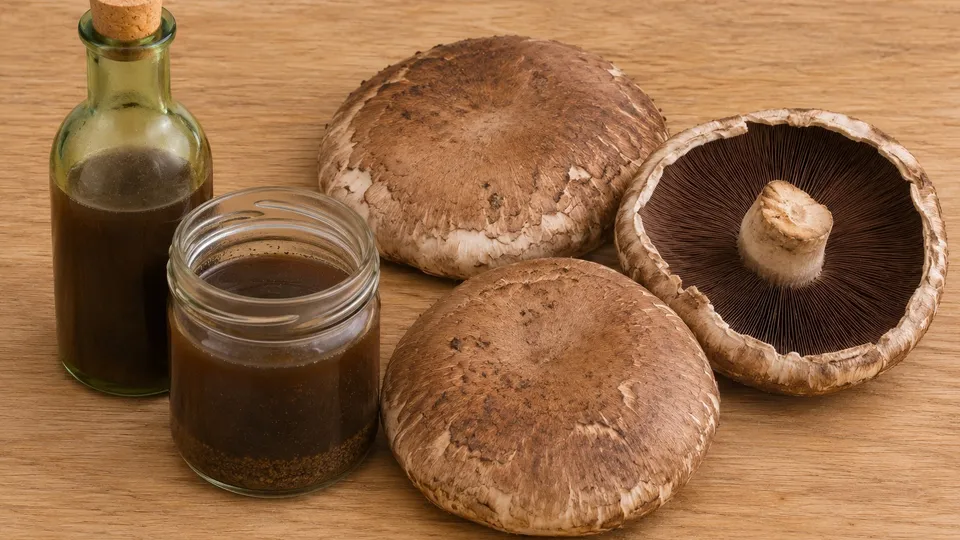 Cook it todayMushroom Catchup (1769)
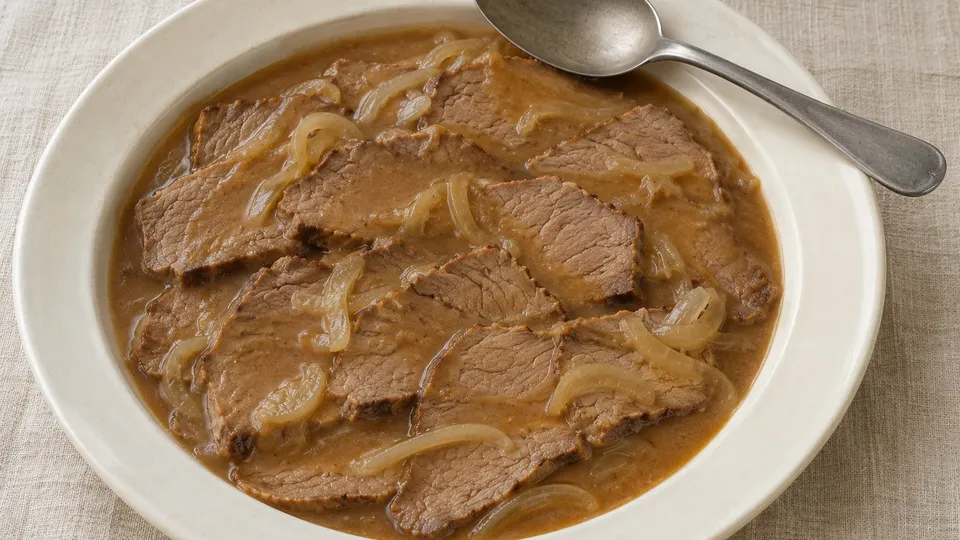 Cook it todayHashed Mutton with Mushroom Catchup (1769)
 Cook it todayBeef and Mum Soja (1769)
Sources
- Anonymous (“D’Autheur van de Hollandsche Keuken-Meid”), Volmaakte grond-beginzelen der keuken-kunde (Amsterdam: Steven van Esveldt, 1769), title page and p. 67, no. 146. Internet Archive (opens in a new tab).
- Elizabeth Raffald, The Experienced English House-keeper (Manchester: J. Harrop, for the author, 1769), title page, preface p. iii, and pp. 2–3, 62–63, 317–318. Internet Archive (opens in a new tab).
- Anonymous, De volmaakte Hollandsche keuken-meid, third printing (Amsterdam: Steven van Esveldt, 1752), no. 14, Soja, pp. 65–66, and pp. 81–82, 95–96, in the DBNL transcription. DBNL (opens in a new tab).
- J. van Goor, ed., Generale missiven van Gouverneurs-Generaal en Raden aan Heren XVII der Verenigde Oostindische Compagnie, vol. 10, 1737–1743 (The Hague: Instituut voor Nederlandse Geschiedenis, 2004), pp. 252–253, letter of 31 January 1739. Huygens Institute (opens in a new tab).
- Stadt Braunschweig, “Hansestadt: Braunschweigs Hansegeschichte.” braunschweig.de (opens in a new tab).
- Anne Gerritsen, “‘Soja, zo als die uit Oost-Indien komt’: De vroege geschiedenis van sojasaus in Nederland,” Aziatische Kunst 45, no. 3 (2015): 24–33. Brill (opens in a new tab).