Beef and Mum Soja (1769)
Reader ratingsA 1769 Amsterdam cookbook’s Soja: beef in its fat with salt, cloves and dark malt beer, cooked until the juice runs, then pressed, skimmed and strained.
- Recipe makes
- About 250 ml seasoning, 16 tablespoons
- Prep
- Cook
- Total
About 1½ hours in the oven and 10 minutes to press and strain. The total adds at least 4 hours in the refrigerator for the fat to set; it can stay overnight. The beef is left over for another meal.
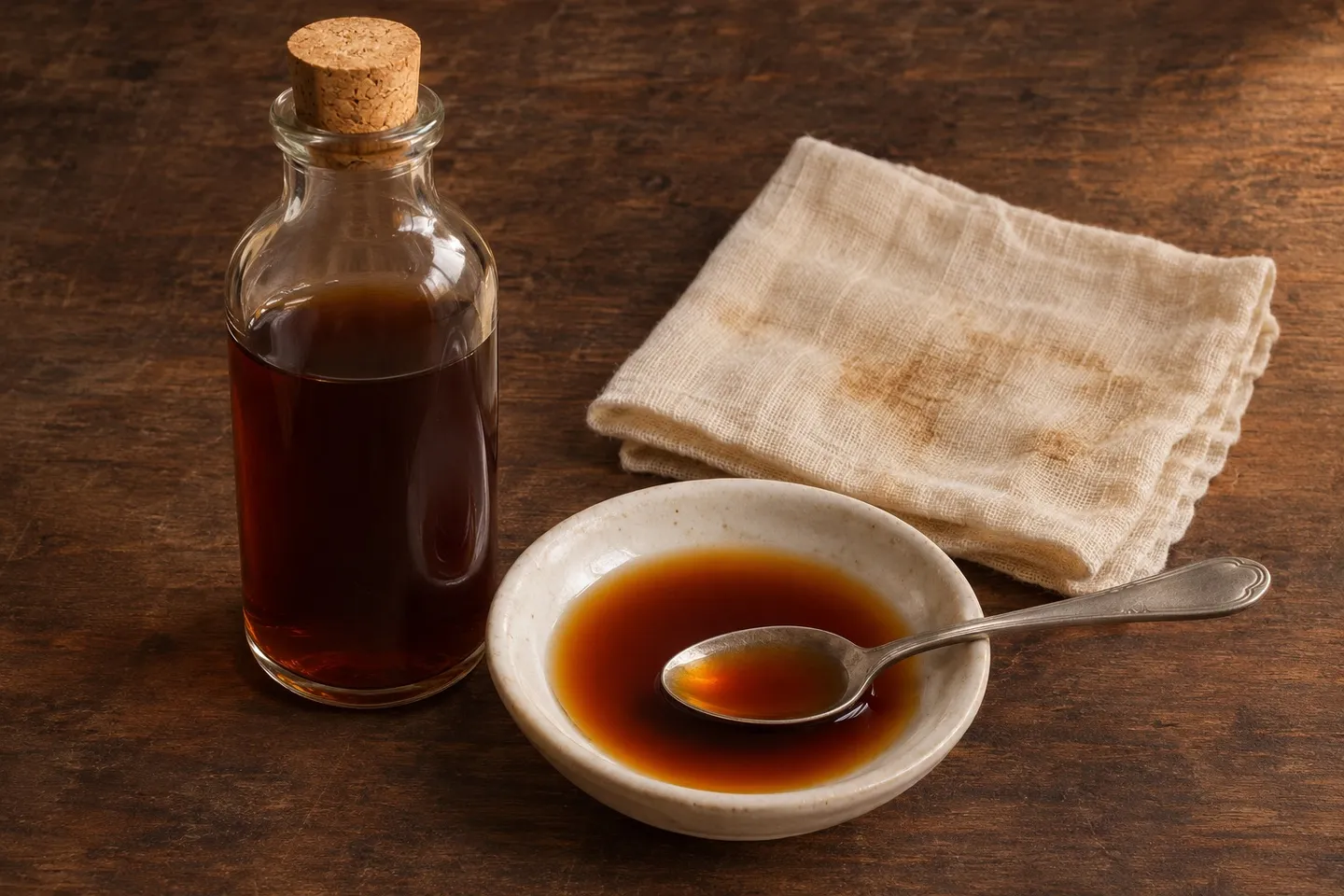
A small bottle and dish of dark brown beef-and-beer seasoning.
The story behind the recipe
This Soja is the juice of a roast. Recipe 146 of Volmaakte grond-beginzelen der keuken-kunde, printed in Amsterdam in 1769, draws all the s’jeu out of a fat loin of beef cooked with salt, cloves and Brunswick mum, a German malt beer, and bottles it once the fat is off. The beef itself is a by-product. The recipe closes by claiming to beat the imported sauce whose name it borrows.
Where did the name come from?
The real thing came from Asia in the ships of the Dutch East India Company, which listed it as Japanese soy in the cargo it sent home. The cookbook calls it Indische, of the Indies, and never says how the imported sauce was made. Its own version has no beans and no fermenting, only meat, beer, salt and one Asian spice, the cloves. An older Amsterdam household book, De volmaakte Hollandsche keuken-meid, had printed the same beef Soja by 1752 with a humbler promise, as good as the sauce from the East Indies. How Did a 1769 Dutch Cookbook Make Soy Sauce Without Soy? follows the claim from that book to this one and sets the bottle beside what an English cook made the same year.
Read more about this recipe
Making it today
The book gives no amounts, no times and no use for the finished bottle, so every quantity here is ours. Its “little fire below and much fire on top” becomes a covered casserole in a moderate oven, which heats from all sides. Brunswick mum is hard to find outside Braunschweig, so use a dark, malty beer such as a doppelbock or a dark lager. The book’s bottles come with no keeping method, so the finished liquid goes in the refrigerator for a few days at most. The beef will be well done, and makes a second meal. Raffald’s Mushroom Catchup (1769) bottles a liquid drawn from mushrooms in the same way.
146. Soja, men neemt de dikke osse lenden met al het vet, zet het op een weinigje vuur, met wat zout, gestote kruid-nagelen, en een goed deel bronswykse mom, met veel vuur daar boven op, en men laat het staan tot dat al de s’jeu daar uit gebraden is, perst het uit, en koud geworden zynde zo ligt men daar het vet af, wringt de s’jeu door een doek en doet het in flessen, is beter als de Indische Soja.
Word for word, in our translation: “146. Soja: one takes the thick ox loins with all the fat, sets it on a little bit of fire, with some salt, pounded cloves and a good part of Brunswick mum, with much fire up on top of it, and one lets it stand until all the juice is roasted out of it, presses it out, and having become cold, one lifts the fat off it, wrings the juice through a cloth and puts it in bottles; is better than the Indian Soja.”
Recipe makes: About 250 ml seasoning, 16 tablespoons
Ingredients
For about 250 ml seasoning, 16 tablespoons. Quantities are shown as written.
Quantities as written here, for about 250 ml seasoning, 16 tablespoons.
- Beef sirloin or strip loin in one thick piece, with its fat500 g
- Fine salt1/2 tsp
- Ground cloves1/8 tsp
- Dark malt beer200 ml
Measurement notes
Ingredients as written here
- 500 g beef sirloin or strip loin in one thick piece, with its fat
- ½ tsp fine salt
- ⅛ tsp ground cloves
- 200 ml dark malt beer
Equipment
 Small heavy casserole with a lid, about 1.5 liters, that holds the beef snugly
 Instant-read thermometer
 Sieve and a ladle for pressing
 Shallow container
 Thin clean cloth or a double layer of cheesecloth
 Small saucepan
 Clean glass jar or bottle
Instructions
Heat the oven to 325°F (160°C).
Put the beef in the casserole with its fat side up. Sprinkle the salt and cloves over it and pour the dark malt beer around it.
Cover the casserole and cook for 1½ hours. Check after an hour: there should still be liquid covering the bottom of the pan. If it is almost dry, turn the oven down to 300°F (150°C) for the rest of the time.
The beef is done when the thickest part reads well above 145°F (63°C); after this long it will be cooked through.
Set the sieve over the casserole, lift the beef into it and press it hard with the back of the ladle so the juice runs back into the pan. Move the beef to a plate, let it cool and refrigerate it for another meal.
Pour the liquid into the shallow container. Let it cool for no more than 30 minutes, then cover and refrigerate it for at least 4 hours, until the fat has set in a layer on top.
Lift off the fat with a spoon and discard it. The liquid underneath may have set to a soft jelly.
Warm the liquid in the saucepan over low heat just until it runs. Line the sieve with the damp cloth, pour the liquid through, then gather the cloth and wring it out over the bowl.
Pour the strained Soja into the jar, cover and refrigerate. Bring the amount you need to a boil before stirring it, a little at a time, into a gravy, soup or stew.
Nutrition
10calories per serving
- Recipe makes
- About 250 ml seasoning, 16 tablespoons
- Servings
- 16
Estimated per tablespoon (16) from USDA FoodData Central values for dark beer and beef pan juices with the fat removed, allowing for some alcohol lost in cooking.
Recipe notes
When adjusting quantities
The book gives no amounts; these are ours. A larger piece of beef needs a larger casserole and about the same time, and gives more liquid.
Notes
Quantities mentioned in these notes don’t change when you adjust the servings.
Our changes from the book: all the amounts; sirloin or strip loin for its “dikke osse lenden”; a dark malt beer for Brunswick mum; a covered casserole in a 325°F (160°C) oven for its little fire below and much fire above; and the refrigerator for its cooling. The book bottles the strained liquid with no time limit; we treat it as a cooked leftover. Following USDA guidance on leftovers, refrigerate it within 2 hours of cooking, keep it at 40°F (4°C) or below and use it within 3 to 4 days, or freeze it; bring it to a rolling boil before use. Long covered cooking doesn’t drive off all the beer’s alcohol. For a version without alcohol, use the same amount of a dark malt beer labeled 0.0%. Contains gluten (beer).
Scaling changes the ingredients only; pan sizes and cooking times need their own judgment. To adapt this recipe further, try the recipe tool at TuneMyRecipe (opens in a new tab), our sister site.
Sources and attribution
After Volmaakte grond-beginzelen der keuken-kunde (Amsterdam, 1769), Soja
See the original pages (scan at Internet Archive) (opens in a new tab)
Recipe details
- Course
- Side dish
- Dish family
- Meat & Poultry
- Region
- Dutch
- Era
- 18th century
- Source decade
- 1760s
- Main ingredient
- Beef
- Difficulty
- Easy
- Occasion
- Everyday meal