Hashed Mutton with Mushroom Catchup (1769)
Reader ratingsElizabeth Raffald’s 1769 hash: sliced roast mutton or lamb warmed in a gravy of broth, onion, mushroom catchup and browning, thickened with butter and flour.
- Recipe makes
- 4 servings
- Prep
- Cook
- Total
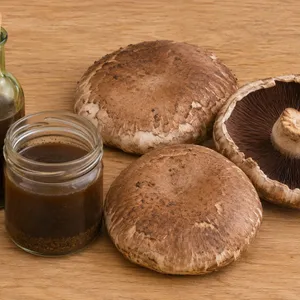
Made from meat that is already roasted. The mushroom catchup takes a night and a day to make, so have it ready in the refrigerator, or use a bottled mushroom ketchup.
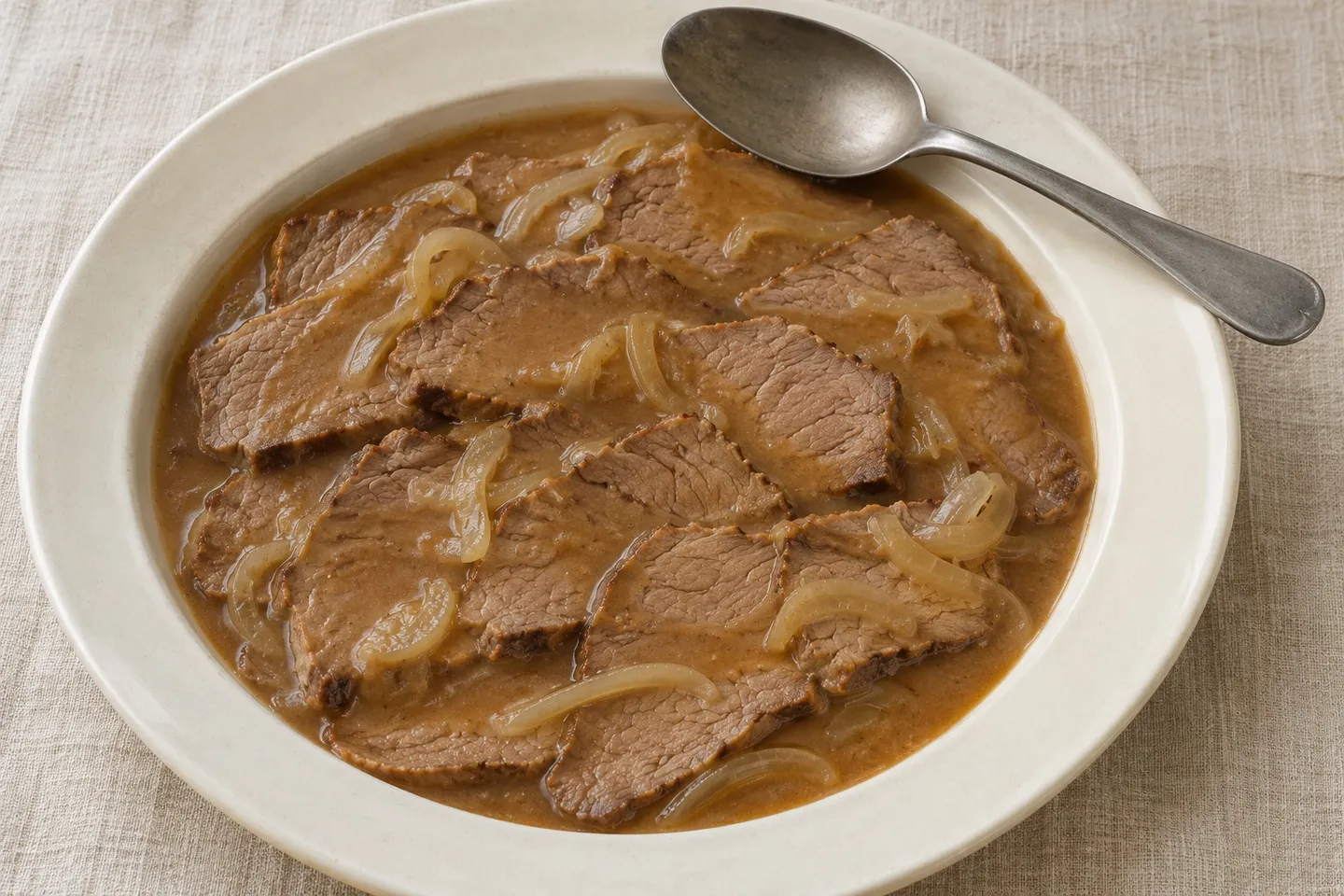
Slices of hashed mutton in brown onion gravy in a deep dish.
The story behind the recipe
A hash, in Raffald’s kitchen, was a way of sending a joint of meat back to the table in gravy. Her hashed mutton, on page 63 of The Experienced English House-keeper (Manchester, 1769), is sliced meat brought “thoroughly hot” in an onion gravy and sent up in a soup dish.
Why two spoonfuls from bottles?
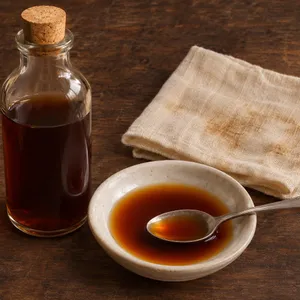
Because Raffald built her gravies that way. Her preface explains that she gives no recipe for cullis, the meat essence of richer kitchens, since she had found her lemon pickle and her browning did the work for less. The browning, near the front of the book, is sugar and butter cooked dark in an iron pan and simmered with red wine, allspice, cloves, shallots, mace, lemon rind and more mushroom catchup, then bottled. The hash takes a spoonful of that and a spoonful of catchup. On the page before, her broiled mutton steaks get the same treatment: a shallot sliced into a spoonful of water and “a Spoonful of Mushroom Catchup” poured over them in the hot dish.
Across the North Sea that year, an Amsterdam cookbook bottled the juice of beef and beer and called it soy. To see how that bottle measured up against Raffald’s, read How Did a 1769 Dutch Cookbook Make Soy Sauce Without Soy?
Read more about this recipe
Making it today
Raffald doesn’t say the mutton is already cooked. Her hash of beef, just before, uses the gravy that ran from the roast, so we read the mutton as a cold roast too; lamb can stand in where mutton is hard to find. In place of her bottled browning, we cook a little sugar dark in butter in the pan and pour the stock straight onto it, leaving out her wine and spice. The onion simmers in the gravy until soft before the meat goes in. Make the catchup a day ahead from Mushroom Catchup (1769), from the same book.
Cut your Mutton in Slices, put a Pint of Gravy or Broth into a Tossing Pan, with one Spoonful of Mushroom Catchup, and one of Browning, slice in an Onion, a little Pepper and Salt, put it over the Fire, and thicken it with Flour and Butter; when it boils put in your Mutton, keep shaking it ‘till it is thoroughly hot, put it in a Soup Dish and serve it up.
Recipe makes: 4 servings
Ingredients
For 4 servings. Quantities are shown as written.
Quantities as written here, for 4 servings.
- Cold roast mutton or lamb400 g
- Sugar, for the browning1 tsp
- Butter, for the browning1 tsp
- Lamb or beef stock500 ml
- Mushroom catchup1 tbsp
- Small onion, thinly sliced1
- Salt1/4 tsp
- Ground black pepper1/4 tsp
- Soft butter, for thickening20 g
- Plain flour15 g
Measurement notes
Ingredients as written here
- 400 g cold roast mutton or lamb
- 1 tsp sugar, for the browning
- 1 tsp butter, for the browning
- 500 ml lamb or beef stock
- 1 tbsp mushroom catchup
- 1 small onion, thinly sliced
- ¼ tsp salt
- ¼ tsp ground black pepper
- 20 g soft butter, for thickening
- 15 g plain flour
Equipment
 Sharp carving knife
 Wide saucepan or deep frying pan
 Small bowl and fork
 Instant-read thermometer
 Warm deep serving dish
Instructions
Cut the roast mutton into thin slices, about 5 mm thick, trimming off any hard fat and gristle.
Put the sugar for the browning and butter for the browning in the wide pan over medium heat and stir until the sugar melts, froths and turns a deep brown, about 3 minutes. Take care not to let it burn black.
Pour in a splash of the stock at once, standing back as it spits, then stir in the rest of the stock until the browning dissolves.
Add the mushroom catchup, onion, salt and black pepper. Bring to a boil, then simmer for 10 minutes, until the onion is soft.
Mash the soft butter for thickening and the flour together in the small bowl with the fork until smooth. Whisk the paste into the simmering gravy a little at a time and simmer for 3 minutes, stirring, until it is smooth and thick enough to coat a spoon.
Add the sliced mutton, lower the heat and shake the pan and turn the slices until they are heated through and the thickest piece reads 165°F (74°C), about 5 minutes. Don’t let it boil hard, or the meat toughens.
Taste for salt, tip it into the warm deep dish and serve at once.
Nutrition
330calories per serving
- Recipe makes
- 4 servings
- Servings
- 4
Estimated per serving (4) from USDA FoodData Central values for roasted leg of lamb, butter, flour, onion, sugar and beef broth.
Recipe notes
When adjusting quantities
Raffald’s pint of gravy with a spoonful each of catchup and browning. Scale the stock, catchup and browning together; the meat can vary a little.
Notes
Quantities mentioned in these notes don’t change when you adjust the servings.
Raffald gives the pint of gravy and the spoonfuls of catchup and browning; the meat, salt, pepper, thickening and timings are ours. Her browning is a bottled sauce of her own; ours is a quick pan browning of sugar and butter, made without her red wine, spices, shallots and lemon rind. We soften the onion before thickening, where she slices it straight in. Without homemade catchup, use the same amount of bottled mushroom ketchup. Use cooked meat that went into the refrigerator within 2 hours of roasting and within 3 to 4 days, and reheat it to 165°F (74°C), as USDA advises for leftovers. Contains milk and gluten; bottled mushroom ketchup may contain anchovy or other allergens.
Scaling changes the ingredients only; pan sizes and cooking times need their own judgment. To adapt this recipe further, try the recipe tool at TuneMyRecipe (opens in a new tab), our sister site.

Sources and attribution
After Elizabeth Raffald, The Experienced English House-keeper (Manchester, 1769), To hash Mutton
See the original pages (scan at Internet Archive) (opens in a new tab)
Recipe details
- Course
- Main course
- Dish family
- Meat & Poultry
- Region
- British
- Era
- 18th century
- Source decade
- 1760s
- Main ingredient
- Lamb & mutton
- Difficulty
- Easy
- Occasion
- Everyday meal
- Season
- Winter