Mushroom Catchup (1769)
Reader ratingsElizabeth Raffald’s 1769 mushroom catchup: mushrooms crushed and salted overnight, baked until they give up their juice, then spiced and boiled down by half.
- Recipe makes
- About 125 ml catchup, 8 tablespoons
- Prep
- Cook
- Total
The salted mushrooms stand 12 hours in the refrigerator, so start the night before. Then 1 hour in the oven, 20 minutes boiling down and 30 minutes to cool. The total includes the salting and cooling.
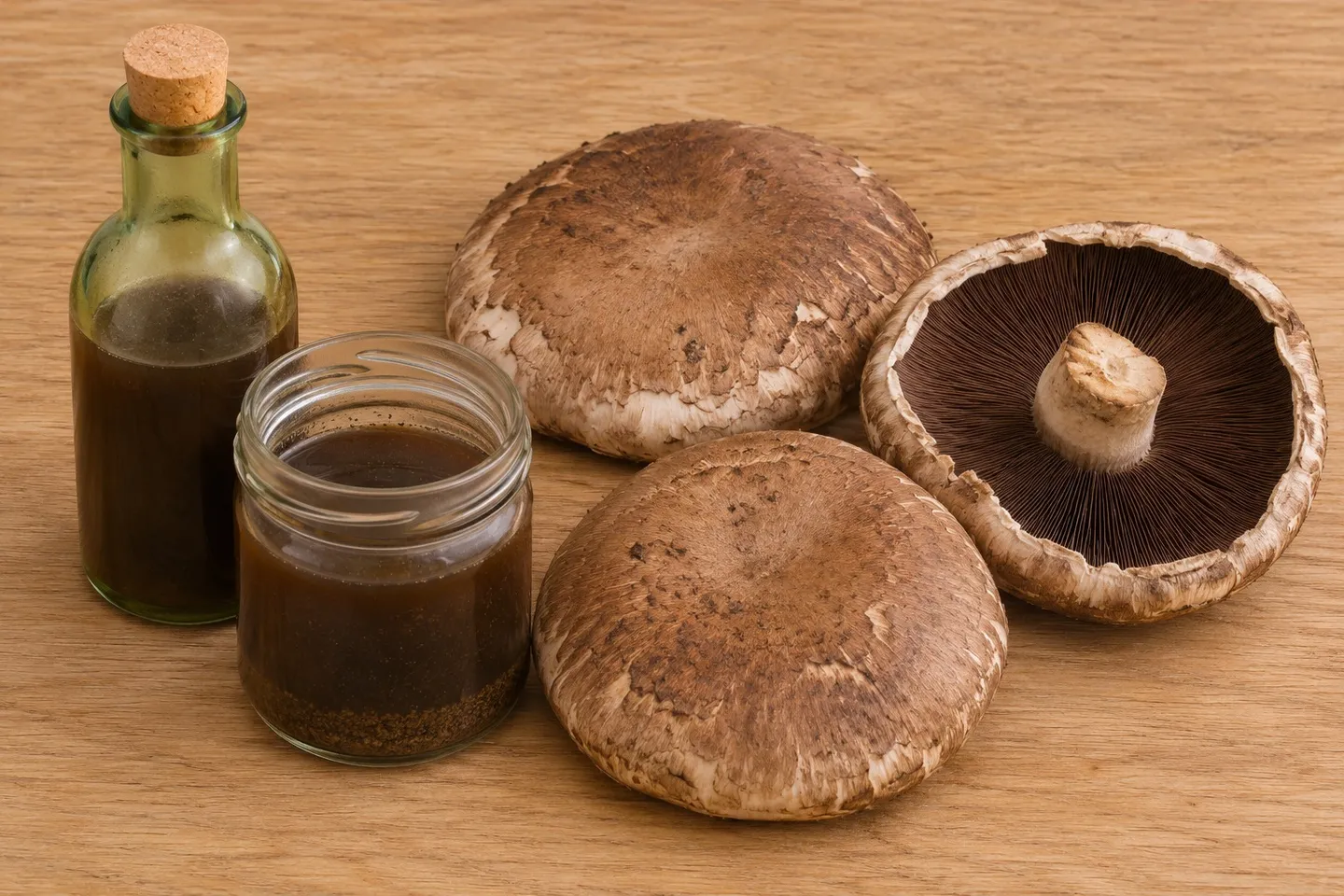
Dark mushroom catchup in a small bottle and jar, with flat mushrooms.
The story behind the recipe
Elizabeth Raffald bottled the dark liquor of salted mushrooms, spiced and boiled down by half. In The Experienced English House-keeper, printed in Manchester in 1769, it sits in a run of catchups made from walnuts, from mum beer and from strong beer and red wine, and her other recipes name it again and again.
What was it for?
Seasoning, a spoonful at a time. Raffald’s hashes, stews and fricassees ask for it by name, and so does her browning, the bottle of burnt sugar, butter and red wine she used in place of cullis, which takes three spoonfuls of it. “Jamaica” in the recipe is Jamaica pepper, which we call allspice.
Her catchups were meant to last. Of her walnut catchup made in ale vinegar she wrote that “the longer it is kept the better it is,” and that she had kept it five years. For the mushroom kind she says only to bottle it when cold, and gives no keeping time.
Raffald never calls her catchup soy. An Amsterdam cookbook of the same year did use that name, for the juice of beef and beer, and How Did a 1769 Dutch Cookbook Make Soy Sauce Without Soy? puts the two bottles side by side.
Read more about this recipe
Making it today
We scaled the amounts down, since Raffald’s peck of mushrooms and handful of salt can’t be weighed. Large flat mushrooms stand in for her full-grown ones, the overnight salting happens in the refrigerator, and an hour in a low oven replaces her twelve hours in a quick one. Her spice, an ounce of each kind to the gallon, is several times stronger than ours, because her catchup had to keep in a bottle and this one lives in the refrigerator. A spoonful goes into the gravy of Hashed Mutton with Mushroom Catchup (1769), and TuneMyRecipe adds mushroom ketchup to its Victorian oxtail soup (opens in a new tab).
Take the full grown Flaps of Mushrooms, crush them with your Hands, throw a Handful of Salt into every Peck of Mushrooms, and let them stand all Night, then put them into Stew Pans, and set them in a quick Oven for twelve Hours, and strain them through a Hair Sieve, to every Gallon of Liquor, put of Cloves, Jamaica, Black Pepper, and Ginger one Ounce each, and half a Pound of common Salt, set it on a slow Fire, and let it boil ‘till half the Liquor is wasted away, then put it in a clean Pot, when cold Bottle it for Use.
Recipe makes: About 125 ml catchup, 8 tablespoons
Ingredients
For about 125 ml catchup, 8 tablespoons. Quantities are shown as written.
Quantities as written here, for about 125 ml catchup, 8 tablespoons.
- Large flat mushrooms500 g
- Fine salt, for the mushrooms2 tsp
- Ground cloves1/4 tsp
- Ground allspice1/4 tsp
- Ground black pepper1/4 tsp
- Ground ginger1/4 tsp
- Fine salt, for the liquor1/2 tsp
Measurement notes
Ingredients as written here
- 500 g large flat mushrooms
- 2 tsp fine salt, for the mushrooms
- ¼ tsp ground cloves
- ¼ tsp ground allspice
- ¼ tsp ground black pepper
- ¼ tsp ground ginger
- ½ tsp fine salt, for the liquor
Equipment
 Glass or ceramic bowl and a plate that fits inside it
 Small casserole with a lid
 Sieve and a measuring jug
 Small saucepan
 Clean glass jar or small bottle
Instructions
Wipe the mushrooms clean with a damp cloth and trim off any dry or gritty stem ends. Break them into pieces and crush them with your hands in the bowl.
Mix in the salt for the mushrooms, press the mushrooms down with the plate, cover the bowl and refrigerate for 12 hours. They will have released some dark liquid.
Heat the oven to 300°F (150°C). Tip the mushrooms and all their liquid into the casserole, cover it and bake for 1 hour, until the mushrooms have collapsed into a heap sitting in dark liquid.
Set the sieve over the jug and pour in the mushrooms. Press them hard with the back of a spoon to get out all the liquor, and discard the pulp. Note how high the liquor comes in the jug.
Pour the liquor into the saucepan and add the cloves, allspice, black pepper, ginger and salt for the liquor. Bring it to a boil over medium heat, then keep it at a gentle boil, uncovered, for about 20 minutes, until half the liquor has boiled away. Pour it back into the jug to check the level.
Pour the catchup into the clean jar and let it cool, then cover and refrigerate it. The spices settle, so shake it before use.
Nutrition
5calories per serving
- Recipe makes
- About 125 ml catchup, 8 tablespoons
- Servings
- 8
Estimated per tablespoon (8) from USDA FoodData Central values for white mushrooms, taking the strained liquid as about a third of their food energy.
Recipe notes
When adjusting quantities
Raffald gives her spice and salt per gallon of liquor. Ours are lighter; keep them in the same proportion to the mushrooms if you make more.
Notes
Quantities mentioned in these notes don’t change when you adjust the servings.
Our changes from Raffald: all the amounts; cultivated flat mushrooms; the refrigerator for her overnight stand; a covered casserole at 300°F (150°C) for 1 hour in place of stew pans in a quick oven for twelve hours; and far less spice and salt in the liquor than her ounce of each spice and half pound of salt to the gallon. We keep her reduction by half and leave the spices in. Her catchup was bottled to keep; ours is a fresh sauce, so keep it covered in the refrigerator at 40°F (4°C) or below and use it within 4 days, or freeze it in small portions.
Scaling changes the ingredients only; pan sizes and cooking times need their own judgment.
Sources and attribution
After Elizabeth Raffald, The Experienced English House-keeper (Manchester, 1769), To make Mushroom Catchup
See the original pages (scan at Internet Archive) (opens in a new tab)
Recipe details
- Course
- Side dish
- Dish family
- Vegetables & Sides
- Region
- British
- Era
- 18th century
- Source decade
- 1760s
- Main ingredient
- VegetablesSpices
- Difficulty
- Easy
- Occasion
- Everyday meal
- Season
- Autumn