Spice burnings outside Batavia, 1777–1783 · Batavia (now Jakarta), Java · c. 1780
Did the Dutch East India Company Really Burn Its Spices?
Yes: a minister at Batavia saw surplus and spoiled spices burned while invited guests took refreshments in a tent. Whether it kept prices up, he could not say.
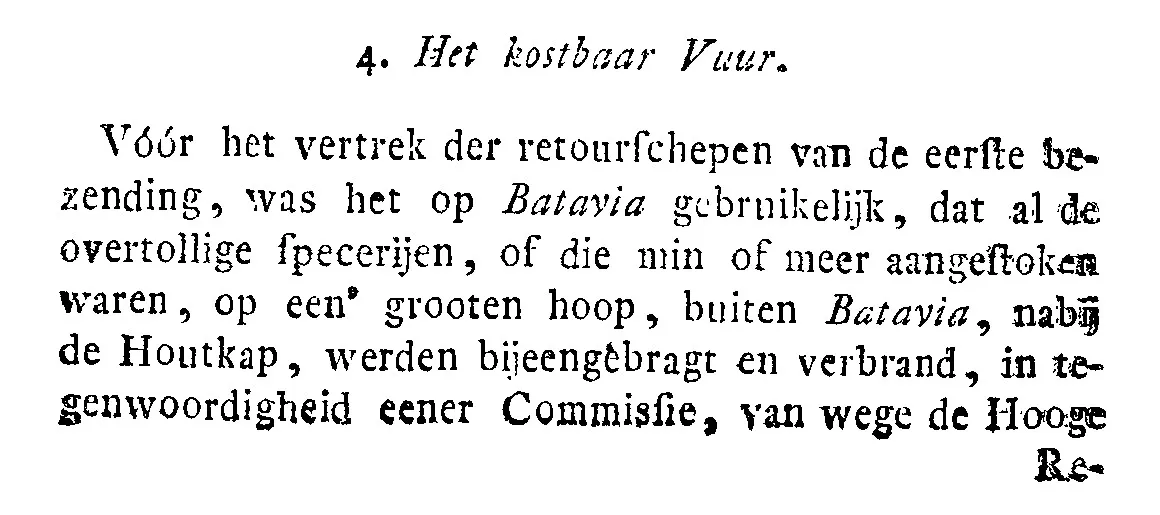
Yes, at least at Batavia, and a man who stood beside the fire said so. Jacob Casper Metzlar, a Dutch Reformed minister in the Company’s capital on Java around 1780, remembered that before the return ships sailed, surplus spices and spoiled ones were heaped up outside the town and burned in front of a government commission and a crowd of invited guests, with refreshments waiting for them in a tent. Why they burned is the harder question. The reason he heard was to keep spice prices from falling too low, and he wrote that he could not tell whether it was true.
The minister at the fire
Metzlar’s account is one paragraph long. It is headed “Het kostbaar Vuur,” the costly fire, and it is the fourth of six “Indische bijzonderheden,” Indies particulars, printed over the initials J.C.M. in the Amsterdam monthly Vaderlandsche letteroefeningen in 1816. The Dutch digital library DBNL identifies the initials as his. The other five particulars are a village elder said to be 112 years old, a rock where birds’ nests were gathered, a hot spring where the party boiled eggs, two stray ships of the West India Company, and the crocodiles of Batavia’s harbor.
He was writing from memory, long after. The Nieuw Nederlandsch biografisch woordenboek of 1918 has him born at Hulst in 1751, appointed a minister in the Indies in 1773, serving first on the island of Onrust and then from 1777 at Batavia, and sailing home in 1783. In the same article he recalls celebrating a commander’s birthday at Padang, on Sumatra, in October 1778, and he records a governor-general’s death in 1800, so the piece was written after that. The fires he attended most likely fall in his Batavia years, though his time on Onrust, an island in the bay, can’t be ruled out. He gives no date for any of them; 1816 is only the year he published.
What he saw
In our translation:
Before the departure of the return ships of the first dispatch, it was the custom at Batavia that all the surplus spices, or those that were more or less spoiled, were brought together on a great heap outside Batavia, near the Houtkap, and burned, in the presence of a commission on behalf of the High Government and of a numerous company invited for the purpose, for whom abundant refreshments then stood ready in a pitched tent, and among whom I found myself more than once.
Four things in that sentence matter. The burning was “gebruikelijk,” customary, so it came round again each season. It was timed to the return ships, the fleet that carried the Company’s Asian cargo home. It was official, with a commission sent by the High Government at Batavia to watch. And it was a social occasion: the company was “talrijk,” numerous, it was invited, and the refreshments were “overvloedige,” abundant.
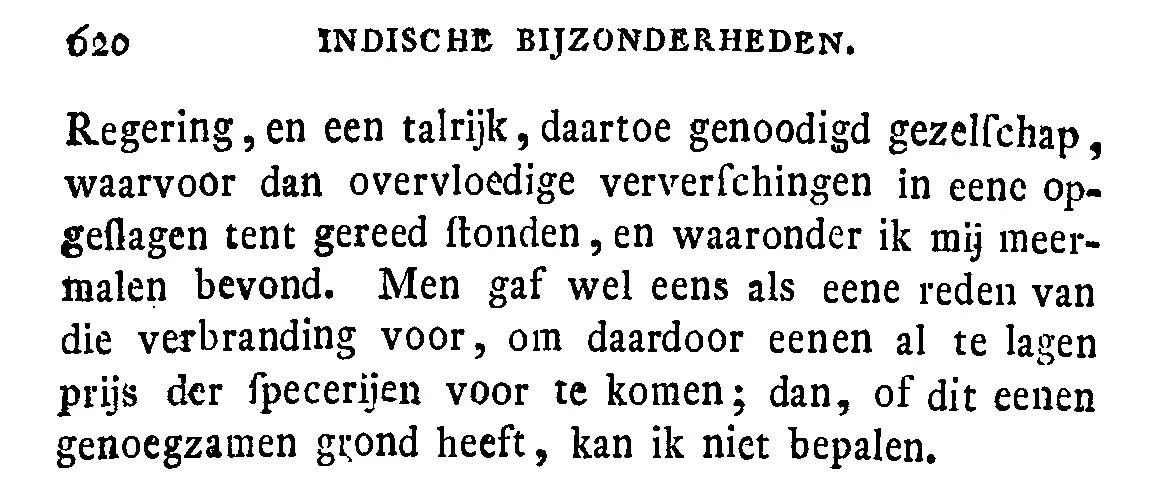 The tent, the guests and the doubt: Metzlar’s “Indische bijzonderheden,” Vaderlandsche letteroefeningen 1816, Mengelwerk, p. 620.
He leaves out nearly everything a historian of trade would want: no spice is named, and there is no weight, value or total, though “costly” is his word for the fire. The people who hauled the sacks to the heap, tended the flames and kept the tent supplied don’t appear in his paragraph at all.
Why burn spice?
His next sentence takes up the question:
“Men gaf wel eens als eene reden van die verbranding voor, om daardoor eenen al te lagen prijs der specerijen voor te komen; dan, of dit eenen genoegzamen grond heeft, kan ik niet bepalen.”
One sometimes gave as a reason for the burning, he wrote, that it prevented too low a price for the spices; “but whether this has sufficient ground, I cannot determine.”
So the price explanation was already being given at Batavia while the fires burned. But the one eyewitness in this account heard it and declined to vouch for it, and his own first sentence offers a second reason. Part of the heap was “aangestoken,” spoiled, and burning goods that have gone bad is plain warehouse housekeeping. Surplus and spoilage could both have been on the same heap, in proportions he doesn’t give.
The price story is easy to believe because of how the Company got its spices. The historian Nancy Um, writing on the Company’s diplomatic gifts of spice oils, calls nutmeg, mace and cloves “the spices that they controlled aggressively.” In the Banda Islands in the early seventeenth century, she writes, the Company decimated the local population to control nutmeg and mace, and on Ambon it tortured and executed competitors and destroyed their crops to keep its hold on cloves. A seller who had taken a monopoly by such means had every reason to keep the market short. A motive still doesn’t show what any one fire was for, and the man in the crowd said he didn’t know.
What was in the tent?
Metzlar calls the food “ververschingen,” refreshments, a word that covers drinks, fruit, sweets or a cold table, and he says no more.
What he does say about eating in the Indies comes two paragraphs earlier, under the birds’ nests. Small birds “veel naar onze zwaluwen gelijkende,” much like our swallows, built them in a deep rock at the estate of Tjitrap above Batavia, and taking them was dangerous work, he wrote, because the ladder had to be fixed to the jutting points of the rock. A heavy trade was carried on in them, and the whitest were the best. “Zij worden in Indië, bij de vermogende lieden, in stokvisch, soep, ragout, enz. gegeten”: they are eaten in the Indies by people of means in stockfish, soup, ragout and so on. People credited them with a strengthening power, “die ik er echter nimmer in gevonden heb,” which I, however, never found in them. Shouldn’t they be seen, he asked, as “een punt van Luxe,” a matter of luxury?
It is the same habit of mind as at the fire. He reports what people said a costly thing was good for, and declines to take their word for it.
Spice in an Amsterdam kitchen
For what the spices became once they reached a Dutch kitchen, there is a cookbook printed in Amsterdam in 1769, four years before Metzlar was appointed to the Indies. Volmaakte grond-beginzelen der keuken-kunde, “perfect first principles of the art of cookery,” came from the bookseller Steven van Esveldt in the Kalverstraat, written “Ten dienste van alle Koks en Keuken-Meisjes,” for the service of all cooks and kitchen maids, by an author the title page names only as the author of the Hollandsche Keuken-Meid.
Its recipes are short paragraphs, and spice runs through many of them. On one page the book makes hylikmaker from flour, brown sugar and honey with cloves, nutmeg and cinnamon, rolled out and shaped as hylikmaker or as what it calls Theerandjes, and cinnamon wafers baked in a small iron. Eighty-five pages on, a brown ragout of sweetbreads is stewed with nutmeg and mace, and the cook may add morels, chestnuts, cockscombs and “vogelnesjes,” the same birds’ nests whose dangerous gathering Metzlar described. Tea tables across the Atlantic had their own small baking in the same years, from spiced yeast buns to thin biscuits, as What Was on the American Tea Table Before the Boston Tea Party? tells.
The book can’t put any of these dishes in the tent. It shows instead what the burned goods were worth to a cook: the distance between a heap of spice on the ground and a ragout fit for people of means.
The recipes
With no menu from the tent, these three come from the 1769 Amsterdam book: a savory dish and two sweet ones.
- Brown Ragout of Sweetbreads (1769): veal sweetbreads with nutmeg, mace, morels and chestnuts in a sauce bound with egg and lime juice. Ragout was one of the dishes Metzlar named for the nests; the nests stay out.
- Hylikmaker, Spiced Honey Biscuits (1769): flour, brown sugar and honey with candied peel, cloves, nutmeg and cinnamon. The book calls this version “beter, en meest in ’t gebruik,” better and most in use.
- Kaneel Wafeltjes, Cinnamon Wafers (1769): a butter dough with cinnamon, baked thin in a wafer iron.
The hylikmaker asks only for flour, dark brown sugar, honey, candied peel and three spices, among them cloves and nutmeg, the two Um shows the Company taking by force on Ambon and Banda, and the whole batch is baked and cooled in under an hour and a half.
 Cook it todayHylikmaker, Spiced Honey Biscuits (1769)
Sources
- J.C.M. (Jacob Casper Metzlar), “Indische bijzonderheden,” Vaderlandsche letteroefeningen 1816, Tweede stuk, Mengelwerk (Amsterdam: G. S. Leeneman van der Kroë and J. W. IJntema, 1816), pp. 617–621. DBNL (opens in a new tab).
- J. Herderscheê, “Metzlar (Jacob Casper),” in P. C. Molhuysen and P. J. Blok, eds., Nieuw Nederlandsch biografisch woordenboek, vol. 4 (1918). DBNL (opens in a new tab).
- Anonymous (“D’Autheur van de Hollandsche Keuken-Meid”), Volmaakte grond-beginzelen der keuken-kunde (Amsterdam: Steven van Esveldt, 1769), pp. 12 and 97. Internet Archive (opens in a new tab).
- Nancy Um, “Nested Containers for Maritime Journeys: Tools of Aromatic Diplomacy around the Late Seventeenth- and Early Eighteenth-Century Indian Ocean,” West 86th 25, no. 2 (2018): 199–223, p. 215.