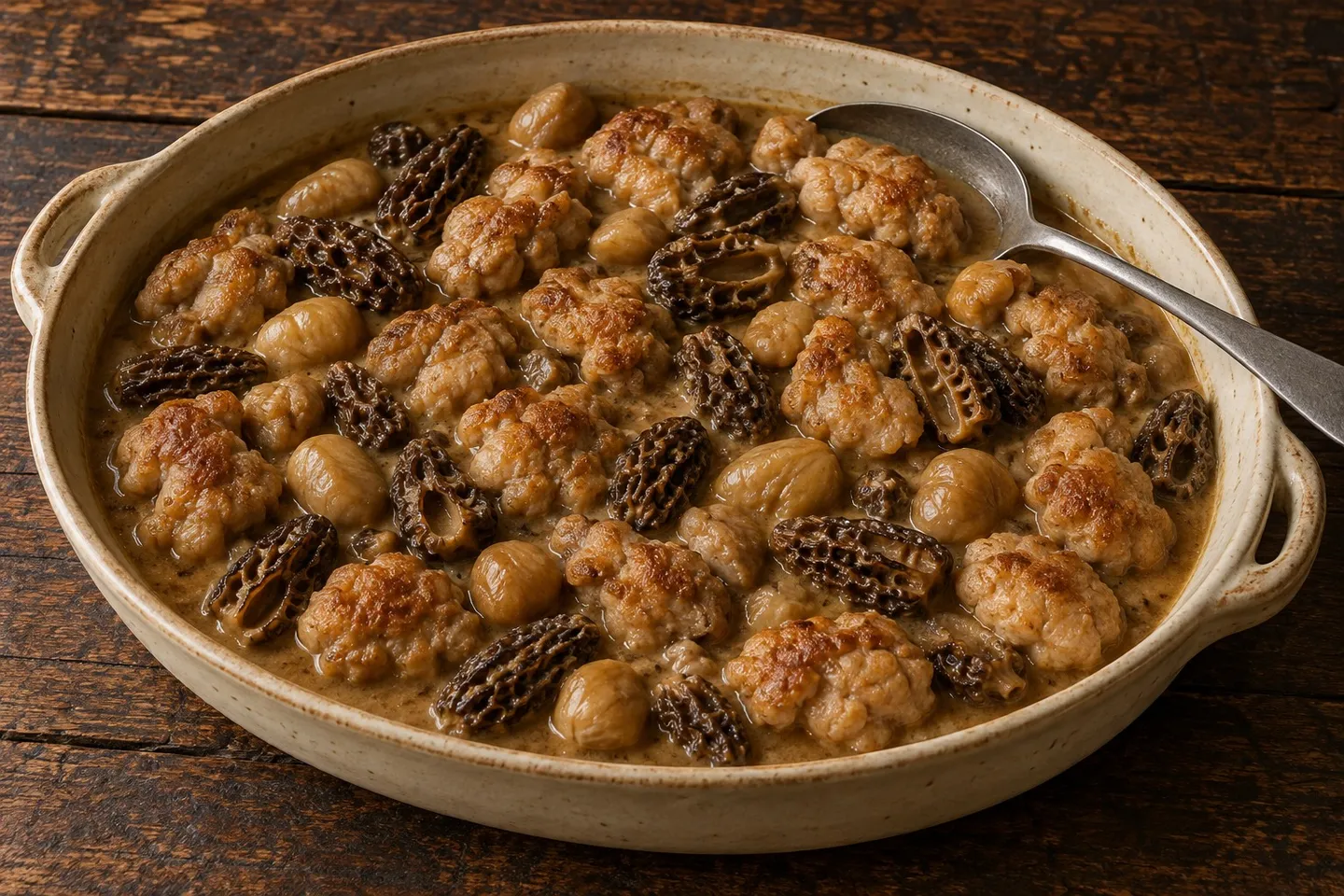
Brown Ragout of Sweetbreads (1769)
Reader ratingsA brown ragout from a 1769 Amsterdam cookbook: veal sweetbreads floured, browned in butter and stewed with nutmeg, mace, morels and chestnuts, bound with egg.
- Recipe makes
- 4 servings
- Prep
- Cook
- Total
The total includes at least 4 hours soaking the sweetbreads and 2 hours pressing them, both in the refrigerator. Both can run overnight, which leaves about 1½ hours of work on the day.
Brown ragout of sweetbreads with morels and chestnuts.
The story behind the recipe
The last extra this ragout allows is “vogelnesjes,” birds’ nests. An Amsterdam cookbook of 1769 lets the cook add them, with morels, chestnuts and cockscombs, to a brown stew of sweetbreads once it has cooked a while. A few years later a Dutch minister arrived at Batavia, and he wrote long afterward that people of means in the Indies ate the nests in stockfish, soup and ragout, so a dish of this kind is where the costly nests of that trade could end up. The ragout is the savory course on our menu for the spice fires, and the nests stay out of it.
What went into a Dutch ragout?
Volmaakte grond-beginzelen der keuken-kunde gives the dish as number 152, in a single sentence, with its sourness from vinegar or verjuice, the juice of unripe fruit, and its spice from nutmeg and mace. “Limoen sap” binds it at the end with the eggs. The book seems to mean lime: the recipe just before this one asks for “limoen sap” and slices of “citroen” in the same dish, so it kept the two fruits apart.
The extras are a matter of choice. The next recipe, a ragout of split pigeons, lists the same cockscombs, nests, morels and chestnuts and adds “of wat gy wilt,” or whatever you like. Neither recipe says how much nest to use or how to clean one. The recipe belongs to an Amsterdam kitchen, with no known tie to Batavia, and it shows what a Dutch cook of the time did with the spices the Company brought home. The fires that destroyed some of those spices are the subject of Did the Dutch East India Company Really Burn Its Spices?
Read more about this recipe
Making it today
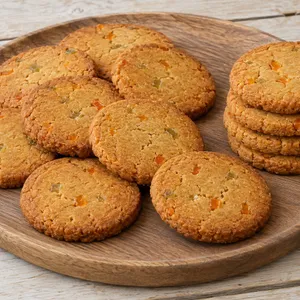
Veal sweetbreads are the heart of it, and a good butcher will order them. The book’s first line runs “balletjes zweserikken en lams-poten” with no commas, so balletjes, little balls, may be forcemeat balls or the sweetbreads themselves in small rounds. We read it the second way, break the sweetbreads into walnut-size pieces and leave out the lamb’s feet. Cockscombs and nests are left out too; dried morels and vacuum-packed chestnuts keep the dish’s two easiest extras. The amounts are ours, since the book gives none. For a sweet course from the same book, bake a tray of Hylikmaker, Spiced Honey Biscuits (1769).
Bruine ragout van zwezerikken; neemt opgekookte balletjes zweserikken en lams-poten; wenteld het in meel, fruit het bruin in de boter, stooft het dan met vleesch-nat, azyn, of, verjuis, notemuscaat, foelie en zout; als dit wat gestooft heeft, zo kan men daar moerilles, kastanjes, hanekammen, en vogelnesjes by doen; eindelyk bind men alles met geklopte eyeren en limoen sap, laat het dan nog eens opkoken.
In our translation: “Brown ragout of sweetbreads: take parboiled little balls [of] sweetbreads and lamb’s feet; roll it in flour, fry it brown in the butter, then stew it with meat broth, vinegar or verjuice, nutmeg, mace and salt; when this has stewed a while, one may add morels, chestnuts, cockscombs and birds’ nests to it; at last one binds everything with beaten eggs and lime juice, and lets it come to the boil once more.”
Recipe makes: 4 servings
Ingredients
For 4 servings. Quantities are shown as written.
Quantities as written here, for 4 servings.
- Veal sweetbreads600 g
- Dried morels15 g
- Hot water, for the morels250 ml
- Plain flour30 g
- Unsalted butter40 g
- Veal or beef stock500 ml
- Verjuice or white wine vinegar2 tbsp
- Freshly grated nutmeg1/4 tsp
- Ground mace1/4 tsp
- Salt1/2 tsp
- Cooked peeled chestnuts150 g
- Eggs2
- Lime juice1 tbsp
Measurement notes
Ingredients as written here
- 600 g veal sweetbreads
- 15 g dried morels
- 250 ml hot water, for the morels
- 30 g plain flour
- 40 g unsalted butter
- 500 ml veal or beef stock
- 2 tbsp verjuice or white wine vinegar
- 1/4 tsp freshly grated nutmeg
- 1/4 tsp ground mace
- 1/2 tsp salt
- 150 g cooked peeled chestnuts
- 2 eggs
- 1 tbsp lime juice
Equipment
 Large bowl
 Medium saucepan
- Bowl of ice water
- Two flat plates or small trays and a weight
- Small bowl and a fine sieve or coffee filter
- Wide, deep frying pan or sauté pan with a lid
 Whisk
 Instant-read thermometer
Instructions
Put the veal sweetbreads in the large bowl, cover them with cold water and refrigerate for at least 4 hours or overnight, changing the water whenever it turns pink.
Drain the sweetbreads, put them in the saucepan and cover them with fresh cold water. Bring it to a boil over medium heat, simmer for 3 minutes, then lift the sweetbreads into the bowl of ice water to cool.
Peel off the thin outer membrane with your fingers and pull away any fat and tough tubes. Lay the sweetbreads on one plate, cover with the second and set a weight on top, then refrigerate for 2 hours to firm them.
Put the dried morels in the small bowl, pour the hot water for the morels over them and leave for 20 minutes. Lift them out, rinse away any grit and cut the large ones in half. Strain the soaking water through the sieve or filter and keep it.
Break or cut the pressed sweetbreads into walnut-size pieces, pat them dry and roll them in the flour.
Melt the butter in the wide pan over medium-high heat. When it foams, brown the sweetbreads in batches, about 3 minutes a side, until golden brown all over. Return them all to the pan.
Pour in the stock, the strained morel water and the verjuice, and add the nutmeg, mace and salt. Bring to a simmer, scraping up the browned bits, cover and stew gently for 10 minutes.
Add the morels and the chestnuts, cover again and simmer for 20 minutes more, until the morels are tender and the sauce has thickened a little.
Beat the eggs with the lime juice in a bowl, then whisk in a little of the hot sauce. Take the pan off the heat and stir the egg mixture in.
Return the pan to low heat and stir gently until the sauce thickens and just comes back to a simmer, and the ragout reads 165°F (74°C) on the thermometer. Taste for salt and serve at once.
Nutrition
410calories per serving
- Recipe makes
- 4 servings
- Servings
- 4
Estimated per serving (4) from USDA FoodData Central values for veal sweetbreads, butter, flour, chestnuts, eggs, stock and dried morels.
Recipe notes
When adjusting quantities
The book gives no amounts. Ours serve 4 with about 150 g of sweetbreads each. Keep dried morels to about 10 g a person or less when you scale up.
Notes
Quantities mentioned in these notes don’t change when you adjust the servings.
Our changes from the book: veal sweetbreads alone, soaked, blanched, peeled and pressed in the modern way (the book only says “opgekookte,” parboiled); no lamb’s feet, cockscombs or birds’ nests; dried morels and cooked chestnuts; lime juice for “limoen sap”; all amounts, times and the final temperature. Verjuice or vinegar is the book’s own choice. Morels must never be eaten raw or undercooked: soak dried ones and cook them for at least 20 minutes, as here, and keep to about 10 g dried a person. Without the morels, add the chestnuts for the last 10 minutes. Chill leftovers within 2 hours and reheat gently to 165°F (74°C); the egg sauce may split if it boils hard. Contains egg, milk and gluten.
Scaling changes the ingredients only; pan sizes and cooking times need their own judgment. To adapt this recipe further, try the recipe tool at TuneMyRecipe (opens in a new tab), our sister site.
Sources and attribution
After Volmaakte grond-beginzelen der keuken-kunde (Amsterdam, 1769), Bruine ragout van zwezerikken
See the original pages (scan at Internet Archive) (opens in a new tab)
Recipe details
- Course
- Main course
- Dish family
- Meat & Poultry
- Region
- Dutch
- Era
- 18th century
- Source decade
- 1760s
- Main ingredient
- Spices
- Difficulty
- Intermediate
- Occasion
- Dinner party