Samuel Johnson’s meagre day with the English Benedictines · Paris
How Did Paris Eat on a Fish Day in 1775?
Five meatless dishes: soup made without meat stock, herrings and eels in sauce, fried fish and lentils, as Samuel Johnson listed them in Paris in 1775.
A fish day in Paris in 1775 meant a day without meat, and it could still mean five dishes. On Tuesday, 31 October 1775, Samuel Johnson ate with the English Benedictine monks in Paris and wrote down what they served: “meagre day; soup meagre, herrings, eels, both with sauce; fryed fish; lentils, tasteless in themselves.” Soup made without meat stock, fish in sauce, fish fried, a dish of pulses: that is the fish day as the English monks of Paris kept it, and a Paris cookbook of the same years shows how much work went into it.
Johnson at the Benedictines
Johnson spent about two months in France in the autumn of 1775. His notes from the trip were mostly lost, but one small paper-book survived, headed “France II,” and James Boswell printed it in his Life of Johnson. It runs from 10 October to 4 November, and Boswell admits the entries are “very short, and evidently written only to assist his own recollection.” They read like a list: a palace, a library, who came to dinner.
The English Benedictines kept a monastery in Paris, St Edmund’s, on the Rue Saint-Jacques, and Johnson went there more than once. On 25 October he “dined with our whole company at the Monastery,” and the prior and the librarian dined with Johnson’s party in turn. On the 31st he spent the day there, ate their meagre dinner, read in their library and “parted very tenderly from the Prior.” He said afterward, as Boswell reports, that he “was very kindly treated by the English Benedictines,” who kept a cell for him in their convent.
The list stops at the lentils, and the lentils are the only dish on it he judged.
What made a day meagre
In Catholic France the Church forbade meat on fixed days: Fridays, the weeks of Lent, and other days of abstinence in its calendar. The French called them jours maigres, lean days, and the English borrowed the word: Johnson’s “meagre day” is the French maigre. The 31st was a Tuesday, the eve of All Saints. Johnson doesn’t say why it was meagre, and a monastery had its own rules besides. A modern history of St Edmund’s describes a house that kept abstinence at its formal meals and ate more meat on what it called “flesh days.”
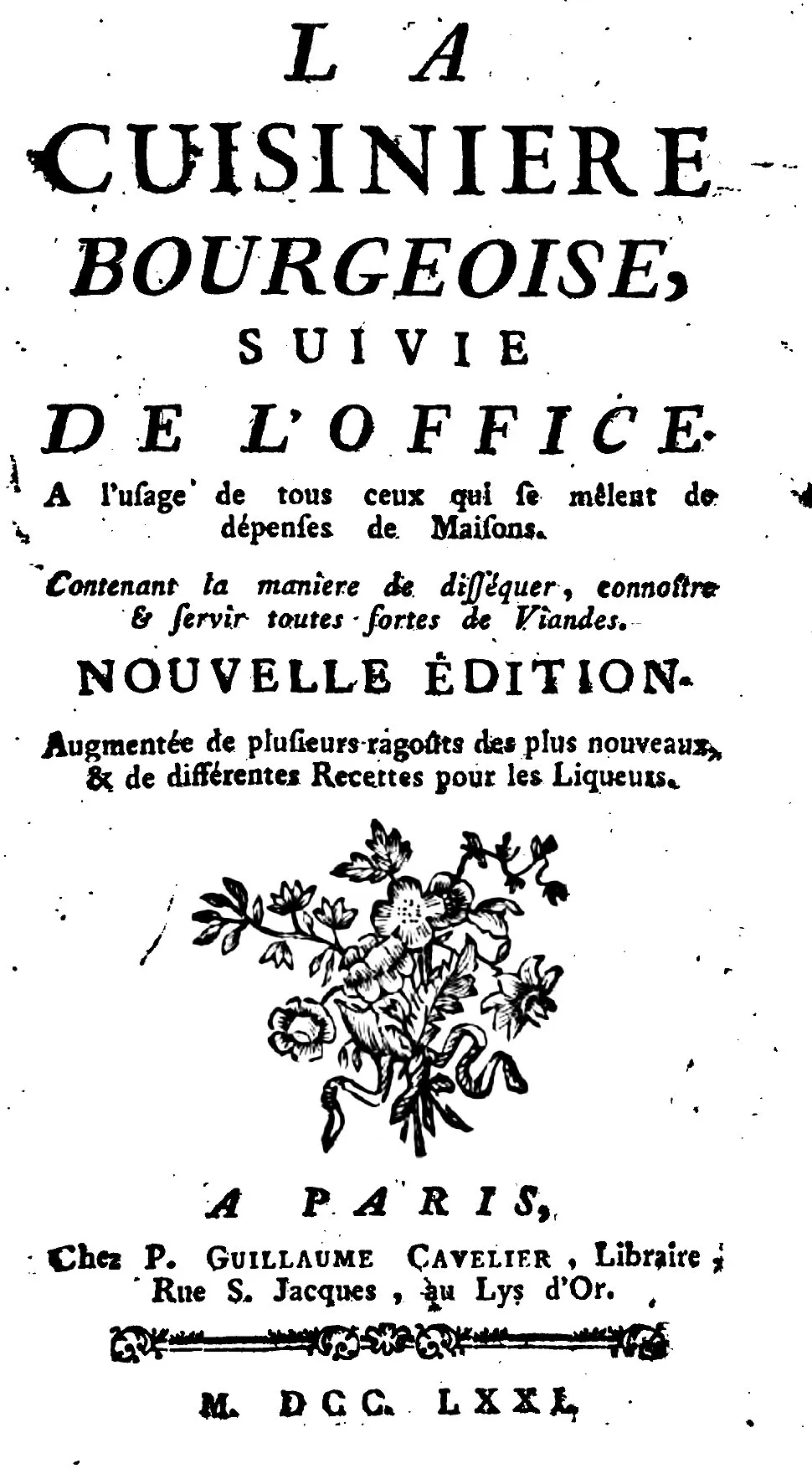
Meagre cooking still ran on butter. Menon’s La Cuisinière bourgeoise, a Paris cookbook for middle-class households, opens its fish chapter in the 1771 edition with the fish “qui nous servent les jours maigres,” that serve us on meagre days, sea fish and river fish alike, and then lists them: turbot, salmon, sole, cod fresh and salted, sardines, mackerel, fresh herring. Its meagre dishes are cooked in butter, bound with egg and finished with cream, and its publisher, Guillaume Cavelier, sold the book from the same street as the monks, the Rue Saint-Jacques.
Soup without meat
Johnson’s first dish, “soup meagre,” had a poor name among English speakers. Three years later John Adams, who had heard the words used in contempt at home, was served one on a French ship and thought it a very respectable thing, as What Was the Soup Meagre John Adams Liked in France? tells.
Menon shows what a Paris cook could put in it. His recipe for meagre soups of several kinds works in two pans. In one, the vegetable that names the soup, turnips, cabbage, celery or small onions, is blanched and cooked in butter. In the other, onion, carrots, parsnips, celery, garlic, herbs and cloves are fried in butter until they are cooked and colored, then boiled in water for half an hour and strained. The cook is told to keep the named vegetable out of this second pan, since the one cooked apart gives enough of its taste. Done right, the broth has “bon goût” and “une belle couleur comme s’il y avoit du jus,” good flavor and a fine color, as if there were meat juices in it. Bread is soaked in the broth, and the vegetables go on top. Made with celery as the vegetable cooked apart, it is our Celery Soup Maigre (1771).
Nothing in Johnson’s note tells us how the monks’ cook made theirs; Menon’s page shows what the soup could be in a Paris kitchen of those years.
The fish
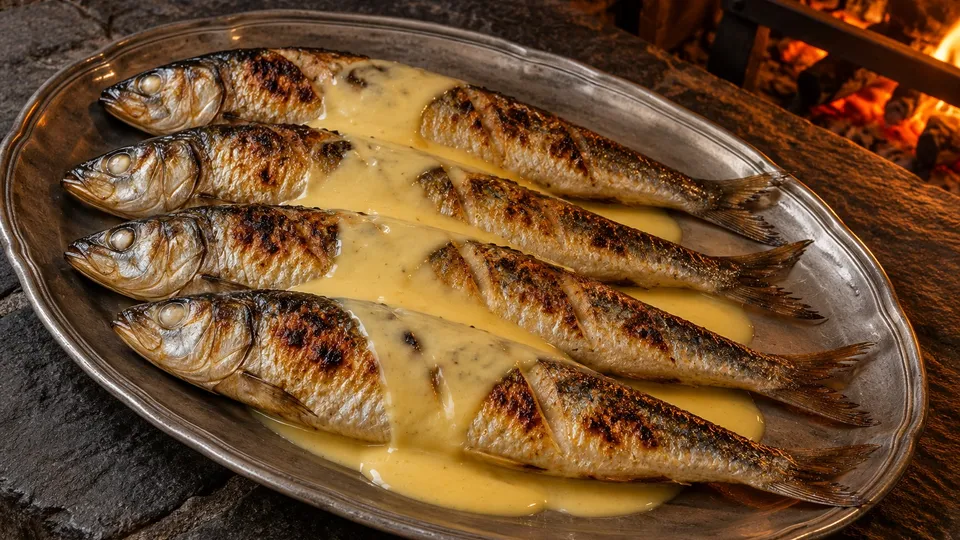
“Herrings, eels, both with sauce.” Johnson does not name the sauces. Menon’s grilled fresh herring, on the same page as his sardines, comes with one: butter, a little flour, a dash of vinegar, a spoonful of fine mustard, salt, pepper and a little water, stirred over the fire until it binds. He sends it to the table as an entrée. Eels he skins and grills in pieces four fingers long, served with a white sauce, capers and anchovies, or stews in a fricassee, one version bound with egg yolks and cream. Smoked herrings are on his table too, soaked in water and milk, dipped in butter and herbs, crumbed and grilled.
Herring had long been fish-day food in Paris. A Paris fish day of about 1393 opened with pease pottage and herring, as What Did a Paris Household Eat in 1393? tells, and nearly four centuries later the herring and the pulses were still there on Johnson’s list. Menon did not leave lentils to their own taste. His cook picks ordinary lentils “larges & d’un beau blond,” large and a fine blond, boils them in water and then fricassees them like white beans: butter and a little flour browned in a pan, chopped onion cooked in that, and the lentils boiled in it a quarter of an hour with parsley, scallion, salt, pepper and a dash of vinegar.
Fast-day cooking was still in print a century later. In 1873 a London publisher brought out German National Cookery for English Kitchens, with a section of “Lent or Fast-day Soups” and a run of water soups after it, which, “if well made, are very much better than their name implies.” Its brown soup is bread fried in butter and boiled in water, poured over beaten eggs: the same move as Menon’s browned roots, coloring in butter first, before the plain water goes in.
The recipes
The herring and the lentils come from Menon’s 1771 edition; the brown soup is from the 1873 London book, a fast-day soup a century on.
- Grilled Herring with Mustard Sauce (1771): fresh herring from the grill under Menon’s butter and mustard sauce.
- Fricasseed Lentils (1771): lentils boiled in water, then simmered with onion in browned butter, parsley, scallion and a dash of vinegar.
- Browned Bread Soup (1873): bread fried brown in butter, boiled in water and poured over eggs, with cheese at the table.
Keep the first Friday of Lent the way the monks kept their Tuesday, with soup first and herring after: the Grilled Herring with Mustard Sauce (1771) takes half an hour, and Menon’s sauce wants nothing a fish-day kitchen wouldn’t have, butter, flour, vinegar and a spoonful of mustard.
 Cook it todayGrilled Herring with Mustard Sauce (1771)
Sources
- James Boswell, Boswell’s Life of Johnson, ed. George Birkbeck Hill, vol. II (Oxford: Clarendon Press, 1887), pp. 389–402, with Johnson’s French journal of 10 October to 4 November 1775.
- Menon (attributed), La Cuisinière bourgeoise, suivie de l’Office, new edition (Paris: P. Guillaume Cavelier, 1771), pp. 17–18, 207–208, 225, 233 and 246–247.
- John Adams, autobiography, part 2, entry for 31 March 1778, written 1802–1807, Adams Family Papers, Massachusetts Historical Society.
- Geoffrey Scott, “Paris 1677–1818,” chapter 2 of the history of Douai Abbey, on St Edmund’s, Rue Saint-Jacques.
- German National Cookery for English Kitchens (London: Chapman and Hall, 1873), pp. 16–18.