
Browned Bread Soup (1873)
Reader ratingsGebrannte Suppe from an 1873 London book of German cooking: floured bread fried brown in butter, boiled in water and poured over eggs, with cheese at table.
- Recipe makes
- About 6 cups, 4 servings
- Prep
- Cook
- Total
The book boils the soup a quarter of an hour after the water goes on. Frying the bread a rich brown takes about 10 minutes, and the eggs are stirred in at the end.
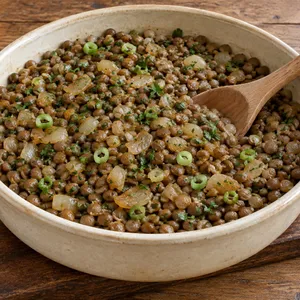
Browned bread soup with egg and chives, grated cheese on the side.
The story behind the recipe
German National Cookery for English Kitchens, published in London in 1873, makes its Gebrannte Suppe, “Burnt or Brown Soup,” from bread, butter, flour, water and eggs, with a few seasonings and herbs. Thin slices of stale bread are floured and fried in butter “a rich brown,” boiled a quarter of an hour in plain water, and poured boiling onto beaten eggs with nutmeg and chives. Grated cheese goes on at the table.
What is a water soup?
A soup with no stock at all. The book’s soup chapter has a section of “Lent or Fast-day Soups,” fish soups and a pea broth, and then sends the reader on: many more fast-day soups “may be found among the following water soups.” It heads the next page “Water Soups” and starts with bread. The book keeps the German names of its dishes, since some of them, its introduction says, cannot be translated, and it warns that few English readers who have not lived abroad can judge foreign cooking fairly. Its title page names no author.
Read more about this recipe
What links it to Johnson’s soup meagre?
It isn’t from Paris, and it is ninety-eight years later. It sits here beside the soup meagre Samuel Johnson ate with the English Benedictines because it does the same thing with less: Menon’s 1771 broth gets its color from roots browned in butter before the water goes in, and this one gets it from bread browned in butter. Johnson’s whole fish-day dinner is told in How Did Paris Eat on a Fish Day in 1775?, and for the French way with browned roots, cook Celery Soup Maigre (1771) beside it.
Making it today
The book asks for stale bread cut thin, and a day or two old is enough. It beats the eggs in the tureen and pours the soup onto them boiling hot. It offers “herb-cheese or Parmesan” at table; Parmesan is our pick.
Cut thin slices of stale roll or loaf-bread. Make a good-sized piece of butter hot in a stew-pan. Dredge the slices of bread with flour, and fry them in the butter a rich brown. Pour over them the requisite quantity of water, and boil a quarter of an hour. Have beaten eggs in the tureen, with salt, pepper, a grate of nutmeg, and minced chives or parsley. Pour in the soup boiling hot. Grated herb-cheese or Parmesan may be added at table.
Recipe makes: About 6 cups, 4 servings
Ingredients
For about 6 cups, 4 servings. Quantities are shown as written.
Quantities as written here, for about 6 cups, 4 servings.
- Thin slices stale white bread, crusts on6
- All-purpose flour3 tbsp
- Butter5 tbsp
- Boiling water6 cups
- Large eggs2
- Salt1 tsp
- Ground black pepper1/4 tsp
- Grated nutmeg1/8 tsp
- Minced chives2 tbsp
- Grated Parmesan, for the table1/2 cup
Measurement notes
Ingredients as written here
- 6 thin slices stale white bread, crusts on
- 3 tbsp all-purpose flour
- 5 tbsp butter
- 6 cups boiling water
- 2 large eggs
- 1 tsp salt
- ¼ tsp ground black pepper
- ⅛ tsp grated nutmeg
- 2 tbsp minced chives
- ½ cup grated Parmesan, for the table
Equipment
- Large heavy pot, about 4 quarts
 Kettle
- Medium bowl
 Whisk
 Instant-read thermometer
Instructions
Cut the slices of stale bread in halves or quarters and dredge them on both sides with the flour, shaking off the excess.
Melt the butter in the pot over medium heat until it foams. Lay in the bread in a single layer, in batches if needed, and fry for 4 to 5 minutes a side, until a rich, even brown. Watch it closely so it browns without blackening. Return all the bread to the pot.
Pour the boiling water over the bread, bring it back to a boil and boil gently, uncovered, for 15 minutes, until the bread is soft and the soup has thickened slightly.
Meanwhile, beat the eggs in the bowl with the salt, black pepper, nutmeg and half the chives.
Take the pot off the heat. Whisk a little of the hot soup into the eggs, then pour the egg mixture into the pot in a thin stream, stirring all the time.
Set the pot over low heat and stir gently until the soup reaches 160°F (71°C) on an instant-read thermometer and the egg sets in soft threads, 1 to 2 minutes. Do not let it boil.
Serve in warmed bowls, sprinkled with the rest of the chives, with the Parmesan on the table.
Nutrition
330calories per serving
- Recipe makes
- About 6 cups, 4 servings
- Servings
- 4
Estimated per serving (4) from USDA FoodData Central values for white bread, butter, flour, eggs and Parmesan, with about 2 tbsp cheese per bowl.
Recipe notes
When adjusting quantities
The book gives no amounts; ours make a pot for four.
Notes
Quantities mentioned in these notes don’t change when you adjust the servings.
The book gives no amounts; every amount here is ours. Stirring the eggs into the pot and heating the soup to 160°F (71°C) is our change from pouring the boiling soup over raw eggs in the tureen; with pasteurized eggs the book’s way can be followed as written. Parsley can replace the chives, as the book allows. The soup is best eaten at once, since the bread keeps softening; chill leftovers within 2 hours and use them within 2 days. Contains wheat (bread, flour), eggs and milk (butter, cheese).
Scaling changes the ingredients only; pan sizes and cooking times need their own judgment. To adapt this recipe further, try the recipe tool at TuneMyRecipe (opens in a new tab), our sister site.


Sources and attribution
After German National Cookery for English Kitchens (London, 1873), No. 63, Gebrannte Suppe
See the original pages (scan at Internet Archive) (opens in a new tab)
Recipe details
- Course
- Soup
- Dish family
- Soups & Broths
- Region
- German
- Era
- 19th century
- Source decade
- 1870s
- Event
- Paris fish day, 1775
- Main ingredient
- Eggs
- Difficulty
- Easy
- Occasion
- Lent