Celery Soup Maigre (1771)
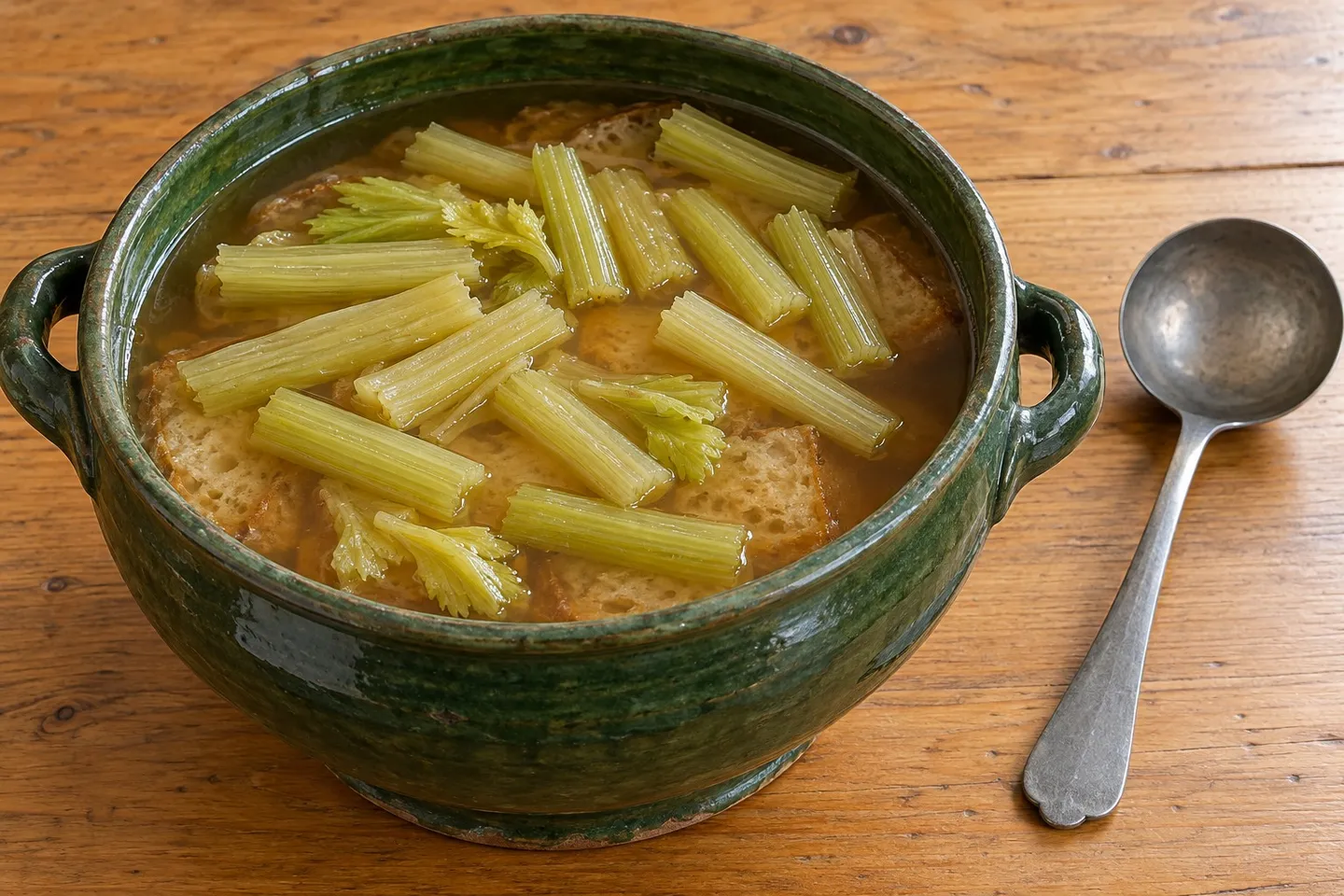
Reader ratingsA meatless French soup of 1771: onion, carrots and parsnip browned in butter and boiled into broth, poured over bread, with celery cooked apart on top.
- Recipe makes
- About 1.5 liters, 4 servings
- Prep
- Cook
- Total
The browning of the roots takes about half an hour and the broth boils for half an hour more. The celery blanches and cooks in its own pan in the meantime, so it adds no time.
Brown vegetable broth over soaked bread, topped with lengths of celery cooked in butter.
The story behind the recipe
Brown broth with no meat in it, poured over soaked bread and crowned with celery cooked in butter. La Cuisinière bourgeoise, printed in Paris in 1771, gives it under the heading “Potages maigres de plusieurs façons,” meatless soups of several kinds, one method for a family of soups that each take their name from the vegetable laid on top: small onions, roots, turnips, cabbage or celery.
Why does the celery leave the broth?
The broth pan normally holds “un pied de céleri,” a head of celery, among the onion, carrots, parsnips and herbs that are browned in butter before the water goes in. The book also forbids the cook to put the garnish vegetable in that pan, since the batch cooked apart “est suffisant pour donner le goût qu’il faut,” enough to give the taste needed. Choose celery for the garnish and the two rules meet: the browned broth loses its celery, and the celery gets a pan of its own.
The page also cares how the soup looks at table. Served on a flat dish, it gets a border of bread crumb glued to the rim with egg white and set by the heat of the fire. Served in a jatte, a deep bowl, it gets no border at all, only the vegetable laid on the surface.
Seven years after this edition came off the press, John Adams sat down to dinner on a French ship in the river below Bordeaux and praised its soup, and decades later he asked himself whether it had been soup meagre. He recorded no recipe; his diary, his memoir and the rest of that dinner are in What Was the Soup Meagre John Adams Liked in France?
Read more about this recipe
Making it today
Celery is our pick of the five vegetables the book names, and it is the choice that changes the broth, because it has to come out of the broth pan. The amounts are ours, since the book counts only the garlic, the bay leaf and the three cloves. We serve it the simpler way, in a deep tureen without the egg-white border. For a meatless broth from London a generation later, colored by a crust toasted hard, Maria Rundell’s Vegetable Soup with a Toasted Crust (1806) makes a good comparison.
Suivant le potage que vous voulez faire, comme petits oignons, racines, navets, choux, céleri, vous prenez le légume que vous voulez employer pour faire la garniture de votre potage, vous le coupez proprement & le faites blanchir un quart d’heure à l’eau bouillante, retirez-le à l’eau fraîche, & le mettez cuire avec un morceau de beurre, de l’eau & du sel; pendant qu’il cuit, vous mettez dans une casserole un morceau de beurre avec de l’oignon, carottes, panais, un pied de céleri, le tout coupé par petits morceaux, une gousse d’ail, une feuille de laurier, thym, basilic, trois cloux de girofle, persil, ciboule; vous observerez de ne point mettre dans la casserole du légume dont vous garnissez votre potage, parce que celui que vous faites cuire à part est suffisant pour donner le goût qu’il faut; vous passerez tous ces légumes sur le feu en les retournant de tems en tems jusqu’à ce qu’ils soient cuites & colorées, vous y mettrez de l’eau & le ferez bouillir une demi heure avec les legumes, cela vous doit faire un bouillon de bon goût & d’une belle couleur comme s’il y avoit du jus: passez-le dans un tamis & le mettez dans la marmite où est le légume à garnir le potage; quand il sera cuit & le bouillon assaisonné de bon goût, prenez-en pour faire mitonner le potage dans une casserole; prenez le plat que vous devez servir, mettez sur les bords de petits fillets de mie de pain que vous trempez dans un peu de blanc d’œuf, mettez le plat sur le feu pour faire attacher les filets, mettez-y après votre garniture de légumes arrangés proprement, dressez votre potage & servez. Si vous servez votre potage dans un plat en façon de jatte, vous n’y ferez point de garniture, mettez simplement le légume sur le potage après qu’il est dressé.
Recipe makes: About 1.5 liters, 4 servings
Ingredients
For about 1.5 liters, 4 servings. Quantities are shown as written.
Quantities as written here, for about 1.5 liters, 4 servings.
- Celery, for the garnish500 g
- Water, for blanching2 l
- Butter, for the celery20 g
- Water, for the celery250 ml
- Salt, for the celery1/2 tsp
- Butter, for the broth40 g
- Onion150 g
- Carrots200 g
- Parsnip150 g
- Garlic1 clove
- Bay leaf1
- Thyme3 sprigs
- Basil leaves4
- Cloves3
- Parsley4 sprigs
- Scallions2
- Water, for the broth2 l
- Salt, for the broth, plus more to taste1 tsp
- Day-old country bread, sliced150 g
Measurement notes
Ingredients as written here
- 500 g celery, for the garnish
- 2 l water, for blanching
- 20 g butter, for the celery
- 250 ml water, for the celery
- ½ tsp salt, for the celery
- 40 g butter, for the broth
- 150 g onion
- 200 g carrots
- 150 g parsnip
- 1 garlic clove
- 1 bay leaf
- 3 sprigs thyme
- 4 basil leaves
- 3 whole cloves
- 4 sprigs parsley
- 2 scallions
- 2 l water, for the broth
- 1 tsp salt, for the broth, plus more to taste
- 150 g day-old country bread, sliced
Equipment
- Large heavy pot, about 4 liters
- Medium saucepan with a lid
 Fine sieve
 Large bowl
- Deep soup tureen or serving bowl
Instructions
Separate the celery into ribs, keep the pale inner ones and a few of their leaves, and trim the ribs into neat lengths of about 5 cm (2 inches).
Bring the water for blanching to a boil in the saucepan, add the celery and blanch it for 15 minutes. Drain it, cool it in a bowl of cold water and drain it again.
Return the celery to the saucepan with the butter for the celery, the water for the celery and the salt for the celery. Cover and cook gently for about 10 minutes, until a knife slides through the thickest piece. Set it aside off the heat.
While the celery cooks, peel the onion, carrots and parsnip and cut them into small pieces. Peel the garlic clove.
Melt the butter for the broth in the large pot over medium heat. Add the cut roots and the garlic with the bay leaf, thyme, basil leaves, whole cloves, parsley and scallions. Cook for 25 to 30 minutes, stirring every few minutes, until the roots are soft and well browned at the edges and a brown film has formed on the bottom of the pot. Turn the heat down if the herbs begin to scorch.
Pour in the water for the broth and scrape the brown film from the bottom into it. Bring to a boil and boil gently, uncovered, for 30 minutes.
Strain the broth through the sieve into the large bowl, pressing lightly on the vegetables, and discard them.
Pour the broth into the saucepan with the celery and its cooking liquid. Add the salt for the broth, bring back to a simmer and taste for salt.
Lay the country bread in the large pot, ladle over enough of the broth to cover it and simmer gently for about 5 minutes, until the bread is soft and swollen.
Lift the bread into the warmed tureen, pour the rest of the hot broth over it and arrange the celery on top. Serve at once.
Nutrition
240calories per serving
- Recipe makes
- About 1.5 liters, 4 servings
- Servings
- 4
Estimated per serving (4) from USDA FoodData Central values for butter, celery and country bread, with a small allowance for what the strained roots leave in the broth.
Recipe notes
When adjusting quantities
The book counts only the garlic clove, the bay leaf and the three cloves. Every other amount is ours, for a soup to serve four.
Notes
Quantities mentioned in these notes don’t change when you adjust the servings.
The book counts only the garlic clove, the bay leaf and the three cloves, so every other quantity is ours. Celery is our choice of garnish; turnips, cabbage, small onions or other roots can take its place, cooked apart the same way, and the celery then goes back into the broth pan. We leave out the bread strips fixed to the rim with egg white and follow the book’s own service for a deep dish. Scallions stand in for ciboule, a green onion. The book has the broth seasoned to taste and names no pepper, so we add none. The strained broth keeps for up to 4 days in the refrigerator if chilled within 2 hours; reheat it to 165°F (74°C) and add the bread and celery then. Contains milk (butter), wheat (bread) and celery.
Scaling changes the ingredients only; pan sizes and cooking times need their own judgment. To adapt this recipe further, try the recipe tool at TuneMyRecipe (opens in a new tab), our sister site.



Sources and attribution
After Menon (attributed), La Cuisinière bourgeoise (Paris, 1771), Potages maigres de plusieurs façons
See the original pages (scan at Internet Archive) (opens in a new tab)
Recipe details
- Course
- Soup
- Dish family
- Soups & Broths
- Region
- French
- Era
- 18th century
- Source decade
- 1770s
- Main ingredient
- Vegetables
- Difficulty
- Intermediate
- Occasion
- Everyday meal