John Adams dines aboard the Julie on reaching France · On the river below Bordeaux
What Was the Soup Meagre John Adams Liked in France?
John Adams liked a French soup on 31 March 1778 and later wondered if it was soup meagre. A Paris cookbook of 1771 shows what a meatless soup could be.
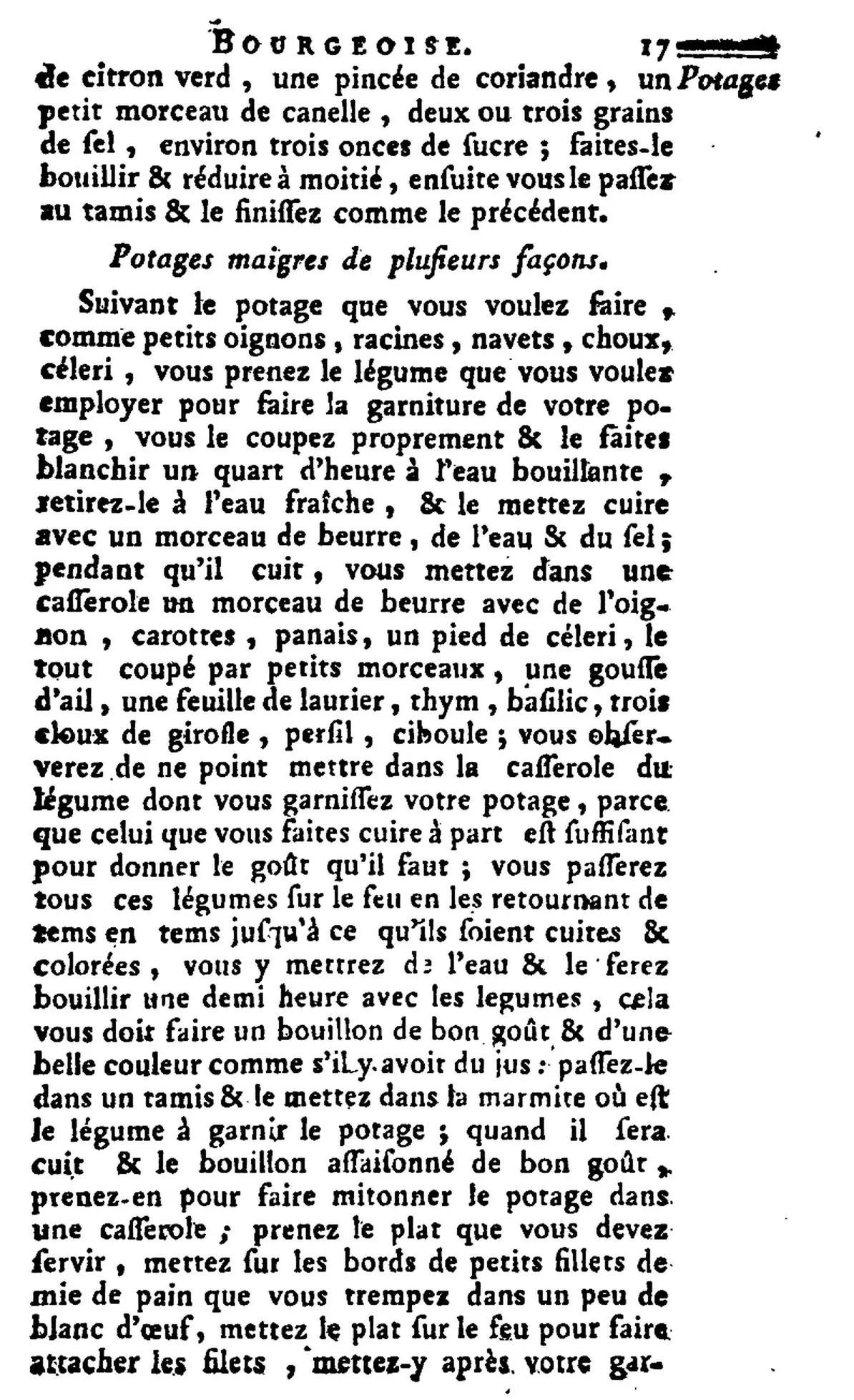
Neither of John Adams’s accounts says what went into the soup he liked on his arrival in France. His diary for 31 March 1778 notes only that “The first Dish was a fine french Soup, which I confess I liked very much.” More than twenty years later, telling the same dinner in his autobiography, he wondered whether it had been soup meagre, a name he knew as a sneer, and decided that “if this was Soup meagre, it was a very respectable thing.” What a French cook of those years meant by a meatless soup is printed in La Cuisinière bourgeoise (Paris, 1771): roots browned in butter and boiled into a broth meant to look and taste as if it held meat juice, poured over bread, with one vegetable cooked apart and laid on top.
Six weeks on the Boston
Congress had elected Adams a joint commissioner to France at the end of November 1777, to serve with Benjamin Franklin and Arthur Lee after Silas Deane was recalled. He went aboard the Continental frigate Boston on 13 February 1778 with his son John Quincy. The ship weighed anchor two days later and put to sea from Marblehead on the evening of the 17th. By the last day of March she was, in his words, “Lying in the River of Bourdeaux, near Pouliac,” with “A 24 Gun Ship close by Us, under French Colours, bound to St. Domingue.”
That morning the French ship’s captain and a passenger came across from the Julie to pay a visit, and invited the Americans to dinner. Adams went with Captain Palmes and “Masters Jesse and Johnny,” young Jesse Deane and his own son. They found “a pretty ship, an elegant Cabin, and every Accommodation.” The table was ready for them: “The white Stone Plates were laid, and a clean Napkin placed in each, and a Cut of fine Bread.”
The diary then lists the dinner course by course. After the soup came “a Dish of boiled Meat,” then “the Lights of a Calf, dressed one Way and the Liver another,” roasted mutton and fricasseed mutton, “A fine Sallad and something very like Asparagus, but not it,” prunes, almonds and “the most delicate Raisins I ever saw,” Dutch cheese, coffee, a French cordial, and “excellent Claret with our Dinner.” The two parties had no language in common: “None of us understood French,” Adams wrote, “none of them English: so that Dr. Noel stood Interpreter.” On deck he admired the hens, capons and cocks in their coops, “the largest I ever saw.”
The calendar adds a puzzle neither account mentions. Easter fell on 19 April in 1778, so this Tuesday dinner came in the middle of Lent, the longest run of meatless days in the Catholic year, and the Julie’s table still served boiled meat, calf’s lights and mutton. Adams does not say whether anyone on board kept the fast.
One soup, two accounts
The diary is the record made on the day, and it is brief about the soup: fine, French and liked. The phrase that has come down with this dinner belongs to a different document. The Massachusetts Historical Society dates Adams’s autobiography to between 1802 and 1807. In its second part, “Travels and Negotiations,” he worked from the 1778 diary and wrote around it, and here the soup gets a sentence of its own: “I had heard of Soup Meagre, which in America as well as in England had been Words of Contempt: but I thought if this was Soup meagre, it was a very respectable thing.”
The “if” is the honest part. Adams had no French and an interpreter between him and his hosts, and he never says he was told what the soup was made of. Neither account says it was made without meat, and the boiled meat that followed shows the dinner as a whole was no fast-day meal. What the retelling records is a later judgment on a name, set beside the memory of a soup he had liked.
The autobiography also gives a second reason the dinner pleased. “All these Appearances and provisions were luxuries to which We had been Strangers for many Weeks.” Adams himself ties the pleasure to six weeks of a frigate’s stores. That does not cancel his verdict on the soup; it is part of it.
Maigre in a Paris kitchen
Maigre, in French cookery, meant food for the days when the Church forbade meat: Fridays, the weeks of Lent and other days of abstinence. In English the word became “meagre,” as in soup meagre. French cooks had kept a second repertoire for those days for centuries: the Paris household book of about 1393 read in What Did a Paris Household Eat in 1393? already plans whole fish-day dinners.
La Cuisinière bourgeoise, here in a “Nouvelle édition” printed in Paris by P. Guillaume Cavelier in 1771, addresses itself “à l’usage de tous ceux qui se mêlent de dépenses de Maisons,” to everyone who manages the spending of a house. Its title page names no author; the Bibliothèque nationale de France catalogues the book under Menon as its presumed author. Seven years before Adams’s dinner, this edition printed, on its seventeenth page, a recipe headed “Potages maigres de plusieurs façons,” meatless soups of several kinds.
Each soup takes its name from its vegetable: small onions, roots, turnips, cabbage or celery, cooked apart in butter and water. The broth is made in a second pan from onion, carrots, parsnips and celery with garlic, bay, thyme, basil, cloves, parsley and ciboule, turned in butter “jusqu’à ce qu’ils soient cuites & colorées,” until they are cooked and colored, and only then boiled in water. The result, the book promises, should be “un bouillon de bon goût & d’une belle couleur comme s’il y avoit du jus”: a broth of good flavor and a fine color, as if there were meat juice in it.
The standard is a meat broth, and the book sets out to match it. One rule keeps the two pans apart. The vegetable chosen for the garnish must stay out of the broth pan, “parce que celui que vous faites cuire à part est suffisant pour donner le goût qu’il faut,” because the share cooked apart is enough to give the taste the soup needs. The broth carries color and depth; the garnish carries the name.
None of this is thin. Butter goes into both pans. For a flat serving dish the book fixes small strips of bread crumb around the rim with egg white and sets the dish over the fire to make them hold, a frame for the soup; for a deep bowl it leaves the border off and simply lays the vegetable on top.
Browned or white
The recipe that follows it on page 18, “Potages maigres aux oignons,” shows that browning was a choice. About a dozen medium onions are sliced, turned in butter until “cuits & un peu colorés également,” cooked and lightly colored all over, then moistened with water, “ou du bouillon maigre si vous en avez,” or with meatless broth if there is some, and seasoned with salt and coarse pepper before the bread goes in.
The same entry then gives a milk soup, and it reverses the method. It uses a few fewer onions and cooks them gently “jusqu’à ce qu’ils soient cuits sans être colorés,” until cooked without coloring, then adds boiling milk. The bread is laid in the serving dish with part of the liquid, covered and set on warm ashes to soak before the rest goes in. On a meatless day a household could have a brown soup or a white one, the color coming from the pan or from the dairy.
No document says whether the Julie’s cook, on a ship bound for St. Domingue, made anything like these soups. What the 1771 book does show is what Adams’s “Words of Contempt” missed: a French meatless soup could be built, on purpose and with some labor, to stand beside a meat broth.
The recipes
The dinner aboard the Julie left no recipe, so the card holds two meatless soups from the 1771 Cuisinière bourgeoise, the kind of soup Adams’s later “if” had in mind.
- Celery Soup Maigre (1771): the browned-root broth from “Potages maigres de plusieurs façons,” poured over bread, with celery as the vegetable cooked apart.
- Onion Soup Maigre (1771): the recipe that follows it in the book, onions colored in butter and simmered with water and bread.
Cook the Celery Soup Maigre (1771) first. It keeps the book’s one rule, with the celery out of the broth pan and cooked on its own in butter, and a pot of its browned-root broth is the “bouillon maigre” the onion soup asks for if you have some. For what Adams drank at the tables of Philadelphia, from punch and porter in 1774 to a morning gill of cider in 1796, Forgotten Drink, our sister site, reads his diary in what the Founding Fathers drank (opens in a new tab).
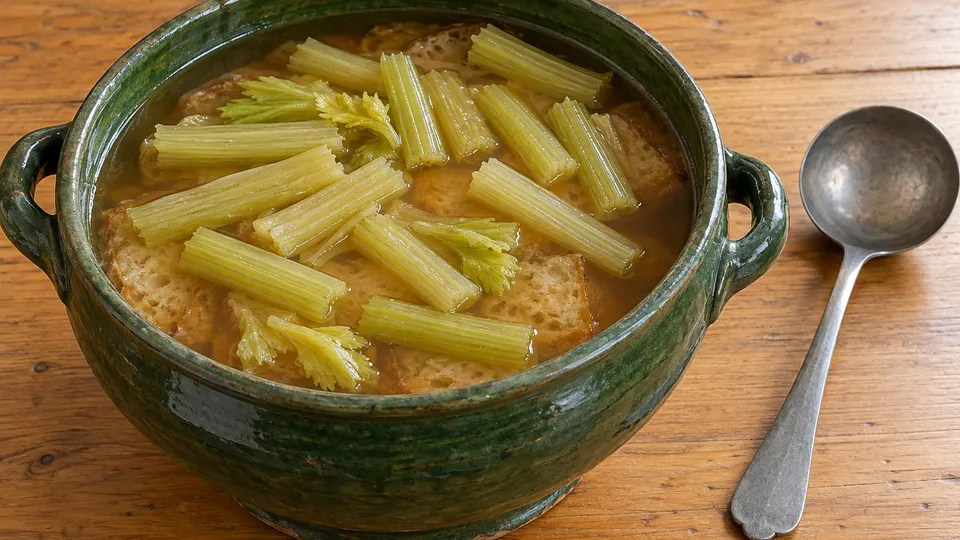 Cook it todayCelery Soup Maigre (1771)
Sources
- John Adams, diary entry for 31 March 1778, in Diary and Autobiography of John Adams, vol. 2, ed. L. H. Butterfield (Cambridge, MA: Belknap Press of Harvard University Press, 1961), pp. 292–293; entry for 13 February 1778 and its editorial note, p. 270, and the entries for 15 to 18 February. Read in the Adams Papers Digital Edition, Massachusetts Historical Society.
- John Adams, autobiography, part 2, “Travels and Negotiations,” entry for 31 March 1778, in Diary and Autobiography of John Adams, vol. 4 (1961), pp. 33–34. Read in the Adams Papers Digital Edition and Founders Online.
- Massachusetts Historical Society, “Autobiography of John Adams,” Adams Family Papers: An Electronic Archive, for the dates of composition.
- [Menon, attributed], La Cuisinière bourgeoise, suivie de l’Office, new edition (Paris: P. Guillaume Cavelier, 1771), title page and pp. 17–18. Translations from the French are ours.