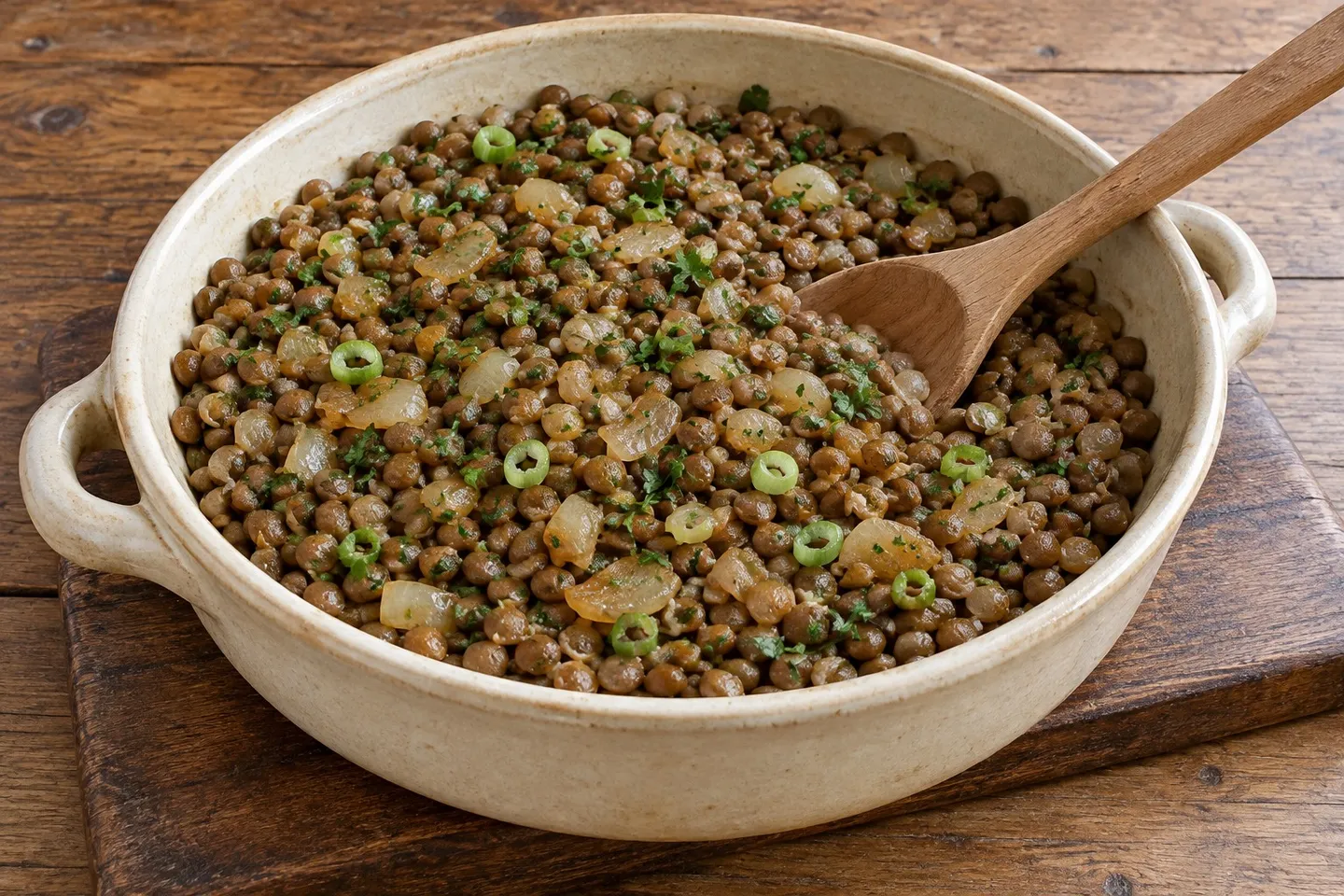
Fricasseed Lentils (1771)
Reader ratingsLentils boiled in water, then simmered with onion in browned butter and flour, parsley, scallion and vinegar: Menon’s meagre-day lentils from Paris, 1771.
- Recipe makes
- About 4 cups, 6 servings
- Prep
- Cook
- Total
Menon boils the fricassee a quarter of an hour once the lentils are in. The lentils cook first in plain water, about 20 minutes, and the roux and onion are made while they simmer.
Brown lentils fricasseed with onion, parsley and scallion.
The story behind the recipe
Samuel Johnson ended his list of the monks’ meagre dinner in Paris on 31 October 1775 with “lentils, tasteless in themselves,” and How Did Paris Eat on a Fish Day in 1775? follows that dinner from the soup down to this last dish. The words “in themselves” leave room for whatever the kitchen did with them. Menon’s La Cuisinière bourgeoise, printed in Paris four years earlier, gives the cook a good deal to do. His entry for ordinary lentils is three lines long: it asks for lentils “larges & d’un beau blond,” large and a fine blond, and sends the cook back a page to his white beans for the rest.
Was it a meat-day dish too?
It could be, since Menon’s white beans, the recipe the lentils borrow, come both ways. He marks the beans in the margin as an hors d’œuvre, one of the small dishes set out with the first course. Beans “au gras,” for a meat day, are made the same way with melted lard and veal juice, which leaves the butter version as the meagre one. The Ménagier de Paris had sorted its greens the same way four centuries before, under a stricter Lent: Watercress Porée (1393) is simmered in almond milk in Lent and in cow’s milk on other days.
Read more about this recipe
Which lentils?
Menon names two kinds. The large blond ones are for fricasseeing. The lentilles à la Reine are “très-petites,” and he uses them for coulis, the smooth purées that thickened soups, “parce que la couleur est plus belle & le goût plus excellent,” because their color is finer and their taste better. So the larger lentil was the one meant to be eaten whole. Johnson doesn’t say which kind the monks’ cook used or how they were dressed, and no recipe from the convent’s kitchen is known.
Making it today
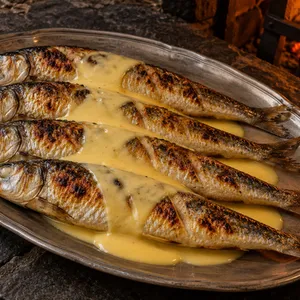
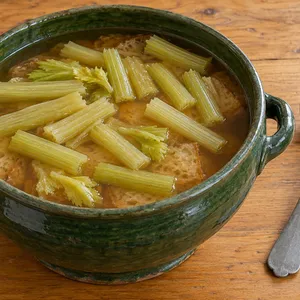
Large brown lentils, the common grocery kind, are the closest match for Menon’s blond ones, and scallions take the place of his ciboule. Made with butter, the dish is meatless as he printed it. It also keeps its old place on the table as one small dish among several: beside a soup and a fish, it rounds out a fish-day dinner of the kind Johnson wrote down.
Les lentilles ordinaires, choisissez-les larges & d’un beau blond; après les avoir lavées & épluchées, faites-les cuire dans de l’eau, quand elles sont cuites fricassez-les comme les haricots blancs.
Faites-les cuire dans l’eau, quand ils sont cuits, vous mettez dans une casserole un morceau de beurre & un peu de farine que vous faites roussir, & y mettez ensuite de l’oignon haché que vous faites cuire dans ce même roux. Quand il est cuit mettez-y les haricots, avec persil, ciboule hachés, sel, poivre, un filet de vinaigre; faites bouillir le tout un quart d’heure, & servez.
In our translation: “Ordinary lentils: choose them large and of a fine blond; after washing them and picking them over, cook them in water; when they are cooked, fricassee them like white beans.” And for the white beans: “Cook them in water; when they are cooked, put into a casserole a piece of butter and a little flour, which you brown, and then put in chopped onion, which you cook in this same roux. When it is cooked, put in the beans, with chopped parsley and scallion, salt, pepper, a dash of vinegar; boil it all a quarter of an hour, and serve.”
Recipe makes: About 4 cups, 6 servings
Ingredients
For about 4 cups, 6 servings. Quantities are shown as written.
Quantities as written here, for about 4 cups, 6 servings.
- Dried brown lentils1 1/2 cups
- Water, for the lentils6 cups
- Butter3 tbsp
- All-purpose flour1 tbsp
- Medium onion1
- Lentil cooking water1 cup
- Chopped parsley3 tbsp
- Scallions2
- Salt1 tsp
- Ground black pepper1/4 tsp
- White wine vinegar1 tbsp
Measurement notes
Ingredients as written here
- 1½ cups dried brown lentils
- 6 cups water, for the lentils
- 3 tbsp butter
- 1 tbsp all-purpose flour
- 1 medium onion
- 1 cup lentil cooking water
- 3 tbsp chopped parsley
- 2 scallions
- 1 tsp salt
- ¼ tsp ground black pepper
- 1 tbsp white wine vinegar
Equipment
 Medium saucepan
 Fine sieve
- Colander
- Heatproof bowl
- Wide heavy saucepan, about 3 quarts
 Wooden spoon
Instructions
Spread the lentils on a plate and pick out any small stones or shriveled ones. Rinse them in the sieve under cold water.
Put the lentils in the medium saucepan with the water for the lentils and bring to a boil. Lower the heat and simmer, uncovered, for about 20 minutes, until just tender all the way through but still whole; they cook further in the fricassee.
While the lentils simmer, chop the onion finely and slice the scallions thin.
Melt the butter in the wide saucepan over medium-low heat. Stir in the flour and cook, stirring all the time, for 3 to 4 minutes, until the roux turns a light nut-brown and smells toasty. Lower the heat if it starts to darken quickly.
Add the onion and cook gently, stirring often, for 8 to 10 minutes, until soft and golden. Take the pan off the heat until the lentils are ready.
Set the colander over the heatproof bowl and drain the lentils, keeping their cooking water. Measure out the lentil cooking water.
Add the lentils to the onion with the parsley, the scallions, the salt, the black pepper, the white wine vinegar and the lentil cooking water. Stir and bring to a boil, then lower the heat and boil gently, uncovered, for 15 minutes, stirring now and then, until the lentils are soft and the liquid has thickened into a little sauce that coats them. If the pan starts to catch before then, stir in a little more of the remaining cooking water. Taste for salt and serve hot.
Nutrition
230calories per serving
- Recipe makes
- About 4 cups, 6 servings
- Servings
- 6
Estimated per serving (6) from USDA FoodData Central values for dry lentils, butter, flour and onion.
Recipe notes
When adjusting quantities
Menon gives no amounts; ours make a side dish for six.
Notes
Quantities mentioned in these notes don’t change when you adjust the servings.
Menon gives no amounts; every amount here is ours. His lentil entry sends the cook to his white beans for the fricassee, so the method follows that recipe. Large brown lentils stand in for his large blond lentilles ordinaires, and scallions for his ciboule, a green onion; the vinegar, which he leaves unnamed, is white wine vinegar. The lentils are cooked a little short of soft, since his quarter-hour boil finishes them. Roussir means to brown, so the roux goes to a light nut-brown before the onion goes in. Menon boils the fricassee a quarter of an hour without naming a liquid; the cup of the lentils’ own cooking water is our addition, to keep them from catching. Cooked lentils keep up to 4 days in the refrigerator; chill them within 2 hours. Contains milk (butter) and wheat (flour).
Scaling changes the ingredients only; pan sizes and cooking times need their own judgment. To adapt this recipe further, try the recipe tool at TuneMyRecipe (opens in a new tab), our sister site.

Sources and attribution
After Menon (attributed), La Cuisinière bourgeoise (Paris, 1771), Des Lentilles and Des Haricots blancs
See the original pages (scan at Internet Archive) (opens in a new tab)
Recipe details
- Course
- Side dish
- Dish family
- Vegetables & Sides
- Region
- French
- Era
- 18th century
- Source decade
- 1770s
- Event
- Paris fish day, 1775
- Main ingredient
- Vegetables
- Difficulty
- Easy
- Occasion
- Lent