Sushi Rice (1910)
Reader ratingsSushi rice from Koizumi Ugai’s 1910 Tokyo book on home sushi: short-grain rice put into boiling water, rested twenty minutes and seasoned hot with vinegar and salt, without sugar.
- Recipe makes
- About 580 g, enough for 6 egg nigiri and 8 inari pockets
- Prep
- Cook
- Total
Drain the rinsed rice for 15 minutes, cook it 15, rest it 20 and season it at once. Use it within 2 hours of cooking.
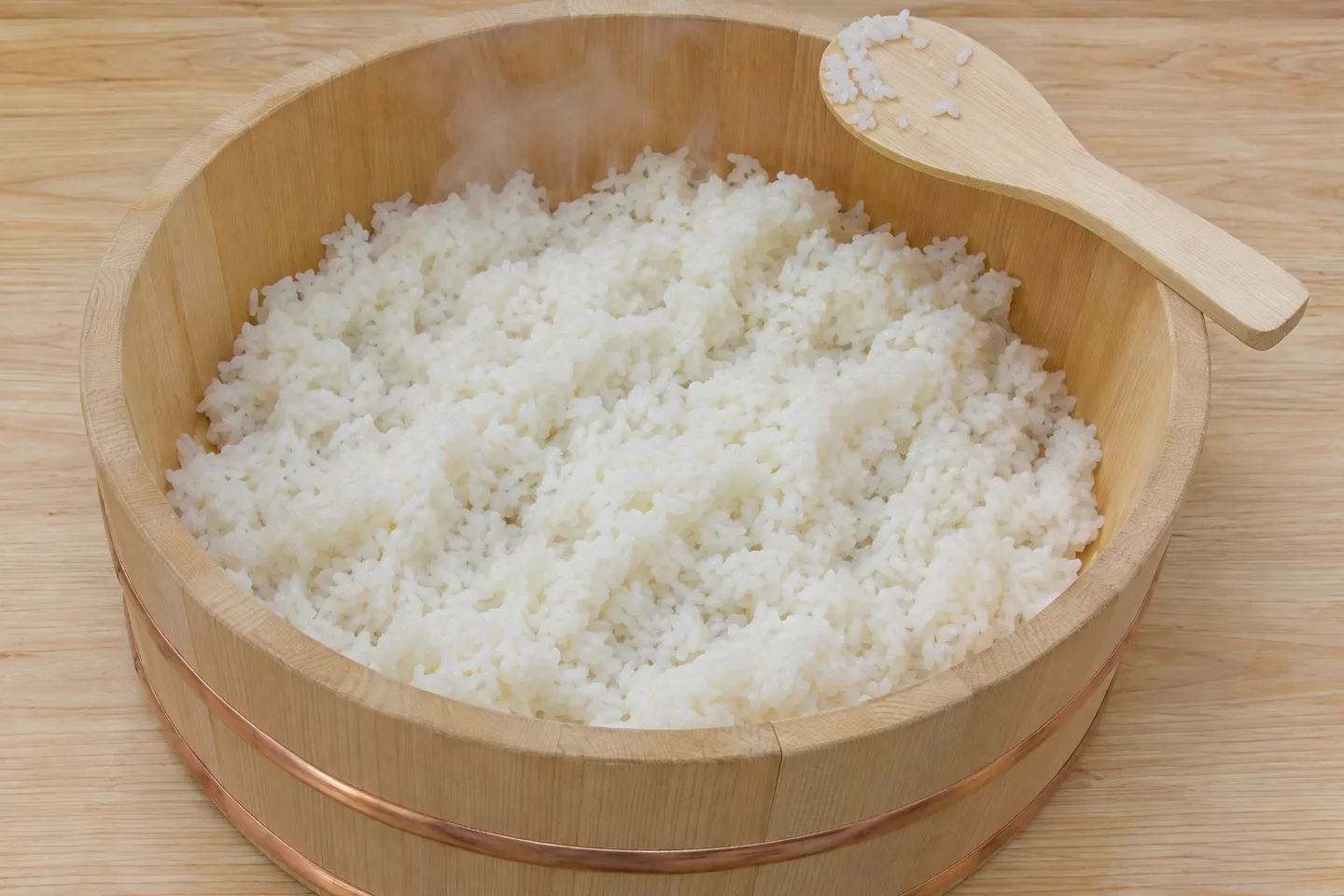
Seasoned sushi rice cooling in a wooden tub, with a rice paddle.
The story behind the recipe
The rice is the sushi, as far as Koizumi Ugai was concerned. “Whatever the sushi, the first essential is the rice,” he wrote on the first page of Katei sushi no tsukekata, “How to make sushi at home,” published in Tokyo in July 1910 with its title page crediting the master of the Yohei sushi shop. Everything else in the book, the egg, the fish and the fried tofu pockets, sits on or in this.
Vinegar, salt and no sugar
His seasoning is only vinegar and salt, mixed into the rice while it is hot. There is no sugar in it. He gives the proportion for a shop-sized batch: to 2 shō of rice, 1 gō of vinegar and a little under 1 gō of salt, both measured by volume. He was particular about the vinegar: for sushi, a top grade brewed at Handa, in Owari province, sold in four-gō bottles from a Tokyo shop. In summer, he warned, vinegar “works a little too strongly,” so the amount had to change with the season or the batch would fail. Salt he was easier about. Professionals kept one kind for the rice and another for the fish; a home cook, he said, could manage with one.
His rice went into the water only once it was boiling, with the water measured against the age of the grain: an equal volume for new rice, a tenth more for old. After cooking, it rested twenty minutes in the closed pot before it was turned out to be seasoned and fanned. The page with the egg nigiri and the page with the inari both send the cook back here.
Read more about this recipe
Making it today
A saucepan replaces the charcoal stove and rice pot, and we keep Koizumi’s order of work: rice into boiling water, a twenty-minute rest, seasoning while hot. The amounts are ours. His proportion puts nearly as much salt as vinegar into the rice; we use six times as much vinegar as salt by weight and 2 percent salt against the raw rice, still with no sugar. Plain rice vinegar is the modern stand-in for his Handa vinegar.
The rice is the base for the Egg Nigiri (1910) and the Inari Sushi (1910), and the shop it came from is the subject of When Did Sushi Leave the Press for the Hand?
〔調和方〕飯が炊けまして廿分間程蒸らしましたら、釜から飯盤へ移すのです。もし飯盤の用意がなければ、適當の大きさの盆か又は膳を代りに用ひます。移した飯は直ぐ用意してある酢と鹽を同時に撒布け、傍から團扇で風を送りながら、杓子を持つて、ムラの生きぬやうに、よく混和するのです。酢と鹽(次章をも參照)の割合は、米二升に對し、酢一合鹽一合弱です。飯を混和し了つたらば、なるべく飯櫃へ入れて置くのです。これは飯の硬ばらぬためです。
〔注意〕團扇及び杓子は、なるべく大きい方が混せ易く、ムラの生る憂が少いのです。飯に酢を合すのは釜から移したてに限ります。冷飯にはムラが生じて、そのうへボロボロして握り悪くなります。
In our translation: “Mixing. When the rice is cooked and has steamed for about twenty minutes, move it from the pot to a rice tray. If you have no rice tray, use a tray or a meal table of a suitable size instead. Over the rice you have moved, scatter the vinegar and salt you have ready, both at once, and while fanning it from the side with a fan, take the paddle and mix it well so that it doesn’t go patchy. The proportion of vinegar and salt (see also the next chapter) is, to two shō of rice, one gō of vinegar and a little under one gō of salt. When the rice is mixed, put it into a rice tub if you can. This is so that the rice does not harden.
“Note. The bigger the fan and the paddle, the easier the mixing and the less risk of patches. Vinegar goes into the rice only when it has just come out of the pot. Cold rice goes patchy, and crumbly besides, and is hard to shape.”
Recipe makes: About 580 g, enough for 6 egg nigiri and 8 inari pockets
Ingredients
For about 580 g, enough for 6 egg nigiri and 8 inari pockets. Quantities are shown as written.
Quantities as written here, for about 580 g, enough for 6 egg nigiri and 8 inari pockets.
- Japanese short-grain white rice250 g
- Water340 ml
- Plain rice vinegar30 ml
- Fine salt5 g
Measurement notes
Ingredients as written here
- 250 g Japanese short-grain white rice
- 340 ml water
- 30 ml plain rice vinegar
- 5 g fine salt
Equipment
 Kitchen scale
 Sieve
 Saucepan with a lid
 Small bowl
- Wide shallow bowl, wooden or glass
 Wooden spoon or rice paddle
 Hand fan or a stiff piece of card
 Clean damp kitchen towel
Instructions
Rinse the Japanese short-grain white rice in the saucepan with cool water, swirling it with your hand, and pour the cloudy water off. Repeat three or four times, until the water is nearly clear, then drain the rice in the sieve for 15 minutes.
Stir the fine salt into the plain rice vinegar in the small bowl until it dissolves, and set it beside the stove.
Bring the water to a full boil in the saucepan. Tip in the drained rice, stir once to loosen it and let it come back to the boil.
Cover the pan, turn the heat as low as it goes and cook for 15 minutes, without lifting the lid. Take the pan off the heat and leave it covered for 20 minutes.
Turn the hot rice out into the wide shallow bowl and spread it a little. Pour the vinegar and salt over it all at once.
Fan the rice with one hand while you cut through it and turn it over with the spoon or paddle in the other, without mashing the grains, for 2 to 3 minutes, until every grain is glossy and the steam has mostly stopped.
Cover the bowl with the damp towel and keep it at room temperature until you shape the sushi. Use it within 2 hours of cooking.
Nutrition
225calories per serving
- Recipe makes
- About 580 g, enough for 6 egg nigiri and 8 inari pockets
- Servings
- 4
Estimated per serving (4) from USDA FoodData Central values for raw medium/short-grain white rice; the vinegar and salt add almost nothing.
Recipe notes
When adjusting quantities
Koizumi seasons 2 shō of raw rice, about 3.6 liters by volume, with 1 gō (180 ml) of vinegar and a little under 1 gō of salt. These amounts are for one household batch and use more vinegar and much less salt than his proportion. A double batch needs a wider pan and the same times.
Notes
Quantities mentioned in these notes don’t change when you adjust the servings.
Koizumi’s own proportion, scaled to this batch (250 g of rice is about 300 ml by volume), would be about 15 ml of vinegar and a little less salt by volume, some 17 g; that is far saltier than these amounts, and the book’s summer warning shows that he changed the vinegar by season. He also measured his water against freshly washed rice and took a tenth off for rice washed and left to stand, as this rice is; the 340 ml here is our amount for a saucepan. One gō is taken as 180 ml, the modern rice measure. A modern rice cooker can replace the saucepan; season the rice the moment it finishes. Cooked rice can carry spores of Bacillus cereus, which survive cooking and multiply in rice left warm. The vinegar makes the rice more acidic, but a home batch isn’t measured for it, so treat sushi rice like any cooked rice: no more than 2 hours at room temperature from the end of cooking (USDA), and refrigerate leftovers within that time and eat them within 24 hours (UK Food Standards Agency). Chilled rice goes hard and won’t shape well, so cook only what the sushi needs.
Scaling changes the ingredients only; pan sizes and cooking times need their own judgment. To adapt this recipe further, try the recipe tool at TuneMyRecipe (opens in a new tab), our sister site.
Sources and attribution
After Koizumi Ugai, Katei sushi no tsukekata (Tokyo, 1910), chapter 1, Rice, and chapter 2, Vinegar and salt
See the original pages (scan at dl.ndl.go.jp) (opens in a new tab)
Recipe details
- Course
- Side dish
- Region
- Japanese
- Era
- Edwardian
- Source decade
- 1910s
- Main ingredient
- Grains & rice
- Difficulty
- Easy
- Occasion
- Everyday meal