Inari Sushi (1910)
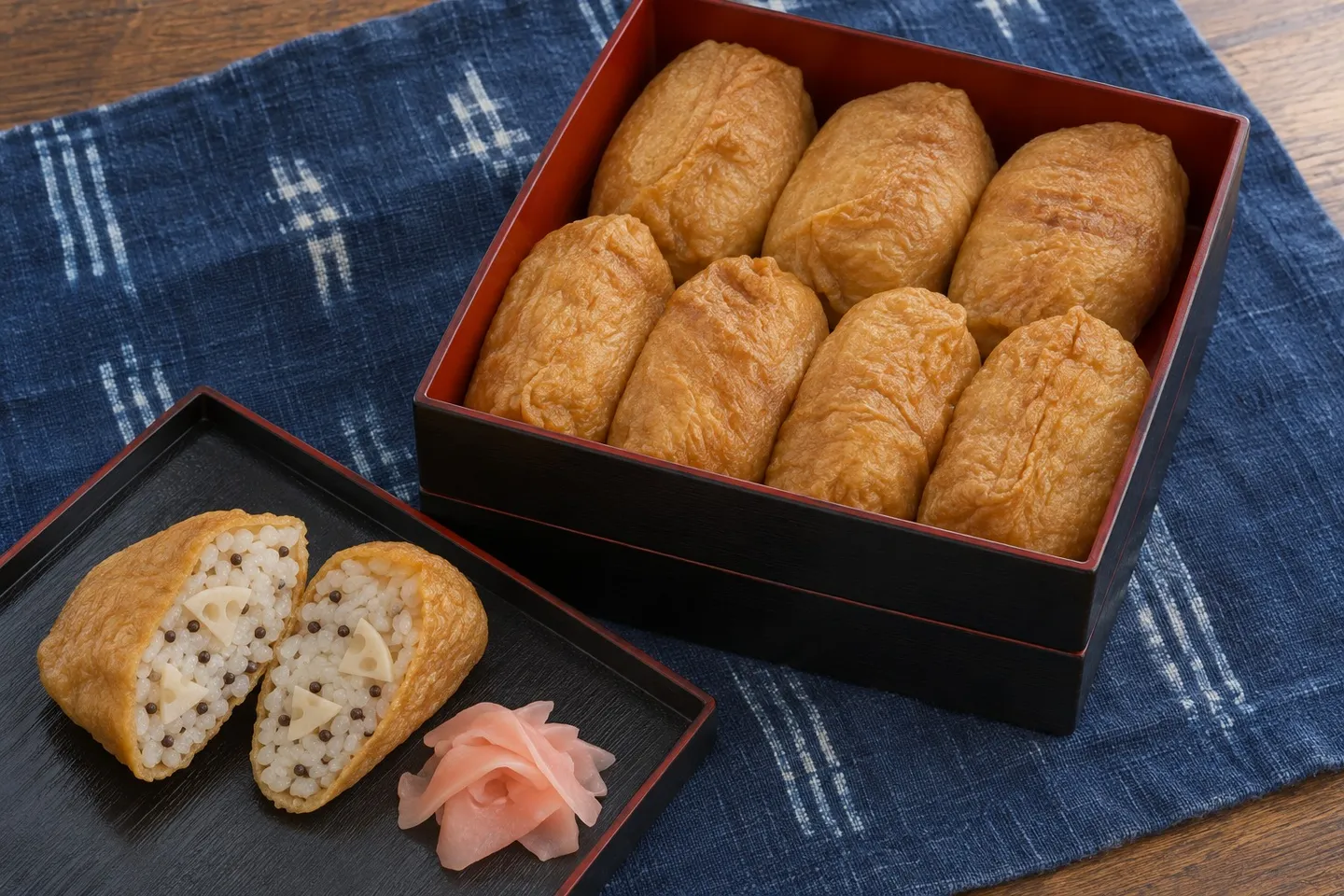
Reader ratingsInari sushi from Koizumi Ugai’s 1910 Tokyo book on home sushi: fried tofu pockets simmered in mirin and light soy and filled with vinegared rice, lotus root and perilla seeds.
- Recipe makes
- 8 pockets, serving 4
- Prep
- Cook
- Total
Start the Sushi Rice (1910) first, about an hour. Make the pockets, lotus and perilla seeds while it drains, cooks and rests, so they are ready to mix in the moment the rice is seasoned.
Inari sushi in a lacquer box, one pouch cut to show rice with perilla seeds and lotus root.
The story behind the recipe
Inari sushi is a fried tofu pocket filled with vinegared rice, and Koizumi Ugai’s 1910 book gives it under both its names, inari-zushi or Shinoda-zushi. His Katei sushi no tsukekata was published in Tokyo under a title page crediting the master of the Yohei sushi shop, and this is its ordinary inari, the plain version before a grander one with nori rice and more vegetables.
Mirin, light soy and no sugar
Today’s inari pockets are usually simmered sweet. Koizumi’s take no sugar: he blanched the halved fried tofu, opened each into a bag with his fingertips, and simmered it briefly in mirin, or sake, with light soy. The sweetness, such as it is, comes from the mirin. The rice is cooked a little firmer than usual, seasoned as for any sushi and, while still hot, mixed with lotus root and the small seeds of perilla, each simmered lightly and squeezed dry first.
The pockets are filled without packing, closed by folding the mouth inward, and set side by side in a stacked box, pressed lightly to set their shape. If a mouth won’t stay shut, he wrote, tie it with a strip of dried gourd. They go out with ginger, which he didn’t expect a home cook to make. Sushi ginger was sliced so thin, he said, that an amateur couldn’t do it, and most sushi shops bought theirs at the Senju market or the fish market.
Read more about this recipe
Making it today
Koizumi gives no amounts and no times, so all of them are ours. We buy unseasoned aburaage, the rectangular fried tofu, and halve it into pockets, and we add water to his mirin and light soy to make enough liquid to simmer in. Fresh perilla seeds are a short summer crop, so we use the salted ones sold in Japanese shops, soaked first to draw out the salt. The fried tofu here is the same bean curd as the bean cake in Bean Cake Chop Suey (1917), from a New York book of seven years later.
The rice is the Sushi Rice (1910), and the shop behind the book is in When Did Sushi Leave the Press for the Hand?
(七)稲荷ずし(又は信田ずし)
材料 油揚豆腐 紫蘇の實 煮蓮根 すし飯
以上の材料を調へましたら、油揚豆腐の腹の斷れぬものを撰つて二つ切りになし、沸騰した湯の鍋に投れてザット茹で、笊に移して湯を斷り、よく冷まして兩手の指先を注意して使つて切口を袋のやうに隙を拵へて置きます。次に味淋(酒でもよろしい)と薄醬油で汁を鹽梅し置き、その鍋を火に懸けて、前記の油揚を投れ、ザット下煮を致します。...
In our translation: “(7) Inari-zushi (or Shinoda-zushi). Ingredients: fried tofu, perilla seeds, simmered lotus root, sushi rice.
“When you have these ready, choose fried tofu whose sides are not torn, cut each in two, drop them into a pan of boiling water and boil them briefly, move them to a basket to drain off the water, let them cool well and, using the fingertips of both hands with care, open the cut edge into a bag. Next season a liquid with mirin (sake will do) and light soy, set the pan on the fire, put in the fried tofu and give it a brief first simmer. ...”
Recipe makes: 8 pockets, serving 4
Ingredients
For 8 pockets, serving 4. Quantities are shown as written.
Quantities as written here, for 8 pockets, serving 4.
- Rectangular aburaage (unseasoned fried tofu), about 8 × 15 cm4
- Water250 ml
- Mirin40 ml
- Light Japanese soy sauce (usukuchi)25 ml
- Lotus root80 g
- Salted perilla seeds (shiso no mi)15 g
- Seasoned sushi rice, freshly made and still warm320 g
- Sliced pickled ginger30 g
Measurement notes
Ingredients as written here
- 4 rectangular aburaage (unseasoned fried tofu), about 8 × 15 cm
- 250 ml water
- 40 ml mirin
- 25 ml light Japanese soy sauce (usukuchi)
- 80 g lotus root
- 15 g salted perilla seeds (shiso no mi)
- 320 g seasoned sushi rice, freshly made and still warm
- 30 g sliced pickled ginger
Equipment
 Kitchen scale
 Measuring jug
 Two saucepans
 Sieve
 Peeler
 Cutting board and knife
 Small bowl
 Two plates
- Wide shallow bowl, wooden or glass
 Wooden spoon or rice paddle
 Shallow lidded container
Instructions
Start the seasoned sushi rice first, from the Sushi Rice (1910) recipe; the pockets, lotus and seeds are made while it drains, cooks and rests.
Cut each aburaage in half across, to make two squares. Drop them into a saucepan of boiling water for 1 minute, then drain them in the sieve and let them cool until you can handle them.
Roll each square gently under your palm, then ease the cut edge open with your fingertips and work them down inside to open a pocket, without tearing the sides.
Mix the water, mirin and light Japanese soy sauce in the measuring jug.
Peel the lotus root, cut it lengthwise into quarters and slice the quarters thinly across. Boil the slices in the second saucepan of water for about 3 minutes, until just tender, then drain them and rinse them under cold water to wash off the slippery starch.
Put the salted perilla seeds to soak in the small bowl of cold water for 10 minutes, then drain them well.
Pour a quarter of the seasoning liquid into the second saucepan, add the lotus and simmer for 3 minutes. Add the perilla seeds for the last minute. Tip them onto one plate, spread them out to cool, then squeeze out the liquid with your hand.
Pour the rest of the seasoning liquid into the first saucepan, bring it to a simmer and lay in the pockets. Simmer gently for 5 minutes, turning them once, then lift them out onto the second plate and press each lightly to drain off the extra liquid.
As soon as the rice is seasoned, scatter the lotus and perilla seeds over it in the wide bowl and fold them through with the spoon or paddle until evenly mixed, without making the rice sticky. Let it cool for 5 minutes.
Divide the rice into equal portions, one for each pocket. Hold a pocket open in one hand and fill it with a portion, pushing it in lightly without packing it hard.
Fold the edges of the mouth inward to close it, and set the pocket fold side down in the container. Fill the rest the same way, setting them side by side.
Press the row lightly with your palm to set the shapes and leave them for 5 minutes. Serve with the sliced pickled ginger, within 2 hours of blanching the fried tofu, the first thing cooked.
Nutrition
245calories per serving
- Recipe makes
- 8 pockets, serving 4
- Servings
- 4
Estimated per serving (2 pockets) from USDA FoodData Central values for fried tofu, the seasoned rice, lotus root, mirin and soy sauce, with about half the simmering liquid left in the pan.
Recipe notes
When adjusting quantities
Koizumi gives no amounts for this recipe. Four sheets of fried tofu make eight pockets, each holding about 40 g of rice; a full batch of the Sushi Rice (1910) covers these and six egg nigiri.
Notes
Quantities mentioned in these notes don’t change when you adjust the servings.
Koizumi cooked his rice a little firmer than usual for inari; make the Sushi Rice (1910) with 20 ml less water if you are making it only for these. If fresh perilla seeds are in season, wash them, simmer them for a minute with the lotus, cool and squeeze them as his recipe says. Finely shredded fresh perilla leaves can stand in for the seeds, but they change the dish. A strip of dried gourd (kanpyō), soaked, will tie a pocket that won’t stay closed. Refrigerate any left over and eat it within 24 hours; the rice will harden. Contains soy; many soy sauces contain wheat.
Scaling changes the ingredients only; pan sizes and cooking times need their own judgment. To adapt this recipe further, try the recipe tool at TuneMyRecipe (opens in a new tab), our sister site.
Sources and attribution
After Koizumi Ugai, Katei sushi no tsukekata (Tokyo, 1910), Inari-zushi (or Shinoda-zushi)
See the original pages (scan at dl.ndl.go.jp) (opens in a new tab)
Recipe details
- Course
- Main course
- Region
- Japanese
- Era
- Edwardian
- Source decade
- 1910s
- Main ingredient
- Grains & riceVegetables
- Difficulty
- Intermediate
- Occasion
- Everyday meal