Beef in the Farmer Fashion (1911)
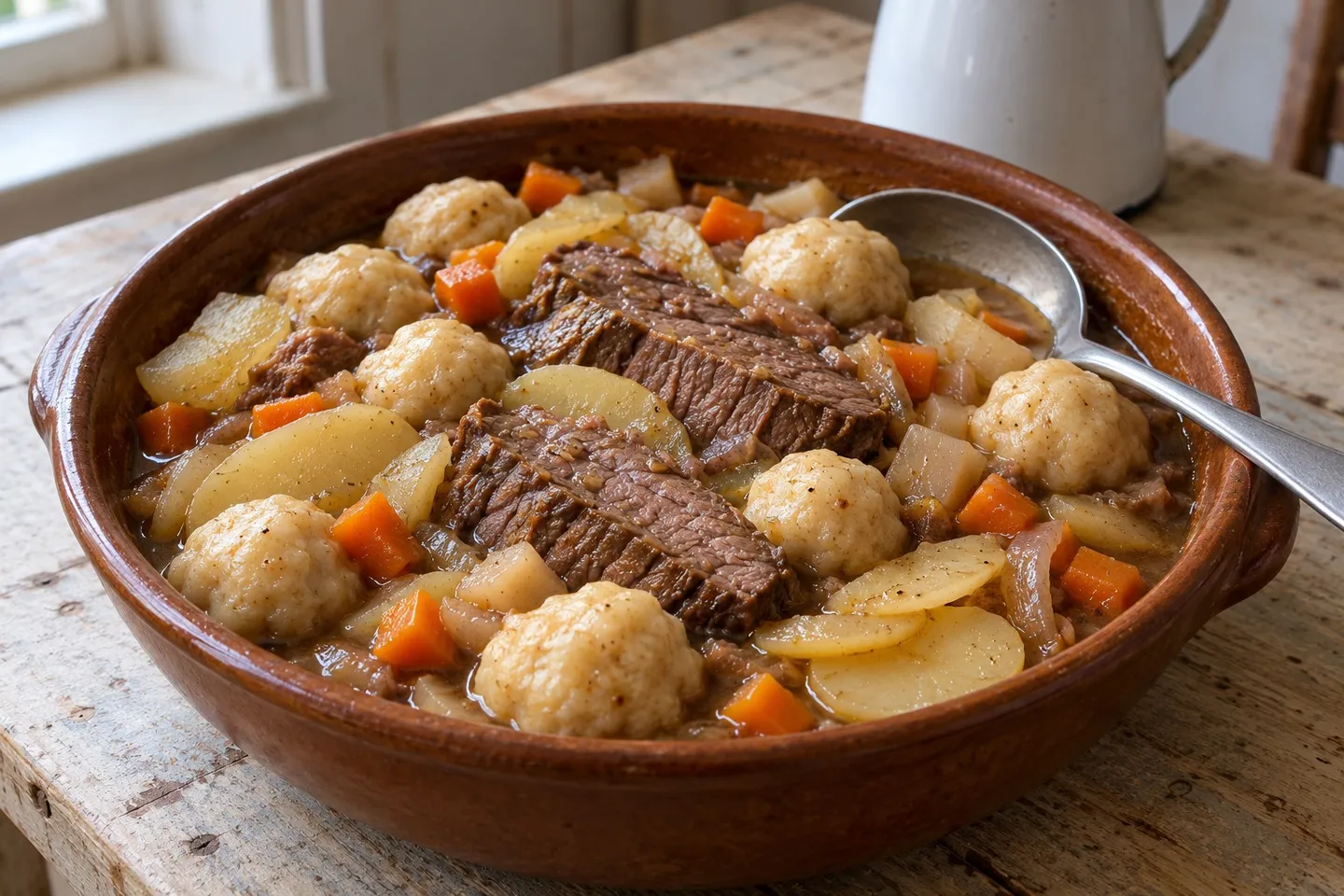
Reader ratingsBeef in the farmer fashion, a whole Sunday dinner in one bag from 1911: floured flank of beef pressed among potatoes, carrots, turnips, onions and little dripping dumplings.
- Recipe makes
- Serves 4
- Prep
- Cook
- Total
Most of the time is hands-off: the bag cooks for 2 to 2½ hours. The book’s own working-man’s dinner took 1½ to 2 hours at a higher heat.
Beef in the farmer fashion, with dumplings and vegetables in gravy.
The story behind the recipe
Sunday dinner for a working family, cooked in a single bag: a floured flank of beef pressed in among sliced potatoes, carrots, turnips and onions, with small dumplings tucked underneath, all cooked together and turned out onto one hot dish. Soyer’s Paper-Bag Cookery (1911) calls it beef “in the good old farmer fashion” and promises “a dinner fit for a king.”
Built in layers
The recipe is the first dinner in the book’s week of working-class meals, and its whole art is in the packing: everything goes in at once, pressed close, and nothing is touched until the bag comes out.
The writer also allowed for the kitchens readers actually had. The bag should sit on a wire broiler in the oven, but a household without one could use “the ordinary gas broiler” and give the bag another quarter of an hour. The 1911 promise behind all of it was a dinner with no shrinkage, no waste and no pans. How the same book also served a barrister’s supper is told in Why Did London Cook Dinner in Paper Bags in 1911?
Read more about this recipe
Making it today
We halve the book’s dinner for four and cook it in a modern oven bag in a deep pan. The biggest change is the heat. The book’s gas oven ran hot and the bag cooked for an hour and a half to two hours; oven bags are made for no more than 400°F (205°C), so we start the oven at that heat and turn it down to 325°F (165°C), a little lower and longer, until the beef is fork-tender. We add a splash of water, which the book doesn’t, because oven-bag makers call for liquid with a pot roast. The book’s “flank of beef” is the American flank steak here; boneless chuck is the usual pot-roast cut in its place.
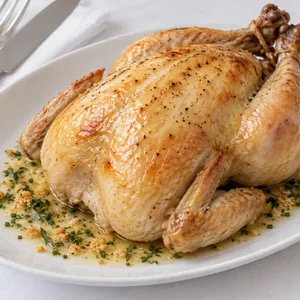
The book’s other menu, the barrister’s supper, puts its roast in a bag too: the Roast Fowl with Savory Crumbs (1911).
Peel the potatoes, slice them very thinly, and leave in water till needed. Peel and slice the onions and turnips and scrape the carrots. ...
Recipe makes: Serves 4
Ingredients
For Serves 4. Quantities are shown as written.
Quantities as written here, for Serves 4.
Dumplings
- All-purpose flour4 oz
- Beef dripping, chilled (heaped)1 tbsp
- Salt1/4 tsp
- Black pepper1/8 tsp
- Cold water3 fl oz
Vegetables
- Potatoes1 lb
- Carrots6 oz
- Turnips6 oz
- Onions6 oz
- Salt1/4 tsp
Beef and seasoned flour
- Beef flank steak2 lb
- All-purpose flour2 tbsp
- Salt1/2 tsp
- Black pepper1/4 tsp
For the bag
- All-purpose flour1 tbsp
- Beef dripping, melted1 tbsp
- Water2 fl oz
Measurement notes
Ingredients as written here
- 4 oz all-purpose flour
- 1 tbsp beef dripping, chilled (heaped)
- ¼ tsp salt
- ⅛ tsp black pepper
- 3 fl oz cold water
- 1 lb potatoes
- 6 oz carrots
- 6 oz turnips
- 6 oz onions
- ¼ tsp salt
- 2 lb beef flank steak
- 2 tbsp all-purpose flour
- ½ tsp salt
- ¼ tsp black pepper
- 1 tbsp all-purpose flour
- 1 tbsp beef dripping, melted
- 2 fl oz water
Equipment
- Large oven bag (about 16 by 17½ inches)
- Roasting pan at least 2 inches deep
- Two mixing bowls
 Small saucepan
 Instant-read thermometer
Instructions
Peel the potatoes, slice them very thinly and leave them in a bowl of cold water.
Peel and slice the onions and turnips, scrape the carrots, and cut all three into small squares, about ½ inch. Rinse them and leave them on a plate.
For the dumplings, rub the chilled beef dripping into the flour with your fingertips until it looks like fine crumbs. Stir in the dumpling salt and pepper, then add the cold water a little at a time, stirring with a knife, to make a soft dough that holds together but isn’t sticky. With floured hands, roll it into balls about 1 inch across, the size of a big Brazil nut. You’ll have 12 to 14.
Heat the oven to 400°F (205°C), with a shelf in the lower third.
Mix the flour, salt and pepper for the seasoned flour in a cup.
Melt the dripping for the bag in the small saucepan. Put the flour for the bag into the oven bag, close it and shake to coat the inside. Pour in the melted dripping and roll the bag about so it coats the bottom. Set the bag in the roasting pan.
Brush the beef steak all over with cold water so it is damp, then sprinkle it on both sides with about half the seasoned flour.
Lift the potatoes out of their water without drying them and sprinkle them with the rest of the seasoned flour. Mix them with the carrots, turnips and onions and sprinkle with the salt for the vegetables.
Put a handful of the vegetables and the dumplings into the bottom of the bag. The book puts “some dumplings” there; putting all of them in the juices is our choice. Lay the beef on top, pressing it down closely against the vegetables, then pack the rest of the vegetables around and over it.
Pour the water into the bag, close it with its tie, and cut six slits about ½ inch long in the top. Tuck the ends in so the bag stays inside the pan.
Put the pan in the oven and turn the heat down at once to 325°F (165°C). Cook for 2 to 2½ hours, until a fork slides easily into the beef through a slit and the potatoes are soft.
Cut the bag open with scissors, keeping your face away from the steam. Check that a dumpling is cooked right through, with no raw dough in the middle; if not, close the bag loosely and give it 15 minutes more.
Tip everything out gently onto a very hot dish and stir the juices and vegetables together with a spoon dipped in boiling water, so the flour thickens the juices into gravy. Slice the beef across the grain and serve it with the vegetables, dumplings and gravy.
Nutrition
650calories per serving
- Recipe makes
- Serves 4
- Servings
- 4
Estimated per serving (a quarter of the bag) from USDA FoodData Central values for the listed ingredients.
Recipe notes
When adjusting quantities
This is half the book’s Sunday dinner, which used 4 pounds of beef for two adults and three or four children, with leftovers. The full amount needs a turkey-size oven bag.
Notes
Quantities mentioned in these notes don’t change when you adjust the servings.
The book washes the beef and leaves it wet so the flour clings; we brush it with water instead, because food-safety advice is not to rinse raw meat. Beef suet can stand in for the dripping in the dumplings, as the book allows. Leftover beef keeps, covered and chilled, for 3 days; reheat it in its gravy until it is steaming hot. Contains wheat.
Scaling changes the ingredients only; pan sizes and cooking times need their own judgment. To adapt this recipe further, try the recipe tool at TuneMyRecipe (opens in a new tab), our sister site.

Sources and attribution
After Nicolas Soyer, Soyer’s Paper-Bag Cookery (New York: Sturgis & Walton, 1911), A Week’s Dinners for the Working Man’s Home, Sunday
Recipe details
- Course
- Main course
- Dish family
- Meat & Poultry
- Region
- British
- Era
- Edwardian
- Source decade
- 1910s
- Main ingredient
- BeefVegetables
- Difficulty
- Easy
- Occasion
- Everyday meal