Paper-bag cookery craze, London, summer 1911 · London
Why Did London Cook Dinner in Paper Bags in 1911?
In 1911 a London club chef promised dinner from a greased paper bag: no pans, no smell, no shrinkage. The craze, the rules and four recipes from his book.
Because a London club chef promised that a greased paper bag, closed with a paper clip and set on a rack in any ordinary oven, could cook nearly the whole dinner, with no pans to scrub, no smell in the flat and no meat shrinking away. Nicolas Soyer, chef at Brooks’s Club, put his system before the readers of the London Daily Chronicle in the spring of 1911, and his book, Soyer’s Paper-Bag Cookery, came out in London and New York that summer. It sold the same bag to everyone: to a bachelor barrister giving a supper for a guest who could only eat white food, and to a working man’s wife feeding six on a Sunday.
A chef and a sheet of foolscap
Soyer told the story of the idea himself, in the book’s introduction. Years earlier, as chef to the Dowager Duchess of Newcastle, he had been cooking small things en papillote, wrapped in a sheet of foolscap writing paper. One day a kitchen-maid put too much sauce in the paper, and “it exploded with a bang.” The fish inside was beautifully tender. He tried again with meat, vegetables and water in an envelope, and that exploded too.
He worked out that the paper burst because it sat on the solid iron shelf, so he set it on a broiler, a wire rack that let the heat pass all round. The cooking was splendid, he wrote, but the food “tasted most unmistakably of the paper.” That was fifteen years before the book. Two more tries, with a chicken and rice and then a fowl with mushrooms, ended the same way, and for the time he gave the idea up.
What brought it back, he said, was a newspaper report about Herr Lampert, “a Frankfort chef,” who had come to London with a special oven for paper cookery. Soyer challenged him. They met at the National School of Cookery in Buckingham Palace Road, Soyer with a small ordinary oven and a supply of grease-proof paper. He cooked eleven dishes, and the judges found that he had proved “cooking in paper is possible in an ordinary oven by direct heat.” All eleven still tasted of paper, by his own account. He went looking for a better paper, found one, and began experimenting in the kitchen at Brooks’s, starting with 18 pounds of beef.
The book calls him the grandson of “the great Soyer,” the Victorian chef Alexis Soyer, and the Daily Chronicle’s G. R. Sims said the same. Research published on alexis-soyer.com, built on archive records, gives his birth name as Marius Soulier, finds no family link, and says Brooks’s dismissed him at the end of May 1911, in the middle of the excitement. The American title page already calls him “Late Chef, Brooks’s Club.”
No pots or pans to clean
The promise went well beyond flavor. “There will be no pots or pans to clean,” Soyer wrote, and meat would shrink less in the bag than in the pan. He wanted the method for everyone: “expert cooking, which has hitherto been the luxury of the rich, can now be equally the privilege of the poor.” All a household needed was “an oven (no matter what sort), a broiler, and the paper-bag.”
He had particular readers in mind. Flats had small kitchens and smelled of cooking; the bag, he claimed, gave off no smell. Women living alone, “typists, clerks, and school teachers,” would sooner eat “a bun and glass of milk” after work than cook and wash up, and the bag offered them a hot meal with nothing to wash but a plate.
The newspaper’s backing carried the idea a long way. Soyer thanked the Daily Chronicle in his introduction and reprinted articles from it, among them a series by Sims. By July the news had reached New Zealand, where the Horowhenua Chronicle of Levin reported that a paper maker, James Spicer and Son, would supply the special grease-proof paper and bags.
In New York, Sturgis & Walton published the book in July 1911 and reprinted it in August. Virginia Terhune Van de Water, who adapted it “to suit American needs,” wrote that the system “has made a great furor in England.” A notice inside the front cover says the American bags were “made only by The Union Bag & Paper Company,” of 17 Battery Place, New York.
How to cook in a bag
The rules are short. Choose a bag that fits the food and grease the inside, except for vegetables or anything cooked with water. Fold the mouth over two or three times and close it with a clip; “Strong wire paper-clips, obtainable of any stationer, answer the purpose.” If a bag leaks, slip it into another. Set the bag on the broiler, never in a dish, except for pies. Roasts go on the lower shelf, fish in the middle, pastry at the top. To check a joint, make a small hole in the bag, or prick it with a needle.
Soyer didn’t claim that everything could be bagged. Tea still went in the teapot, and he listed what to avoid: soup (except beef tea), omelettes, scrambled eggs, jam, cabbage, cauliflower, broccoli, kale, beans, artichokes and macaroni.
Then there is the oven. The book says to light the gas at least eight minutes ahead, and that “the average oven heat should not be less than 200 degs. Fahr.,” turned down to “170 degs.” eight minutes after the bag goes in. A 200°F (95°C) oven is a warming oven; it could not roast a fowl in the 65 minutes the book allows. Our reading is that the figures are Celsius, though the book doesn’t say so: 200°C is about 390°F, and 170°C about 340°F, a hot oven turned down to a moderate one, which fits the times in the recipes. The book itself says a thermometer is most accurate but that experience, or a piece of paper browning in the oven, soon teaches the cook.
The book also admitted the obvious danger. “A draught from an open door or window may cause a gas flame to ignite a bag,” it warns, and if that happens, take the bag out and put it inside a fresh one.
Supper for a barrister
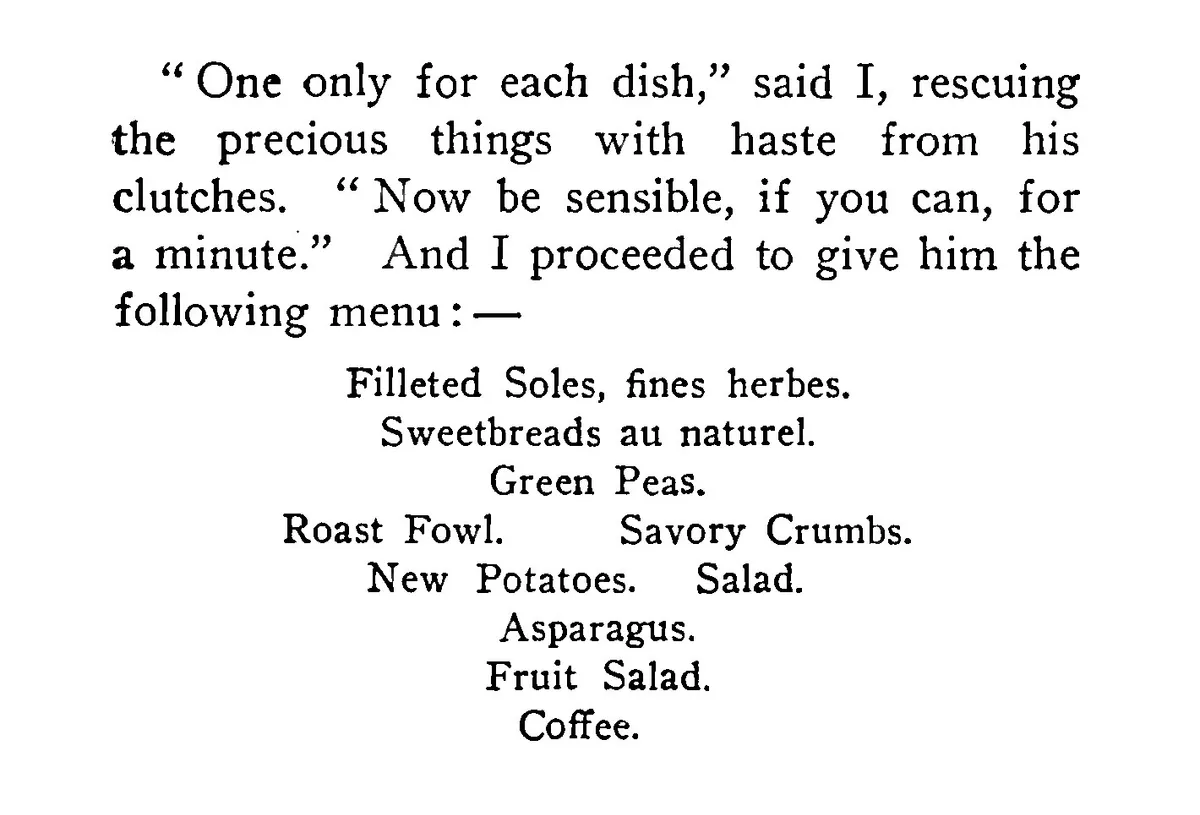
The book’s liveliest chapter, “The Bag and the Bachelor,” is written by an unnamed “cookery expert” about the writer’s youngest brother-in-law, a barrister. His housekeeper has gone away for a day or two, and an eminent lawyer is coming to supper, a man who won’t eat in restaurants and “can only eat white foods, and must have a fruit salad at every meal.” The barrister hasn’t cooked since school. “Paper-bag it,” the writer tells him, and gives him a bag for each dish and a menu.
The supper runs to filleted soles with fines herbes, sweetbreads, green peas, roast fowl with savory crumbs, new potatoes and salad, asparagus as a course of its own, fruit salad and coffee. Everything cooks in a bag except the salads and the fruit. Late that night the barrister telephones: “The old boy was delighted. Helped himself twice to everything, and asked who my cook was!” It’s a story told to sell the system, and it reads like one, but the recipes that follow it are practical, with times for each bag.
Sunday dinner in one bag
The next chapter, “A Week’s Dinners for the Working Man’s Home,” is by “One Who has Tried the Soyer Paper-Bag System.” It plans for a mother, a father and three or four children aged five to twelve, and every dinner of the week goes into a single bag, leaving only the pudding to cook another way.
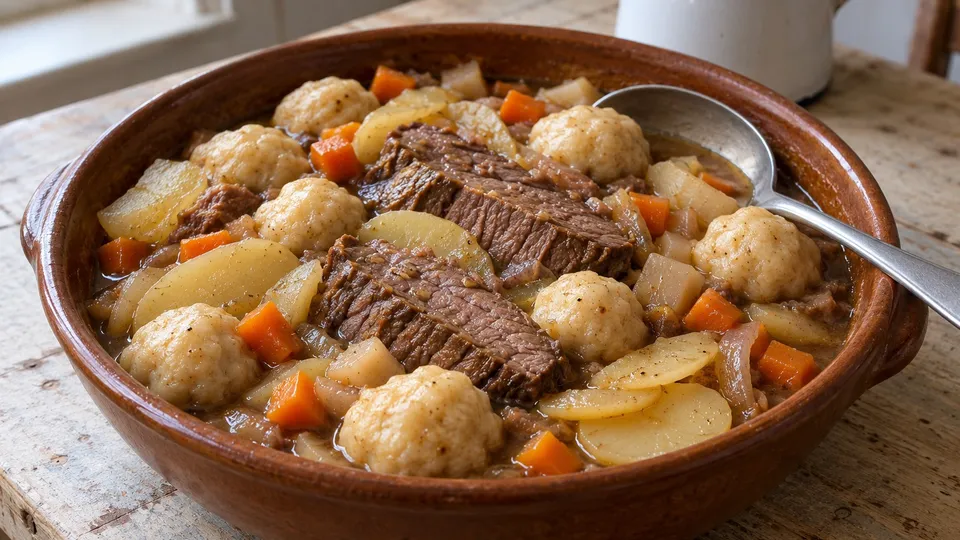
Sunday is beef “in the good old farmer fashion”: the four pounds of flank the chapter reckons on, floured and pressed into a large greased bag among sliced potatoes, carrots, turnips, onions and small suet or dripping dumplings, then cooked for an hour and a half to two hours. The writer counts the meat out per head, a quarter pound for each child and half a pound for each adult, and notes that “if you put 4 lbs. into the bag, 4 lbs. will come out,” so two pounds are left for Sunday supper or Monday’s dinner. Emptied onto a hot dish and stirred, the bag makes “a dinner fit for a king.”
The recipes
These four come from Soyer’s book. The first two are the barrister’s supper in the order of its menu, the third is the working man’s Sunday, and the fourth is a sweet from the book’s chapter of sweets.
- Filleted Soles Fines Herbes (1911): the supper’s fish course, with parsley, mushrooms, shallot and a little sherry.
- Roast Fowl with Savory Crumbs (1911): the supper’s roast, cooked in the bag with buttered crumbs, chives and tarragon.
- Beef in the Farmer Fashion (1911): the working man’s Sunday dinner, with potatoes, roots and dumplings, all in one bag.
- Pommes à la Mascotte (1911): peeled apples rolled in egg and sugar, baked in a paper case and filled with apricot jam.
The bag today
The fashion didn’t last, but cooking in paper never went away. En papillote was a restaurant technique long before Soyer, and parchment packets and plastic oven bags do much the same job today. What has changed is the bag. Food-safety advice is clear that ordinary brown grocery bags were never meant for cooking, so these recipes use parchment paper for the fish and a modern oven bag for the roasts and the apples. Oven bags are made for heat up to 400°F (205°C), which is why none of our oven settings go higher.
Start with the Beef in the Farmer Fashion (1911): the meat, the vegetables and the dumplings all go into one bag and come out together onto one hot dish. The four bags are part of our Edwardian recipes. A year later the cooking of a grand London hotel went to sea, and the Titanic’s last first-class dinner shows the other end of the Edwardian table. For what went into the glasses at an Edwardian table, Forgotten Drink, our sister site, visits an Edwardian country house (opens in a new tab).
 Cook it todayBeef in the Farmer Fashion (1911)
Sources
- Nicolas Soyer, Soyer’s Paper-Bag Cookery (New York: Sturgis & Walton, 1911), with a note to the American edition by Virginia Terhune Van de Water.
- Soyer’s Paper-bag Cookery (London: A. Melrose, 1911), catalogue record (opens in a new tab), University of Minnesota Libraries.
- “Making Grease Proof Paper,” Horowhenua Chronicle (Levin, New Zealand), July 18, 1911, p. 4, at Papers Past (opens in a new tab).
- “Nicolas Soyer (opens in a new tab),” alexis-soyer.com.
- “Brown Paper Bag Method (opens in a new tab),” University of Illinois Extension.
- “Oven Bag Cooking Chart & Guide,” Reynolds Kitchens (the oven-bag maker’s own instructions, cited for the 400°F (205°C) rating).