Pommes à la Mascotte (1911)
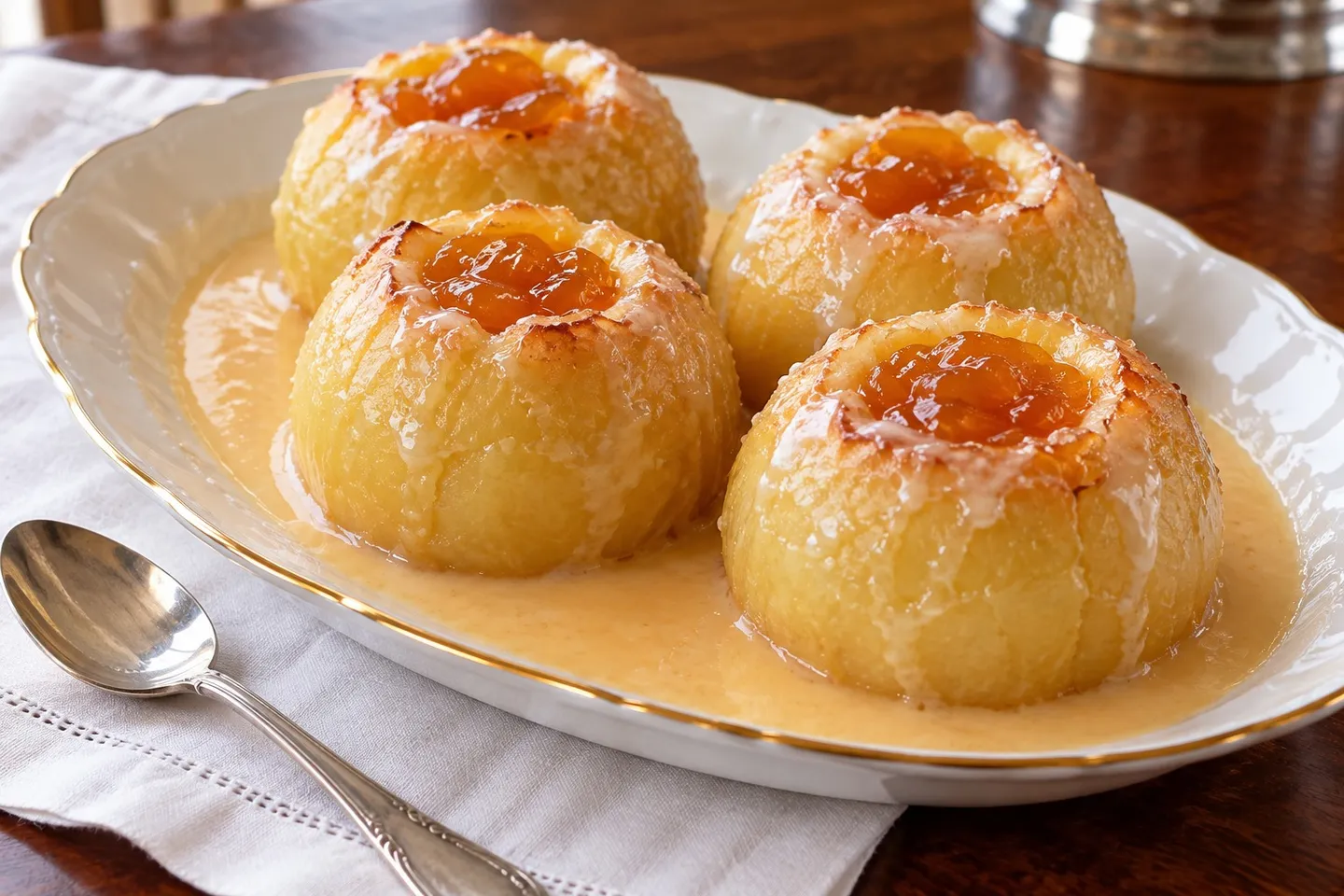
Reader ratingsPommes à la mascotte: peeled, cored apples rolled in vanilla egg and confectioners’ sugar, baked in a paper case inside a bag, then filled with apricot jam and served with apricot cream.
- Recipe makes
- 4 apples, serves 4
- Prep
- Cook
- Total
The apples bake for 30 to 40 minutes in their bag; make the apricot sauce while they bake and serve them at once.
Pommes à la mascotte: glazed apples filled with apricot jam, in apricot cream sauce.
The story behind the recipe
Pommes à la Mascotte are baked apples dressed for company: peeled very thin, cored, rolled in beaten egg scented with vanilla and then in confectioners’ sugar, baked in a paper case inside a bag, and filled with apricot jam when they come out. A little apricot sauce, made with whipped cream, goes round the base. They come from the sweets chapter of Soyer’s Paper-Bag Cookery (1911), where the book makes them by the dozen.
Jam after the bag
Soyer’s general directions list the things he advised against cooking in a bag, and jam is on the list, “except in small quantities.” In this recipe the jam stays out of the bag: the apples bake plain in their coat of egg and sugar, and the jam goes into their centers only after the bag is opened, with the sauce made separately in a small pan.
The book’s menus don’t include this sweet, so it isn’t part of the barrister’s supper or the working man’s Sunday; the barrister finished with fruit salad, and the working man’s week left the pudding to be cooked another way. It is here because it shows the bag at its most delicate, with a paper soufflé case inside the paper bag. The rest of the paper-bag story is in Why Did London Cook Dinner in Paper Bags in 1911?
Read more about this recipe
Making it today
We set the apples in a buttered parchment case inside a modern oven bag, and the bag in a deep pan, because oven bags are meant to sit in a pan. The book bakes the apples “for half an hour in a moderately hot oven.” Modern baked-apple recipes bake whole apples at 375°F (190°C) for 30 to 45 minutes, so we use that heat and start checking at the book’s half hour; firm apples may need 40 minutes. Choose apples that hold their shape when baked. In the steam of a closed bag the egg-and-sugar coat should set as a thin, pale glaze rather than browning as it would in an open dish.
For a main course from the same book that also comes out of one bag, the working man’s Sunday dinner is the Beef in the Farmer Fashion (1911).
Take a dozen large apples, as nearly of a size as possible. Peel very thinly, and remove the cores with an apple corer. ...
Recipe makes: 4 apples, serves 4
Ingredients
For 4 apples, serves 4. Quantities are shown as written.
Quantities as written here, for 4 apples, serves 4.
Apples
- Large apples, as nearly the same size as possible4
- Large egg1
- Vanilla extract1/4 tsp
- Confectioners’ sugar2 oz
- Butter, softened, for the case1 tsp
- All-purpose flour, for the bag1 tbsp
Filling and sauce
- Apricot jam, for the filling4 tbsp
- Apricot jam, for the sauce2 tbsp
- Heavy cream4 fl oz
Measurement notes
Ingredients as written here
- 4 large apples, as nearly the same size as possible
- 1 large egg
- ¼ tsp vanilla extract
- 2 oz confectioners’ sugar
- 1 tsp butter, softened, for the case
- 1 tbsp all-purpose flour, for the bag
- 4 tbsp apricot jam, for the filling
- 2 tbsp apricot jam, for the sauce
- 4 fl oz heavy cream
Equipment
- Apple corer
- Shallow bowl and a plate
- Parchment paper
- Large oven bag (about 16 by 17½ inches)
- 9 by 13-inch baking pan, at least 2 inches deep
 Small saucepan
 Fine sieve
 Whisk
Instructions
Heat the oven to 375°F (190°C), with a shelf in the middle.
Cut a sheet of parchment about 12 inches square and fold up the edges about 1½ inches, pinching the corners, to make a shallow case. Spread the butter over the bottom of the case.
Peel the apples very thinly and core them right through with the apple corer.
Beat the egg with the vanilla in the shallow bowl. Spread the confectioners’ sugar on the plate.
Roll each apple in the egg so it is coated all over, then roll it in the sugar, pressing on a thick coat. Stand the apples upright in the case, a little apart.
Put the flour into the oven bag, close it and shake so the inside is coated. Set the bag in the baking pan and carefully slide the case of apples into it. Close the bag, cut four slits about ½ inch long in the top, and tuck the ends into the pan so no part of the bag hangs over the edge.
Bake for 30 to 40 minutes, until a skewer pushed into an apple through a slit meets no resistance.
While the apples bake, warm all the apricot jam gently in the small saucepan and press it through the sieve. Keep two thirds aside for the filling and leave the rest in the pan for the sauce.
Whip the heavy cream until it holds soft peaks.
When the apples are ready, take the pan out of the oven and cut the bag open with scissors, away from your face because of the steam.
Bring the jam for the sauce back to a bubble, take it off the heat and whisk in the whipped cream until smooth.
Lift the apples onto a warm serving dish, fill the center of each with the strained jam for the filling, pour a little of the sauce round the base, and serve at once.
Nutrition
360calories per serving
- Recipe makes
- 4 apples, serves 4
- Servings
- 4
Estimated per apple with its filling and sauce from USDA FoodData Central values for the listed ingredients.
Recipe notes
When adjusting quantities
This is a third of the book’s dozen apples. The egg coats four to six apples; for a full dozen use two or three eggs and two bags.
Notes
Quantities mentioned in these notes don’t change when you adjust the servings.
The sauce thins as the cream melts into the hot jam; pass any extra in a jug. Contains egg, milk and wheat (flour in the bag).
Scaling changes the ingredients only; pan sizes and cooking times need their own judgment. To adapt this recipe further, try the recipe tool at TuneMyRecipe (opens in a new tab), our sister site.
Sources and attribution
After Nicolas Soyer, Soyer’s Paper-Bag Cookery (New York: Sturgis & Walton, 1911), Pommes à la Mascotte
Recipe details
- Course
- Dessert
- Dish family
- Desserts & Sweets
- Region
- British
- Era
- Edwardian
- Source decade
- 1910s
- Main ingredient
- Fruit
- Difficulty
- Easy
- Occasion
- Dinner party