Egg Nigiri (1910)
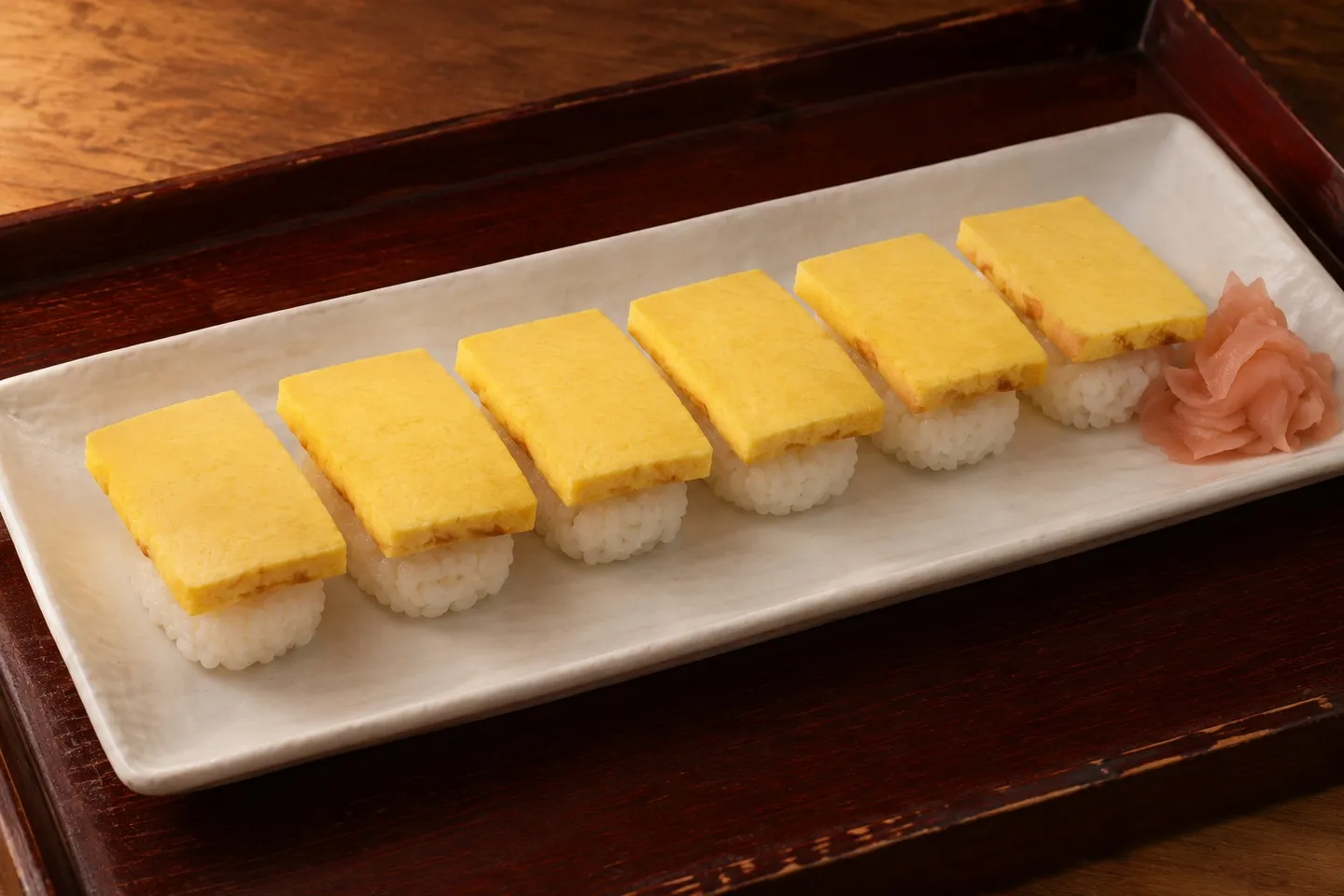
Reader ratingsEgg nigiri from Koizumi Ugai’s 1910 Tokyo book on home sushi: a thin sheet of egg seasoned with mirin, sugar and soy, cut into oblongs and pressed onto vinegared rice, pale side up.
- Recipe makes
- 6 pieces, serving 2
- Prep
- Cook
- Total
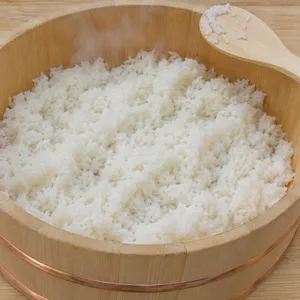
Start the Sushi Rice (1910) first, about an hour. Cook the egg while the rice drains and cooks, so it has cooled when the rice is seasoned, and shape the pieces while the rice is still warm.
Six egg nigiri on a long white plate with pickled ginger.
The story behind the recipe
Egg comes first among the hand-shaped sushi in Koizumi Ugai’s Katei sushi no tsukekata (Tokyo, 1910), and he said why: it was easy to prepare. The book came from the Yohei sushi shop, whose master its title page credits as author, and it opens its nigiri chapter with this thin sheet of egg, sweet and salty, cut into oblongs and set on rice browned side down.
Egg on the earliest nigiri
Egg is older on nigiri than this book. In the late Edo period Kitagawa Morisada drew Edo’s nigiri in his notebook, and the first sketch on the page is an oblong of rice under a slab of egg, labeled just “egg.” Koizumi’s recipe is a 1910 household version, from a shop that traced itself to the Edo founder Yohei; how the stalls of the 1820s made theirs is not recorded.
His seasoning is mirin, soy and akuhiki, sugar boiled with water and an egg white and skimmed again and again until it ran clear, about half a small sake cup of each to three good large eggs. He cooked the egg in sesame oil, wiped thin over the pan, pressed it hard with the pan lid and turned it out onto the lid. He wanted hard charcoal and a strong fire, and over gas he slid a metal plate under the pan so the egg wouldn’t scorch. Once the egg was cold he trimmed every edge thinly, “to avoid the oily smell.” He also had a word about the mirin: cheap sake and mirin sold by measure, he warned, were often doctored with salicylic acid powder, and a good bottled mirin was worth the extra cost.
Read more about this recipe
Making it today
Koizumi told households to use whatever egg pan they had, or even a frying pan, so a 20 cm nonstick frying pan does the job here, with white sugar, dissolved straight into the eggs, for his skimmed syrup. The amounts of seasoning are our reading of his half sake cup: 10 ml each of mirin and soy, and 8 g of sugar for the syrup. Koizumi rolls the setting egg from its lower edge with a bamboo spatula as he turns it; we turn a flat sheet with a plate, which gives the same thin slab to cut. His pieces measure about 4.5 by 7 cm, and we keep that size.
The rice under it is the Sushi Rice (1910) from the first chapter of the same book. The Yohei shop and its claim to nigiri are in When Did Sushi Leave the Press for the Hand?
(一)薄焼玉子
材料 鷄卵 すし飯 道具 玉子焼鍋 竹べら
〔調和方〕佳良の大なる鷄卵三個を器に割り、味淋、アク引、醬油、各々小さき猪口に半杯程を混ぜ、箸にてよく攪拌して置きます。
〔焼き方〕胡麻の油少量を布片又は紙にて玉子焼鍋に塗りてよく拭き、さて鍋を火に懸け、鍋の熱するを待つて、前の材料を器より鍋に手早く流し込みます。鍋の玉子が漸く泡立つて來ましたら、竹べラを使つて下端から切れぬやうに巻き上げながら、玉子の表裏を速く轉じて鍋蓋にて強く壓し、鍋を轉して玉子を蓋に取り、之を他の平らな板又は膳に移します。
〔握り方〕焼きたる玉子のよく冷るのを待つて四方の耳を薄く落し(油臭きを避けるため)、巾一寸五分長さ二寸二三分位づゝに切ります。握りますには色の薄い方を上にし、焦色の方を飯につけて、なるべく材料を切り損じないやうに輕く握るのです。
In our translation: “(1) Thin egg. Ingredients: eggs, sushi rice. Tools: egg pan, bamboo spatula.
“Mixing. Break three good large eggs into a bowl, add mirin, akuhiki syrup and soy, about half a small sake cup of each, and beat well with chopsticks.
“Cooking. With a scrap of cloth or paper, spread a little sesame oil over the egg pan and wipe it well. Set the pan on the fire, wait for it to heat, and pour the mixture in quickly. When the egg in the pan begins to bubble, use the bamboo spatula to roll it up from the lower edge without tearing it, quickly turning the egg over, press it hard with the pan lid, turn the pan over to take the egg onto the lid, and move it to another flat board or tray.
“Shaping. Wait until the cooked egg is quite cold, trim the four edges thinly (to avoid the oily smell) and cut it into pieces about one sun five bu wide and two sun two or three bu long. To shape, put the paler side up and the browned side against the rice, and press lightly, taking care not to break the topping.”
Recipe makes: 6 pieces, serving 2
Ingredients
For 6 pieces, serving 2. Quantities are shown as written.
Quantities as written here, for 6 pieces, serving 2.
- Large eggs3
- Mirin10 ml
- Sugar8 g
- Japanese soy sauce10 ml
- Untoasted sesame oil5 ml
- Seasoned sushi rice120 g
- Plain rice vinegar, for the hands30 ml
Measurement notes
Ingredients as written here
- 3 large eggs
- 10 ml mirin
- 8 g sugar
- 10 ml Japanese soy sauce
- 5 ml untoasted sesame oil
- 120 g seasoned sushi rice
- 30 ml plain rice vinegar, for the hands
Equipment
 Kitchen scale
 Mixing bowl
 Paper towel
 Whisk
 Nonstick frying pan, 20 cm (8-inch) across
 Flat spatula
 Large plate
 Instant-read thermometer
 Cutting board and knife
- Small bowl
Instructions
Start the seasoned sushi rice first, from the Sushi Rice (1910) recipe; the egg is cooked and cooled while the rice drains, cooks and rests.
Whisk the large eggs in the mixing bowl with the mirin, sugar and Japanese soy sauce until the sugar has dissolved and no streaks of white remain.
Put the untoasted sesame oil in the frying pan and wipe it over the whole surface with a folded paper towel, leaving only a thin film. Heat the pan over medium-low heat for 1 minute.
Pour in all the egg (for a double batch, half of it, then cook the second sheet the same way) and tilt the pan to cover the base evenly. Cook for 3 to 4 minutes, pricking any large bubbles, until the edges are set and the top is barely liquid.
Slide the sheet onto the large plate, set the pan upside down over it and turn the two over together, so the egg drops back into the pan with its uncooked side down.
Press the sheet flat with the spatula and cook for 1 to 2 minutes more, until no liquid egg remains anywhere and the center reads 160°F (71°C) on the thermometer.
Slide the egg onto the cutting board, browned side down, and let it cool for 15 minutes.
Trim a thin strip from each edge to make a square, then cut each sheet into six pieces about 4.5 cm wide and 7 cm long.
Pour the plain rice vinegar into the small bowl and dip your fingertips in it. Divide the warm seasoned rice into as many equal portions as you have pieces of egg and squeeze each lightly into an oblong about 5 cm long.
Lay a piece of egg across the fingers of one hand, browned side up. Set a rice oblong on it, press it down gently with two fingers of the other hand, then turn the piece over so the egg is on top and press lightly along the sides to shape it.
Repeat with the rest, wetting your fingertips with the vinegar as the rice starts to stick. Serve within 2 hours of cooking the egg, which is cooked first.
Nutrition
250calories per serving
- Recipe makes
- 6 pieces, serving 2
- Servings
- 2
Estimated per serving (3 pieces) from USDA FoodData Central values for whole egg, sugar, mirin, soy sauce, sesame oil absorbed in the pan and the seasoned rice, with the trimmed edges left out.
Recipe notes
When adjusting quantities
Three eggs make one sheet in a 20 cm pan and six pieces. For twelve pieces, cook two sheets one after the other.
Notes
Quantities mentioned in these notes don’t change when you adjust the servings.
The eggs must be cooked until firm right through; FoodSafety.gov gives 160°F (71°C) for egg dishes. Nigiri is best eaten the hour it is made. If any is left, refrigerate it and eat it within 24 hours; the rice will harden. Koizumi’s akuhiki used 1 kanme (3.75 kg) of sugar to 1 shō of water and one egg white, boiled and skimmed four or five times; white sugar needs none of that. Wiping the hands with plain vinegar is his; many cooks today use water with a little vinegar in it. On the next page he folds the same egg around the rice like a leaf-wrapped rice cake, as kashiwa tamago. Contains egg, soy and sesame; many soy sauces contain wheat.
Scaling changes the ingredients only; pan sizes and cooking times need their own judgment. To adapt this recipe further, try the recipe tool at TuneMyRecipe (opens in a new tab), our sister site.
Sources and attribution
After Koizumi Ugai, Katei sushi no tsukekata (Tokyo, 1910), Thin egg (usuyaki tamago)
See the original pages (scan at dl.ndl.go.jp) (opens in a new tab)
Recipe details
- Course
- Main course
- Region
- Japanese
- Era
- Edwardian
- Source decade
- 1910s
- Main ingredient
- EggsGrains & rice
- Difficulty
- Intermediate
- Occasion
- Everyday meal