Hand-shaped nigiri sushi appears in Edo · Edo (Tokyo) · c. 1820
When Did Sushi Leave the Press for the Hand?
Edo sushi went from a weighted box to the hand in the early 1800s, and no one wrote down the day. The evidence, and the Yohei shop’s 1910 egg nigiri and inari.
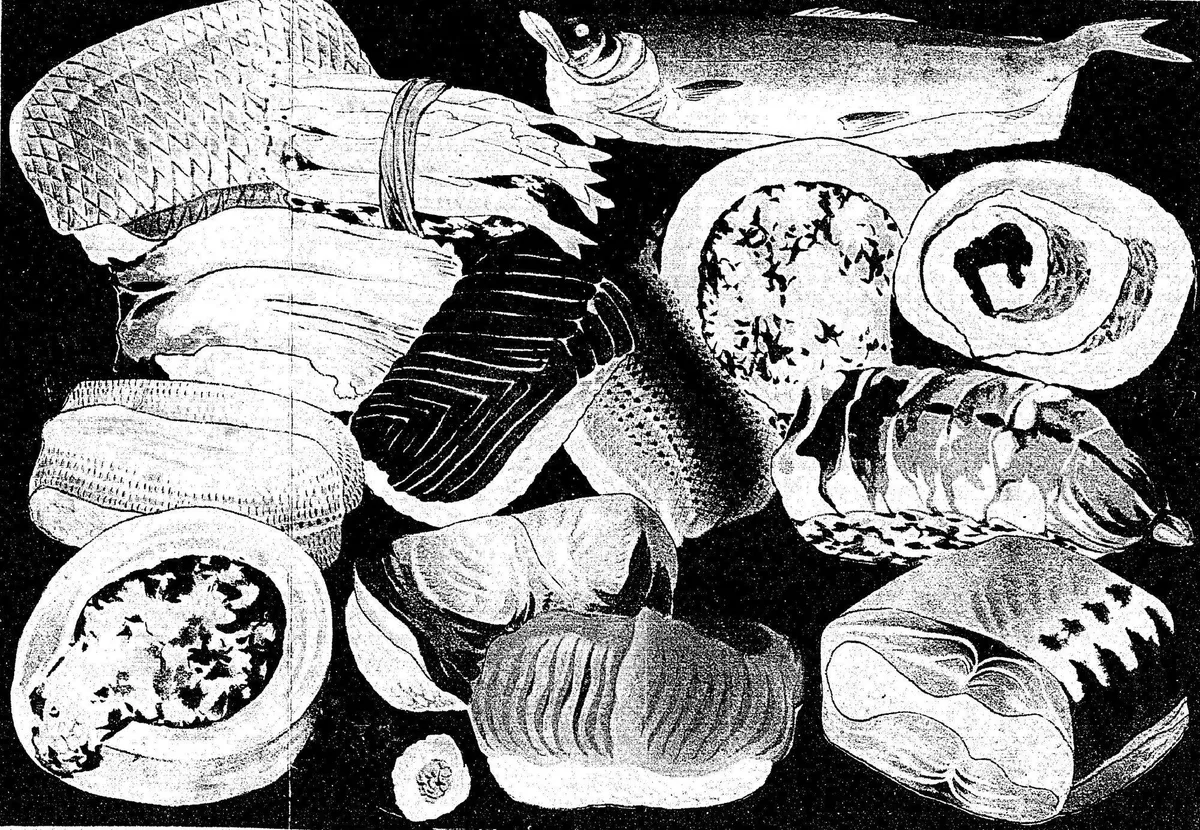
Sushi left the press for the hand in Edo, the city now called Tokyo, in the early nineteenth century, and the man who described the change best couldn’t say when it happened. All three great cities had once made pressed sushi, Kitagawa Morisada wrote in a notebook of the late Edo period, but in Edo, “since when, I wonder” (江戸ハイツ比ヨリ歟), the box was given up and only nigiri was left. The shop most often credited with the change put its own account into print in Tokyo in July 1910, in a household book that teaches egg nigiri and inari to home cooks. Its author admits, in the middle of claiming the honor, that others had tried the method first.
Rice that was thrown away
The older sushi was a way of keeping fish. Koizumi Ugai’s 1910 book ends with a history of sushi, and to show the old kind he chose the funa-zushi of Ōmi, made from crucian carp around Lake Biwa and once sent by the Hikone domain to the shogun. The fish were salted for forty or fifty days, washed, stuffed with cooled rice and packed in a tub between layers of rice, under a lid and a heavy stone. They fermented through the heat of the sixth month and were ready by winter. At serving, the rice came off. “Funa-zushi,” Koizumi summed up, “lets the rice rot, and only the fish is eaten” (鮒鮓は飯を腐らして魚のみ食用とする).
It was no relic in 1910. Passing that stretch of line on a trip west, he wrote, a traveler could still call for it from the train window. He also quoted the poet Buson, who died in 1784: “Funa-zushi, and over Hikone Castle the clouds hang” (鮒すしや彦根が城に雲かゝる).
Vinegar and the box
Edo bought its sushi ready-made long before nigiri. Japan’s National Diet Library, in an online exhibition on fish in the Edo period, places fermented sushi in Edo’s eating houses in the later seventeenth century, and then, in the Hōreki era of 1751 to 1764, hayazushi, “fast sushi,” which took its sourness from vinegar instead of months of fermentation, sold in eating houses and at stalls. The next step was the box: seasoned rice packed into a wooden frame, fish laid on top and the lid pressed down. Stall sushi came already scored into pieces for easy eating. A comic novel of 1770, Yūshi hōgen, already shows sellers of horse mackerel and gizzard shad sushi.
Morisada drew the box. His was about four sun square, roughly 12 cm, with a lid that fitted inside it. Rice mixed with vinegar and salt went in by halves, with shiitake simmered in soy and chopped fine between them; on top went egg omelet, sea bream and thin slices of abalone, and the whole was weighted and then cut, four by three, into twelve.
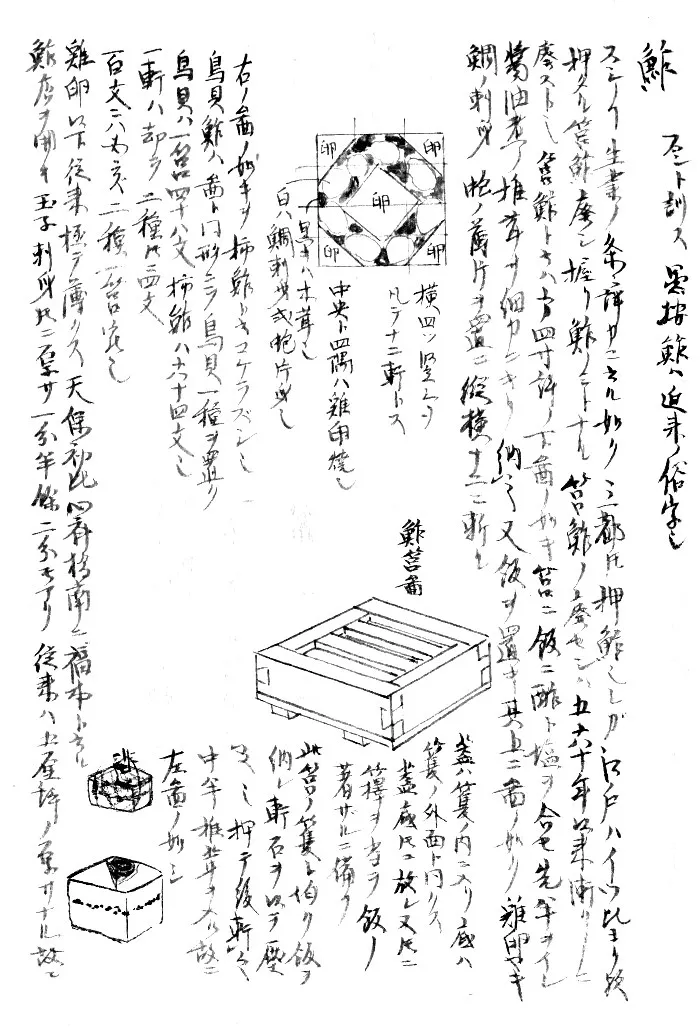 Box sushi and the box it was pressed in, from Kitagawa Morisada’s notebook (Morisada mankō, later collection, book 1), frame 26. National Diet Library Digital Collections.
The book from the Yohei shop copies out a biography of its founder on why the box lost out. The sushi of his youth, it says, had too much rice and was coarse. Fish went on rice shaped in the hand, the pieces were set in a box with a bamboo leaf between each, a lid and a stone went on top, and after three or four hours each piece was prised out with a bamboo spatula. Made that way it kept for three days, so a shop could tell a customer it was “ready right away,” but each batch sat for hours under the stone, and the pressing squeezed the oil, and with it the flavor, out of good fish. Yohei, the biography says, disliked the slowness and worked out a quick sushi pressed in the hand instead. Even in the shop’s own telling, the hand came before the invention; what Yohei dropped was the box and the wait.
What Morisada saw in Edo
Two pages on, Morisada gives the clearest picture of early nigiri there is. “Edo’s present make is nigiri sushi,” he wrote, and listed the toppings: “egg omelet, kuruma prawn, prawn floss, whitebait, tuna sashimi, gizzard shad, conger simmered sweet, left whole.” The first drawing on the page is an oblong of rice under a slab of egg, labeled simply “egg” (玉子). Below come rolls with gourd strips and nori, a conger, whitebait held on with a band of dried gourd, tuna and a gizzard shad with its tail on. For the tuna and shad, he noted, the wasabi went between the rice and the fish. Vinegared young ginger came on the side, and cut bamboo leaves divided the pieces.
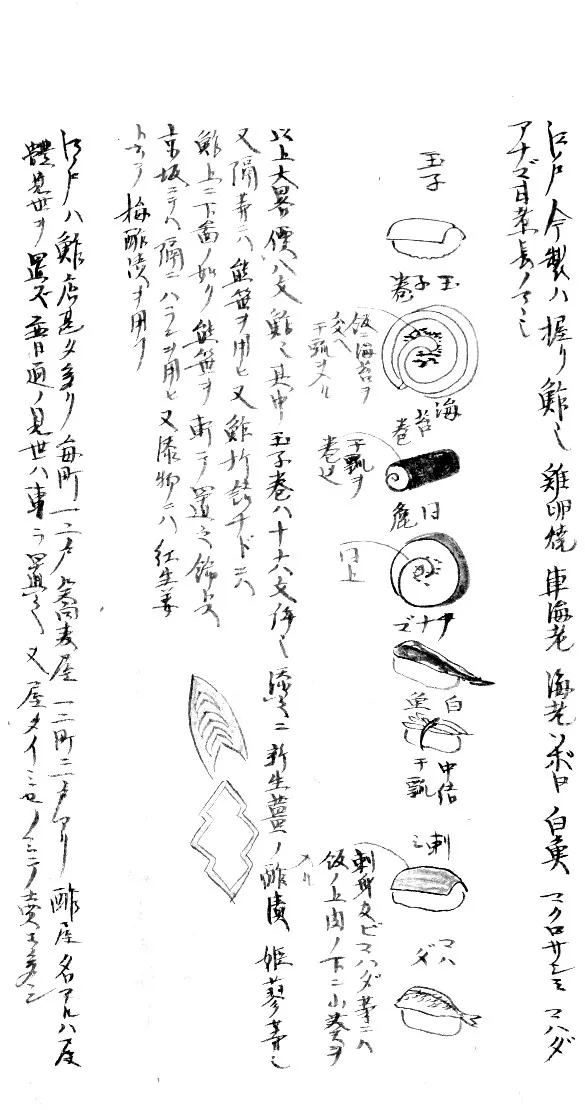 Edo’s nigiri, with egg drawn first, from Kitagawa Morisada’s notebook, frame 27. National Diet Library Digital Collections.
The National Diet Library adds a note that changes the picture of that tuna: Edo didn’t care for the fatty belly, and the lean red meat was marinated in soy before it went on the rice. Morisada also gives a sense of the trade’s size. By his count Edo had one or two sushi shops to every block, where soba shops ran to one for every block or two. Kyoto and Osaka, in his account, went on pressing theirs in a box, with one telling exception. From about the end of the Bunsei era, around 1830, a shop south of Ebisu Bridge in Osaka, the Matsu no sushi, sold “Edo-style nigiri” (江戸風ノ握リ鮓). When he lived in Osaka, he wrote, it was the only one; now, he had heard, they were sold in many places.
Who invented nigiri?
No document names the first person to shape sushi by hand. The name that comes up is Yohei, founder of the Yohei sushi shop at Ryōgoku, often called Hanaya Yohei, and the fullest case for him comes from his own shop. An outsider vouches for the shop’s fame, if not for the invention: on the page after his nigiri drawings, Morisada lists “Yohei’s sushi” at Moto-machi in East Ryōgoku (元町與兵衛鮓) among Edo’s best-known sushi. Koizumi’s book has “by the master of Yohei sushi” brushed on its title page. In its history chapter he writes that, according to old records, nigiri began in Edo at the start of the Bunsei era, “ninety years ago,” and that the first Yohei devised the new method. Until then, he adds, you could have searched every street of Edo and found no trace of it.
Then he qualifies it himself: “There do seem to have been two or three who attempted this method before Yohei” (尤も與兵衛以前に之の法を企てた者も二三はありましたやうですが). They failed, he says, to suit the public taste. So Yohei may be called the founder of nigiri, in the way haikai verse only became literature with Bashō: others had gone before, and he showed what the thing was worth. The National Diet Library’s exhibition, working from the same period sources, leaves the exact birth of nigiri unknown and places it before the Bunsei era, which began in 1818. The two accounts fit together if one is about the first pieces and the other about the first shop to make them famous. Morisada’s Osaka shop sets a later bound on both: by about 1830 nigiri was well enough known as Edo’s own to be sold under the city’s name in Osaka.
The shop’s own story of its rise is a modest one. The founder made the sushi himself in a rented house, carried it through the streets in a lidded box, and later set up a stall every night, selling until late, before he took a shop. Koizumi quotes a comic verse on the crowds that followed: “Packed in and worn out with waiting at Yohei’s sushi, the customers clench their hands along with him,” a pun on nigiru, to grip. He also quotes, from a contemporary’s notebook, an entry for the fourth month of 1842, during the Tenpō reforms against luxury, that lists the sushi of Yohei among the costly goods whose sellers were taken in by the authorities. In Koizumi’s telling the arrest only made the public more curious.
A sushi shop’s book for the home
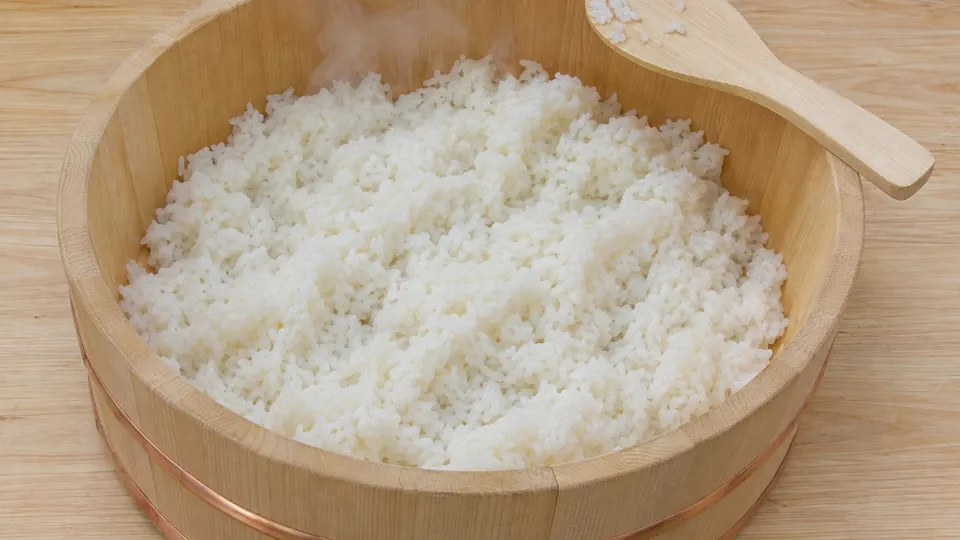
The book itself is small and practical. Katei sushi no tsukekata, “How to make sushi at home,” was printed by Ōkura Shoten in Tokyo on July 20, 1910, and published on the 24th; the text is signed Koizumi Ugai and the colophon names Koizumi Seizaburō. Its first chapter starts where a sushi master would: “Whatever the sushi, the first essential is the rice.” The rice goes into water already boiling, rests twenty minutes, and is seasoned with nothing but vinegar and salt while it is hot.
For the hand itself, Koizumi allowed that every house had its own grip, finer or rougher, and drew the simplest one he knew in a sequence of hands.
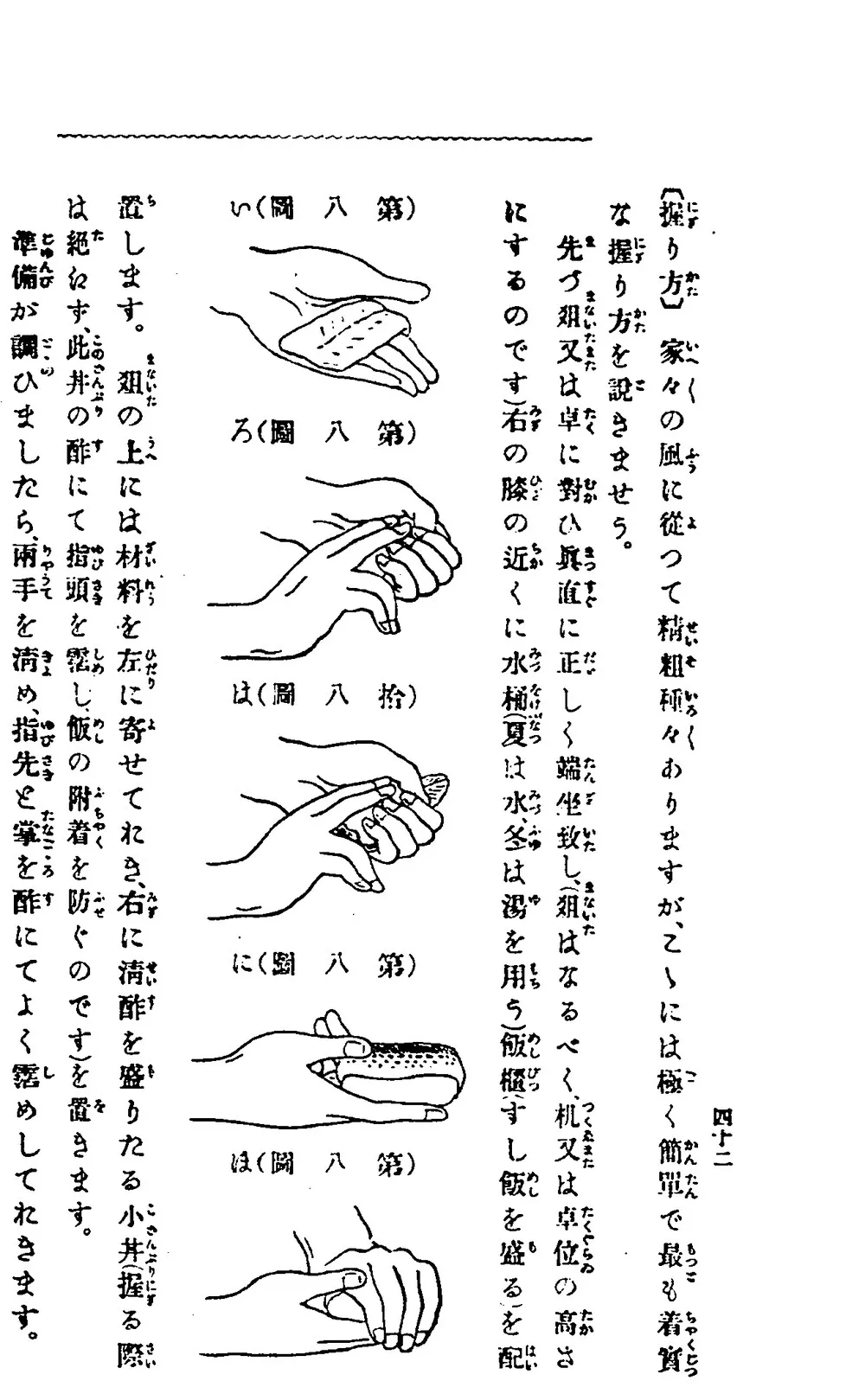 The grip, figure 8, from Koizumi Ugai, Katei sushi no tsukekata (Tokyo, 1910), p. 42. National Diet Library Digital Collections.
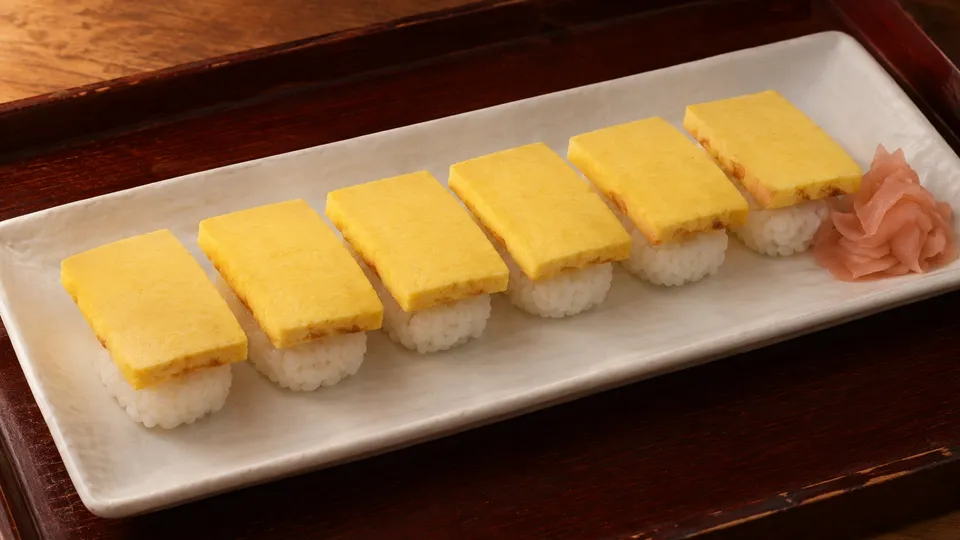
Among the hand-shaped sushi he put egg first, because it was easy to prepare. His inari is the fried tofu pocket filled with seasoned rice, under its other name too, Shinoda-zushi. The pockets are simmered in mirin, or sake, with light soy, and the rice is mixed with lotus root and perilla seeds. That fried tofu is the same bean curd that a New York cookbook called “bean cake” seven years later, as How Did a 1917 Cookbook Bring Chop Suey Home? tells.
These are recipes from 1910, written for Tokyo households by a shop that traced itself to Yohei. They show what that shop taught at the end of the Meiji era; how Edo’s stalls made their egg in the 1820s is not recorded.
The recipes
All three come from Koizumi’s book, in the order he teaches them. No single meal served them together; the grouping is ours.
- Sushi Rice (1910): short-grain rice put into boiling water, rested and seasoned hot with vinegar and salt, without sugar.
- Egg Nigiri (1910): a thin, sweet-salty sheet of egg cut into oblongs and pressed onto rice, pale side up.
- Inari Sushi (1910): fried tofu pockets simmered in mirin and light soy and filled with rice, lotus root and perilla seeds.
Cooking it
The one detail Koizumi insists on is timing: vinegar goes on the rice straight from the pot, because cold rice seasons unevenly and crumbles in the hand. So have the egg cooled and the pockets simmered before you start the Sushi Rice (1910), and the rice will be warm when the Egg Nigiri (1910) needs it.
 Cook it todaySushi Rice (1910)
 Cook it todayEgg Nigiri (1910)
Sources
- Koizumi Ugai (Koizumi Seizaburō), Katei sushi no tsukekata (Tokyo: Ōkura Shoten, 1910), title leaf, pp. 1–7, 42–46, 132–134, 149–150, 158–161 and colophon. National Diet Library copy, call no. 246-213, NDL Digital Collections (opens in a new tab).
- Kitagawa Morisada, Morisada mankō, later collection, book 1 (manuscript, late Edo period), frames 26–28. National Diet Library, call no. 寄別13-41, NDL Digital Collections (opens in a new tab).
- National Diet Library, “Tenka tai-hei: fish and people in the Edo period,” Book Kaleidoscope no. 30, chapter 3. ndl.go.jp (opens in a new tab).