Rolled Oat Mush (1896)
Reader ratingsRolled oat mush by Fannie Farmer’s 1896 cereal table, boiled five minutes and steamed half an hour, served with milk and maple sugar as Horace Fletcher ate his cereal at Yale.
- Recipe makes
- About 2½ cups, 2 servings
- Prep
- Cook
- Total
About 5 minutes to bring the water to the boil, 5 minutes of boiling over direct heat and 30 minutes over simmering water.
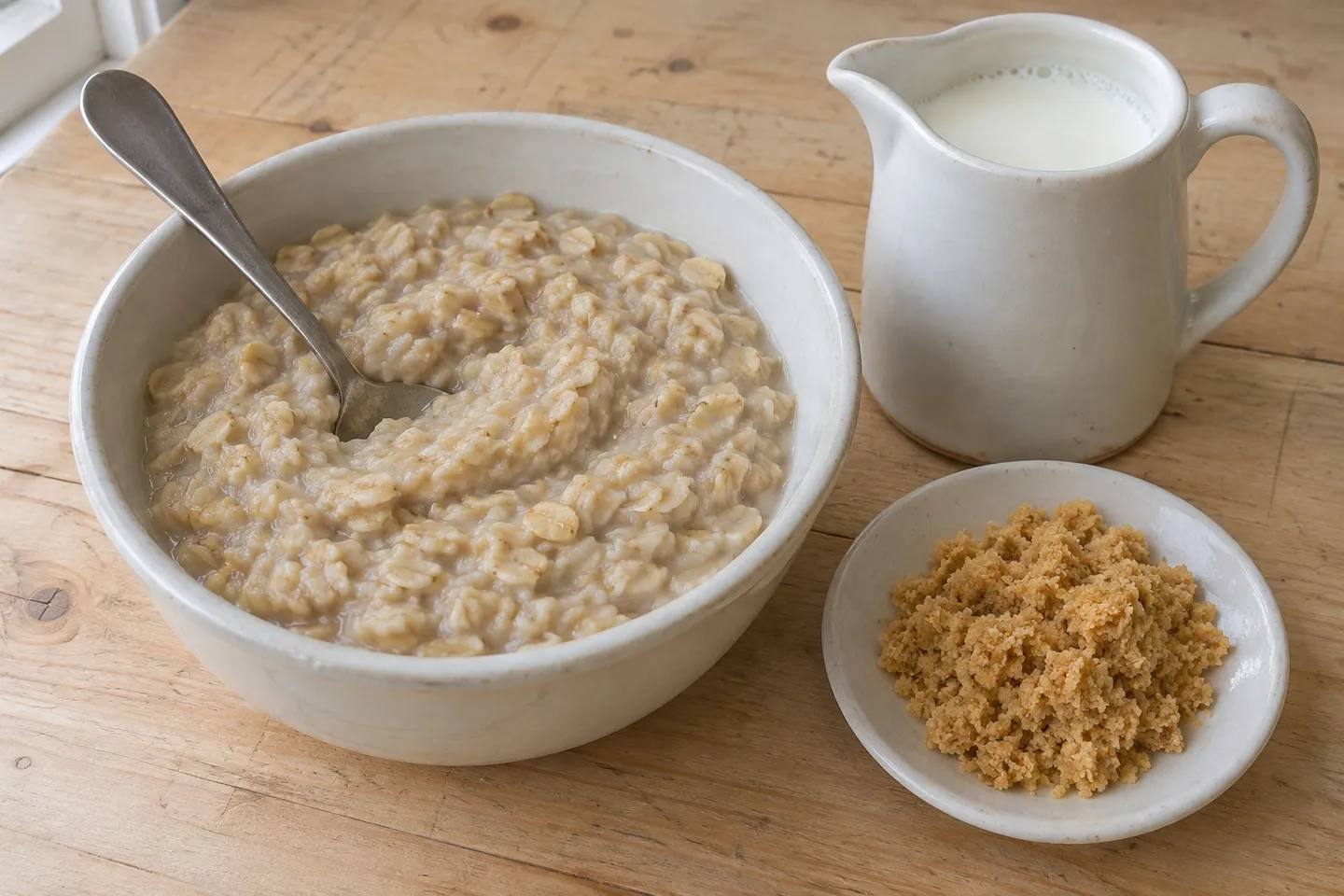
Bowl of rolled oat mush with a pitcher of milk and a dish of maple sugar.
The story behind the recipe
Russell H. Chittenden never named the cereal Horace Fletcher chose at Yale in February 1903. He called it only a prepared cereal food, and set it beside milk and maple sugar as the whole of the diet. What a prepared cereal was, Fannie Farmer’s Boston Cooking-School Cook Book had explained seven years earlier: oats “steam-cooked and rolled,” sold under names such as Rolled Avena, Quaker Rolled Oats and H-O, “put up in one and two pound packages, with directions for cooking.” This bowl takes the first line of her cereal table and adds the milk and maple sugar from Chittenden’s list.
Farmer didn’t trust the packet
The directions on those packages were wrong, in Farmer’s view. “In nearly all cases, time allowed for cooking is not sufficient,” she wrote, unless the cereal sat right on the fire, “which is not the best way.” Her answer was the double boiler: five minutes over the heat, then cooking “over hot water,” and anyone without one should “improvise one.” Even rolled oats, made to cook fast, got half an hour by her table. Salt went in at the start, “to give flavor.”
Read more about this recipe
How close is this to Fletcher’s bowl?
As close as the record allows, which is not very. The laboratory weighed every portion but printed only what was in it: protein, fat, carbohydrate and calories. The brand, the cooking and how much milk and sugar went with each meal are lost, and so is whether the milk went on the cereal or into a glass. Fletcher picked the foods himself and ate as much as his appetite asked for, twice a day; how the laboratory and the gymnasium tested him is the subject of What Did Horace Fletcher Eat at Yale in 1903?
Making it today
Old-fashioned rolled oats are the nearest thing to Farmer’s steam-cooked oats. Her water has lasted: Quaker’s directions today give the same 1¾ cups to a cup of oats for two servings. Her time has not, since the packet now asks for about five minutes on the stove. We keep her five minutes on the heat and her half hour over simmering water. We halve her salt, and the milk and maple sugar, with their amounts, are our choice. For the other end of the oat shelf, Margaret Mitchell’s Fireless Cooker Steel Cut Oatmeal (1909) soaks coarse oats all day and cooks them overnight.
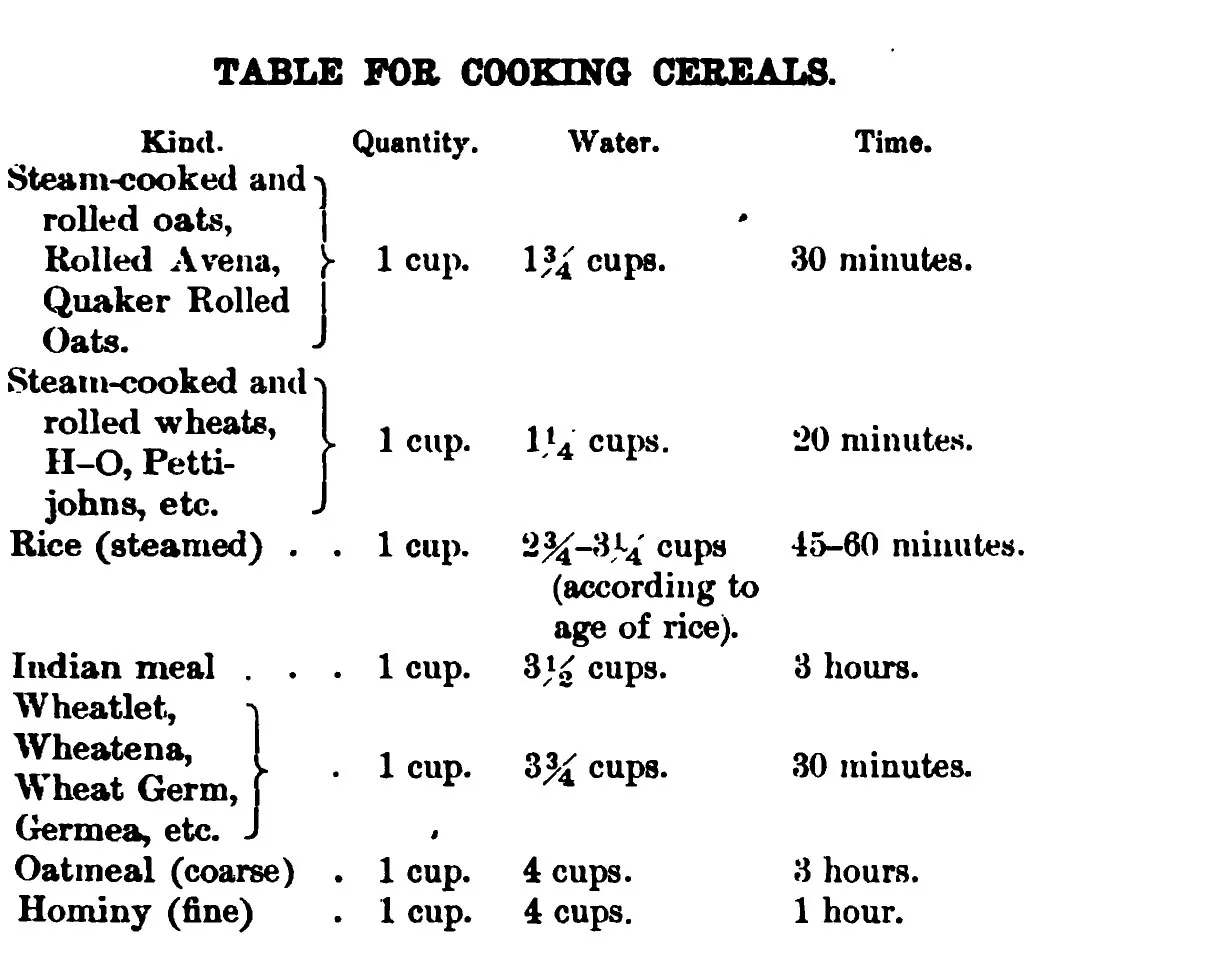
Many cereal preparations are on the market for making breakfast mushes, put up in one and two pound packages, with directions for cooking. In nearly all cases, time allowed for cooking is not sufficient, unless dish containing cereal is brought in direct contact with fire, which is not the best way. Mushes should be cooked over hot water after the first five minutes; if a double boiler is not procurable, improvise one. Boiling water and salt should always be added to cereals, allowing one teaspoon salt to each cup of cereal, — boiled to soften cellulose and swell starch grains, salted to give flavor.
Table for Cooking Cereals.
Kind. Steam-cooked and rolled oats, Rolled Avena, Quaker Rolled Oats. Quantity. 1 cup. Water. 1¾ cups. Time. 30 minutes.
Recipe makes: About 2½ cups, 2 servings
Ingredients
For about 2½ cups, 2 servings. Quantities are shown as written.
Quantities as written here, for about 2½ cups, 2 servings.
- Old-fashioned rolled oats1 cup
- Boiling water1 3/4 cups
- Salt1/2 tsp
- Cold whole milk, to serve1 cup
- Maple sugar, to serve2 tbsp
Measurement notes
Ingredients as written here
- 1 cup old-fashioned rolled oats
- 1¾ cups boiling water
- ½ tsp salt
- 1 cup cold whole milk, to serve
- 2 tbsp maple sugar, to serve
Equipment
 Double boiler, or a heatproof bowl that sits snugly over a saucepan
 Kettle
 Wooden spoon
Instructions
Pour a few inches of water into the bottom of the double boiler and bring it to a simmer; the top pan or bowl should sit above the water without touching it.
Put the boiling water and salt in the top pan and set it directly over medium-high heat until the water boils again.
Stir in the old-fashioned rolled oats and boil for 5 minutes, stirring often so they don’t catch.
Set the top pan over the simmering water, cover and cook for 30 minutes, stirring once or twice and topping up the water below if it runs low. The mush is ready when the oats are soft all through and the mush is thick enough to hold a spoon’s track.
Spoon it into two bowls and serve hot, with the cold whole milk in a small pitcher and the maple sugar in a dish beside it.
Nutrition
260calories per serving
- Recipe makes
- About 2½ cups, 2 servings
- Servings
- 2
Estimated per serving (2) from USDA FoodData Central values for rolled oats, whole milk and maple sugar, counting all the milk and sugar as eaten.
Recipe notes
When adjusting quantities
Farmer’s table is for one cup of oats. Doubled, it fits a 2-quart double boiler; keep the 30 minutes over the water.
Notes
Quantities mentioned in these notes don’t change when you adjust the servings.
The oats, water, salt, five-minute boil and thirty minutes over hot water follow Farmer’s directions and table; she counts one teaspoon of salt to each cup of cereal, and we use half. Her “thirty minutes” is read here as the time over the water, after the first five minutes, as in her Cereal with Fruit on the same page. The milk and maple sugar come from Chittenden’s list of Fletcher’s foods; their amounts are ours. Chill leftovers within 2 hours and reheat them on the stove with a splash of water, to 165°F (74°C).
Scaling changes the ingredients only; pan sizes and cooking times need their own judgment. To adapt this recipe further, try the recipe tool at TuneMyRecipe (opens in a new tab), our sister site.

Sources and attribution
After Fannie Merritt Farmer, The Boston Cooking-School Cook Book (Boston, 1896), cereal directions and Table for Cooking Cereals; served with the milk and maple sugar of Horace Fletcher’s Yale diet of 1903
See the original pages (scan at Internet Archive) (opens in a new tab)
Recipe details
- Course
- Breakfast
- Region
- American
- Era
- 19th century
- Source decade
- 1890s
- Main ingredient
- Grains & riceMilk & cream
- Difficulty
- Easy
- Occasion
- Everyday meal