Horace Fletcher’s diet under observation at Yale · Yale University, New Haven, Connecticut
What Did Horace Fletcher Eat at Yale in 1903?
Cereal, milk and maple sugar, twice a day, every portion weighed: Horace Fletcher’s Yale diet of 1903 averaged 1,606 calories and cost eleven cents a day.
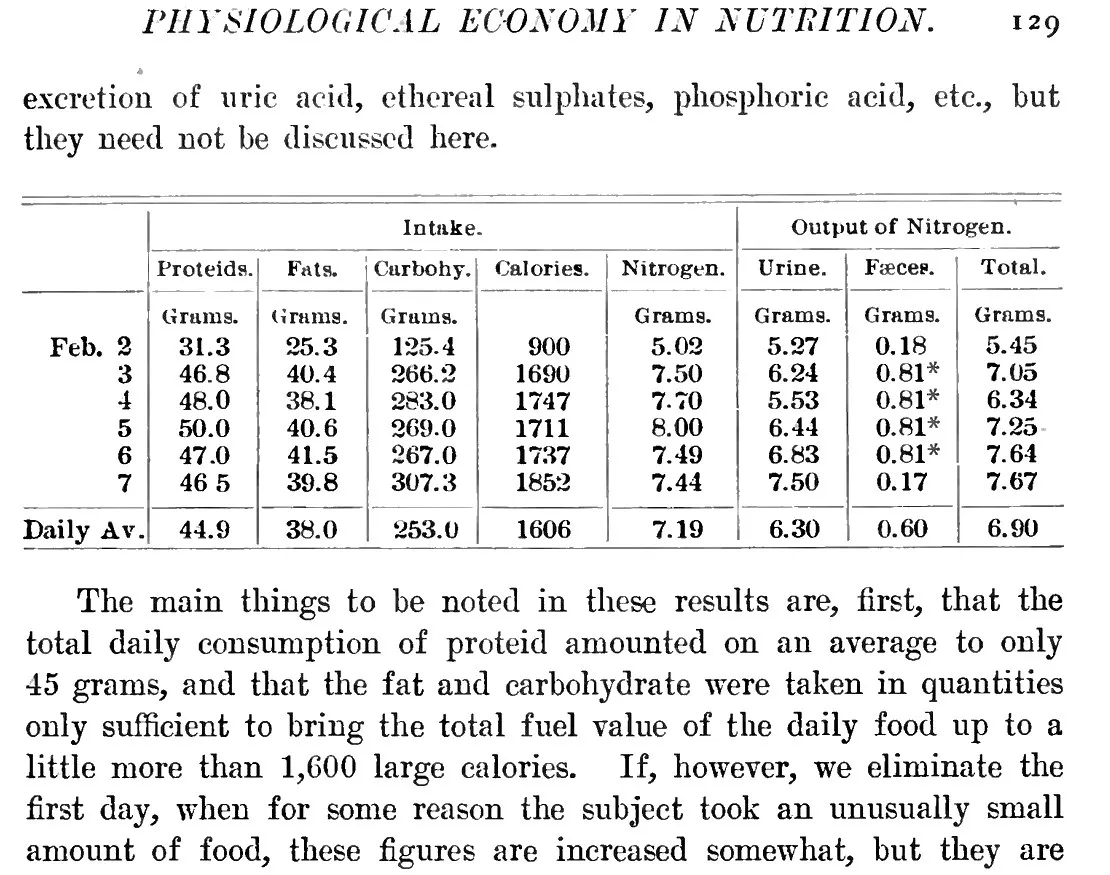
Horace Fletcher ate a prepared cereal food, milk and maple sugar, twice a day, for a week in February 1903, and nothing else. He chose the foods himself and ate as much as his appetite asked for, while the laboratory of Russell H. Chittenden at Yale weighed every portion, analyzed it and worked out its fuel value. The printed table averages 44.9 grams of protein and 1,606 calories a day, about half the fuel the standard of the day said a man needed, and Chittenden put the cost at eleven cents a day, about $4 today by US consumer prices (Minneapolis Fed and BLS CPI-U tables). Ten years later Fletcher retold the week as the proof of his method. The numbers in his book stayed the same, and the claims around them grew.
The man with the food-gate
Fletcher is remembered as the man who chewed every mouthful, though his own rules asked for more than chewing. Fletcherism: What It Is; or, How I Became Young at Sixty, which he published in New York in 1913, sets out five principles. The first is “Wait for a true, earned appetite.” The second is to select from the food available “that which appeals most to appetite, and in the order called for by appetite.” The third is to get all the good taste out of food in the mouth and “swallow only when it practically ‘swallows itself.’” The last two ask the eater to enjoy that taste without “depressing or diverting” thoughts, and to wait: “Nature will do the rest.”
Behind the rules sat a theory of his own. Fletcher wrote that each of us has “a food-filter: a discriminating muscular gate located at the back of the mouth,” which stays shut while food is chewed and opens only when the taste-buds find it properly prepared. “It is a real gate,” he insisted. The anatomy is Fletcher’s own. By his account, five months of eating this way took off “upwards of sixty pounds of fat.”
The Yale diet shows the second principle at work. Nobody handed Fletcher a ration. He picked three foods from what was available and kept to them for a week.
Justified or disillusioned
How Fletcher came to New Haven is told in his 1913 book. Chittenden, whom he describes as director of Yale’s Sheffield Scientific School and the leading physiological chemist in America, had invited him to a meeting of the American Physiological Association in Washington to describe his results. Afterward, Fletcher says, Chittenden told him “in effect” that no one there took much stock in his claims. Come to New Haven for an examination, Fletcher remembered him saying: “You will be either justified or disillusioned.” And then: “I think you will be disillusioned.” This is Fletcher’s memory of the conversation ten years on, in his words.
Chittenden’s account came out much sooner, in Popular Science Monthly for June 1903, as “Physiological Economy in Nutrition.” His subject, he wrote, “fully satisfies his appetite, but no longer desires the amount of food consumed by most individuals.” For thirteen days in January, Fletcher ate whatever he liked, with “perfect freedom of choice,” while the laboratory analyzed what his body excreted. From the nitrogen in it, Chittenden worked out that Fletcher had broken down an average of 41.25 grams of protein a day, with his weight holding steady at 165 pounds. That January figure came from the output alone.
February went further, with what Chittenden called “a careful analysis of the daily diet, together with analysis of the excreta.” Here the menu appears. “The diet consumed was quite simple, and consisted merely of a prepared cereal food, milk and maple sugar,” Chittenden wrote. It was taken twice a day and “selected by the subject as giving sufficient variety for his needs and quite in accord with his taste.” No one fixed the amounts: Fletcher “took each day such amounts of the above foods as his appetite craved,” and each portion “was carefully weighed in the laboratory.”
Six rows for seven days
The article says the diet ran for seven days, but its table prints six, February 2 to 7, on the page shown at the top of this story. On February 2 Fletcher took in only 900 calories, and after that between 1,690 and 1,852. The six calorie figures add up to 9,637, which divided by six gives the printed 1,606. Chittenden admitted the first day dragged the average down, when “for some reason the subject took an unusually small amount of food.” Leave it out, and our arithmetic puts the other five days at about 1,747 calories.
Even so, he found the figures “ridiculously low compared with the ordinarily accepted dietary standards.” The Voit standard he measured them against called for at least 118 grams of protein and 3,000 calories a day. Fletcher’s average was 44.9 grams of protein, 38.0 of fat and 253 of carbohydrate.
The table’s real business was nitrogen, the laboratory’s measure of protein. Fletcher took in 7.19 grams a day on average and put out 6.90, so his body was holding its own, close to what physiologists called nitrogenous equilibrium. Not every figure was taken daily: the nitrogen in the feces for February 3 to 6 is, by the table’s footnote, an “Average of the four days.” And the six fat figures, added up, average 37.6 grams, a shade under the printed 38.0. Whether a seventh day was lost, never measured or simply not printed, the article doesn’t say. Chittenden’s book of 1904 speaks of “a period of six days,” and neither later account fills the gap.
The Varsity Crew exercises
Chittenden’s next question was whether a man could do real work on so little. He sent Fletcher to the Yale Gymnasium and its director, William G. Anderson, and printed Anderson’s report “verbatim.” On the 4th, 5th, 6th and 7th of February, Anderson wrote, he gave Fletcher “the same kind of exercises we give to the Varsity Crew.” They were “drastic and fatiguing,” and “I should not give these exercises to Freshmen on account of their severity.”
Fletcher took them “with an ease that is unlooked for,” with no soreness or lameness, and no distress during or after “the long run.” Anderson was “surprised that Mr. Fletcher can do the work of trained athletes and not give marked evidences of over exertion.” He had gone through the same exercises himself as a standard of comparison, but the article adds in brackets, “The figures are not given here.” His conclusion was measured: Fletcher did the work “with greater ease and with fewer noticeable bad results than any man of his age and condition I have ever worked with.”
Chittenden added that for several months Fletcher had taken “practically no exercise other than that involved in daily walks about town.”
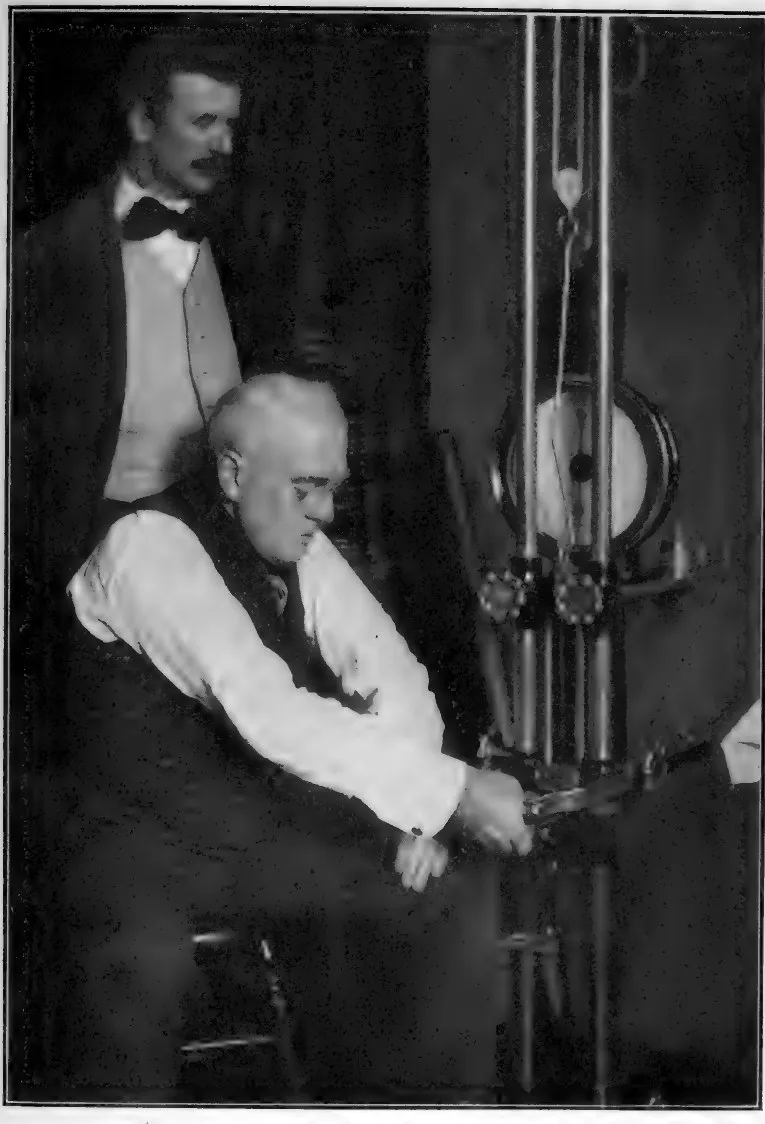 “The Author Testing his Endurance by means of the Kellogg Mercurial Dynamometer. Dr. Anderson, Director of the Yale Gymnasium, in the background.” Plate facing p. 16 of Horace Fletcher, Fletcherism: What It Is (New York: Frederick A. Stokes Company, 1913). The book gives no date for the photograph.
Eleven cents a day
Then Chittenden turned to money. The food Fletcher ate during the seven days, Chittenden wrote, cost “eleven cents daily, thus making the total cost for the seven days seventy-seven cents!” That comes to about $30 today for the week. “If we contrast this figure with the amounts generally paid for average nourishment for a like period of time, there is certainly food for serious thought.”
The cereal makes the point at its sharpest. At the Waldorf in New York in 1896, a bowl of oatmeal or Wheatena cost 25 cents plain, as the hotel’s breakfast card shows in What Did People Eat for Breakfast in the 1890s? One hotel bowl, seven years before Yale, cost more than two of Fletcher’s days. Chittenden itemized none of it, so the eleven cents is one man’s food bill as he reported it.
Chittenden passed on what Fletcher said of himself: he had lived this way for nearly five years, “usually takes two meals a day,” and had been “led to a strong liking for sugar and carbohydrates in general and away from a meat diet.” He set the case beside results obtained under Sir Michael Foster at Cambridge and asked whether dietary standards were far too high. But he closed with a caution: “no definite and positive conclusions can be arrived at except as the result of careful experiments and observations on many individuals covering long periods of time.”
Who got the credit
Chittenden’s longer experiments followed, and in 1904 he published them as a book, also called Physiological Economy in Nutrition. Its early pages retell the Fletcher case in a paragraph, with the same averages, and draw a line under it: “It is not our purpose here to discuss how far these results are due to insalivation, or the more thorough mastication of food.” His question was how far protein could be cut. Whether the chewing explained it, he left open.
Fletcher had no such doubts in 1913. His book repeats the 44.9 grams, the 38.0, the 253 and the 1,606, and says “the Cambridge and the Venice findings were fully confirmed at New Haven.” The gymnasium had become a contest: “I personally showed endurance and strength in special tests superior to the foremost among the College athletes.” A footnote sends readers to Chittenden’s book for the later experiment, then complains that it made “such small mention of indebtedness to Fletcherism” that Professor Irving Fisher organized a further test of his own.
The repeated numbers can look like proof piling up, but they all come from the same six rows. The 1904 book cites the 1903 article, and Fletcher’s 1913 book borrows from both. What Yale recorded was a man of 165 pounds, eating cereal, milk and maple sugar by choice, who kept his weight and nitrogen steady and did a crew’s exercises without much distress.
The recipes
Chittenden named three foods and gave no recipe, brand or portion, so no dish here can claim to be the one Fletcher ate. Both recipes come from Fannie Merritt Farmer’s Boston Cooking-School Cook Book, published in Boston seven years before the Yale test, and each shows what a cook of the time did with a packaged cereal like his.
- Rolled Oat Mush (1896): rolled oats cooked by Farmer’s cereal table, with cold milk and maple sugar beside it. It is the nearest we can come to Fletcher’s bowl, and the pairing is ours.
- Cereal with Fruit (1896): a wheat cereal with dates stirred in and cream poured over, the more dressed-up bowl Farmer offered “for breakfast, or as a simple dessert.”
The steel-cut oatmeal of Why Did Kitchens of the 1910s Cook Dinner in a Box? takes the same kind of breakfast cereal through a whole night in a box.
Cooking it
The Rolled Oat Mush (1896) asks for a cup of rolled oats in place of Chittenden’s unnamed cereal, the milk and maple sugar from his list, salt, and one pan set over another of simmering water: Farmer’s way to cook a mush for half an hour without scorching it.
 Cook it todayRolled Oat Mush (1896)
Sources
- Russell H. Chittenden, “Physiological Economy in Nutrition,” Popular Science Monthly 63 (June 1903), pp. 123–131, especially pp. 128–131. Page images on Wikisource (opens in a new tab).
- Russell H. Chittenden, Physiological Economy in Nutrition, with Special Reference to the Minimal Proteid Requirement of the Healthy Man (New York: Frederick A. Stokes Company, 1904; 1907 printing), p. 14. Internet Archive (opens in a new tab).
- Horace Fletcher, Fletcherism: What It Is; or, How I Became Young at Sixty (New York: Frederick A. Stokes Company, 1913), pp. 6–10, 16–20 and plate facing p. 16. Internet Archive (opens in a new tab).
- Fannie Merritt Farmer, The Boston Cooking-School Cook Book (Boston: Little, Brown, and Company, 1896), pp. 86–87, at the Internet Archive (opens in a new tab).
- Present-day equivalents: Federal Reserve Bank of Minneapolis, Consumer Price Index, 1800–, with BLS CPI-U.