The fireless cooker bulletin, University of Wisconsin · University of Wisconsin, Madison
Why Did Kitchens of the 1910s Cook Dinner in a Box?
The fireless cooker was a packed, insulated box: food boiled on the stove went in hot and finished on its own heat, saving fuel and watching.
A fireless cooker was an insulated box, and kitchens cooked in it to save fuel and, above all, watching. The cook brought dinner to a boil on the stove, set the hot pail inside, shut the lid and left it, and the food went on cooking for hours on its own stored heat with no fire under it. A pot roast could cook all morning, or a breakfast porridge all night, while nobody stood over it. In May 1908 the University of Wisconsin published what its thermometers had found in the box, and a year later Margaret J. Mitchell’s Fireless Cook Book gave American households 250 recipes for it.
From Norway to the army
The box was older than its name. Ellen Alden Huntington, an instructor at the University of Wisconsin, opened her bulletin The Fireless Cooker with a felt-lined “Norwegian Cook Box” shown at the Paris Exhibition of 1867, and with German peasants who, she wrote, seem to have put kettles of boiling soup into feather beds overnight. A 1905 consular report told of a Mrs. Bach of Frankfurt, who had used a hay box for thirteen years and found it “a great comfort to the housewife to know that the rest of the meal is ready and hot in the box.”
The report caught the eye of the United States War Department, which tried the method at its commissary stations. Huntington printed a letter from one station, dated February 1906, about a field cooker packed in the morning and loaded on a wagon: “At 5 P. M. the cooker was opened (packed at 7:18 A. M.) and everything was perfectly done.” By 1908 many household cookers were on the market, and Huntington found almost nothing printed about how to use them.
The Madison boxes
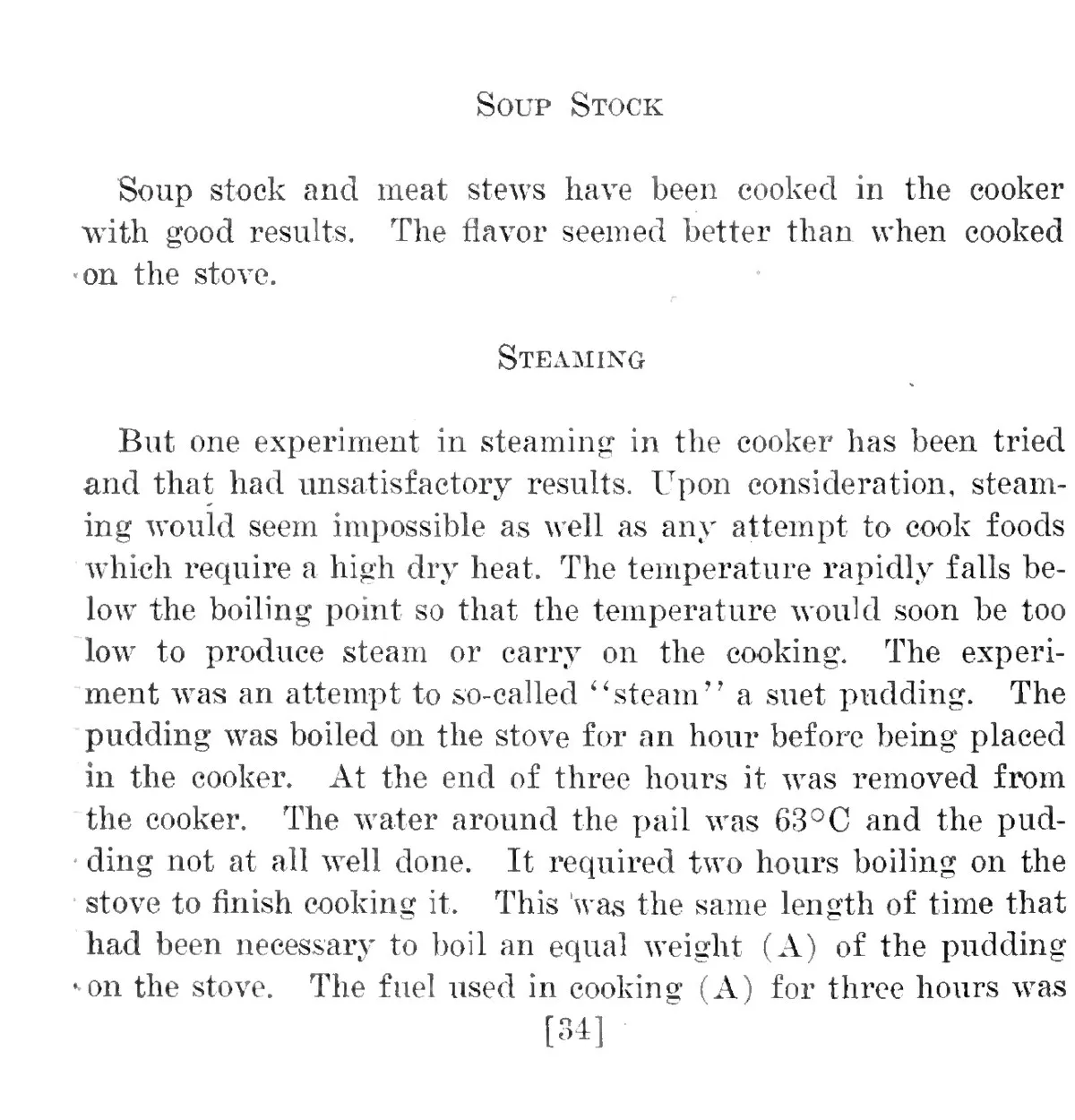
So the university’s Home Economics Department tested them in 1906 and 1907. The first was the plain “hay box,” an ordinary box with hay packed tight around agate-ware pails. Hay was troublesome to pack, Huntington wrote, and “the food was inclined to taste of it,” so the boxes moved to asbestos and then to mineral wool, which held the heat best. A cork pushed through a hole in each cover carried a Centigrade thermometer down into the food, and the readings went on for hours.
Quantity mattered. Pails of hot starch solution in different amounts went in side by side, and the largest held its heat far better. A pint can of oatmeal, boiled five minutes and left in a small cooker overnight, was cold in the morning and not cooked through. The box only stored the heat the food carried in with it.
The pudding that took more gas
The bulletin is frank about failures. A custard curdled badly after four hours, and potatoes left too long soaked up water.
Wisconsin tried only one steamed dish, a suet pudding, boiled on the stove for an hour and put in the cooker for three. When it came out, the water around the pail had fallen to 63°C (145°F) and the pudding was “not at all well done.” It needed two more hours of boiling on the stove to finish, and an equal pudding boiled the ordinary way had taken three hours from start to finish.
The laboratory cooked with gas, and Huntington measured it. The pudding boiled the ordinary way for three hours used 7.6 feet of gas (the bulletin’s “ft.” means cubic feet). The one that went through the box used 9.8 feet, about 29 percent more, because bringing food back to the boil burns gas fast while a simmer burns little. Of her gas trials in general she found the results “somewhat surprising in that there is not a greater economy of fuel in using the cooker.”
What the box did well
The same page records a success. “Soup stock and meat stews have been cooked in the cooker with good results,” Huntington wrote, and their flavor seemed better than from the stove. She concluded that the cooker was “most desirable and economical of time and fuel for those foods which require long slow cooking, such as oatmeal, meats and dried fruits,” and impractical for anything that needed the high, dry heat of an oven. She closed on a wider point: “Housekeeping has lagged far behind other industries.”
Mitchell’s cook book
Margaret J. Mitchell, a former dietitian at Manhattan State Hospital who taught domestic science at the Drexel Institute in Philadelphia, published The Fireless Cook Book in New York in 1909. Her preface takes on the women who had tried the new cookers without learning to manage them and judged them “altogether a good deal of a disappointment,” no good for starchy foods, most vegetables, raised breads or puddings. Understanding the box, she wrote, brought “complete success, followed inevitably by enthusiasm.” She credited “Miss Huntington’s bulletin” with suggesting several of the experiments in her appendix.
Her suet pudding gives the box more to work with than Madison did: a one-quart mold in a six-quart pail of water reaching two-thirds of the way up, boiled half an hour and left five hours in the cooker. She gives no fuel figures, so the book cannot say whether it beat Wisconsin’s gas bill.
The fireless cooker had its decade after that. Emily Marsh’s history for the National Agricultural Library traces United States Department of Agriculture publications on it through the 1910s and commercial models advertised from 1910 into the late 1920s, and quotes a 1913 Washington Herald writer: “The chief trouble with the fireless cooker is its name.” As gas and electric stoves spread, fewer cooks kept one.
The recipes
All three come from Mitchell’s 1909 book. Two are the long, slow foods Huntington said the box did best, and the third is the dish it failed at in Madison. No single meal served these three together; the grouping is ours.
- Fireless Cooker Pot Roast (1909): beef rump browned, simmered half an hour with onion, carrot and bay, then left nine hours in the box.
- Fireless Cooker Suet Pudding (1909): a dark molasses and spice pudding, boiled half an hour and left five hours in the box.
- Fireless Cooker Steel Cut Oatmeal (1909): oats soaked, boiled ten minutes and cooked overnight.
The modern versions leave the box out. Food held for hours in an unheated box cools slowly into the range below 140°F (60°C) where bacteria grow, as Wisconsin’s own water, already down to 145°F (63°C) after three hours, suggests. So the pot roast and the oatmeal keep Mitchell’s start on the stove and give the long hours to a slow cooker on low, which keeps the food hot throughout, and the pudding steams on the stove. London’s paper-bag craze three years later promised the same savings from a different gadget, as Why Did London Cook Dinner in Paper Bags in 1911? tells.
Cooking it
Start the Fireless Cooker Pot Roast (1909) after breakfast: about 45 minutes on the stove, about eight hours in the slow cooker on low, and Mitchell’s last step, the liquor brought back to the boil and thickened, gives you the gravy ten minutes before dinner. Mitchell’s three dishes are part of our Edwardian recipes, as is the paper-bag cookery that followed three years later.
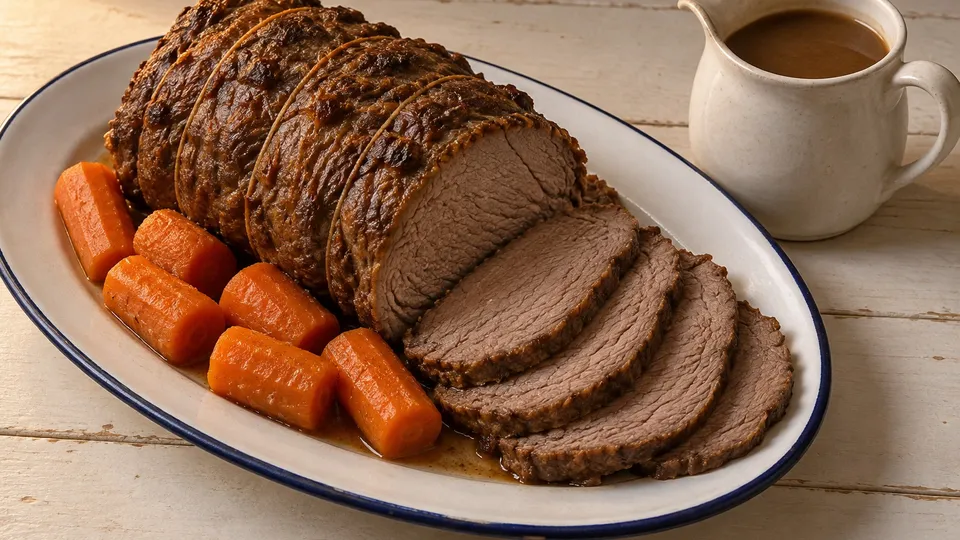 Cook it todayFireless Cooker Pot Roast (1909)
Sources
- Ellen Alden Huntington, The Fireless Cooker, Bulletin of the University of Wisconsin No. 217, University Extension Series vol. 1, no. 1 (Madison, May 1908), pp. 5–7, 9, 18–19, 30, 34–37. Internet Archive (opens in a new tab).
- Margaret J. Mitchell, The Fireless Cook Book (New York: Doubleday, Page & Company, 1909), pp. vii–viii, 55–56, 94–95, 157–158. Internet Archive (opens in a new tab).
- Emily Marsh, “The Fireless Cooker,” National Agricultural Library, U.S. Department of Agriculture. nal.usda.gov (opens in a new tab).
- Colorado State University Extension, “Crockpot and Slow Cooker Food Safety” (2013), for the modern safety guidance.