Fannie Farmer’s Baking Powder Biscuit II (1896)
Reader ratingsFannie Farmer’s second baking powder biscuit of 1896, the all-butter, all-milk one: mixed with a knife, rolled half an inch thick and baked fast in a hot oven.
- Recipe makes
- About 12 biscuits, 2 inches across
- Prep
- Cook
- Total
Heat the oven before you mix: once the milk is in, the dough is cut and baked straight away. Farmer bakes them twelve to fifteen minutes in a hot oven.
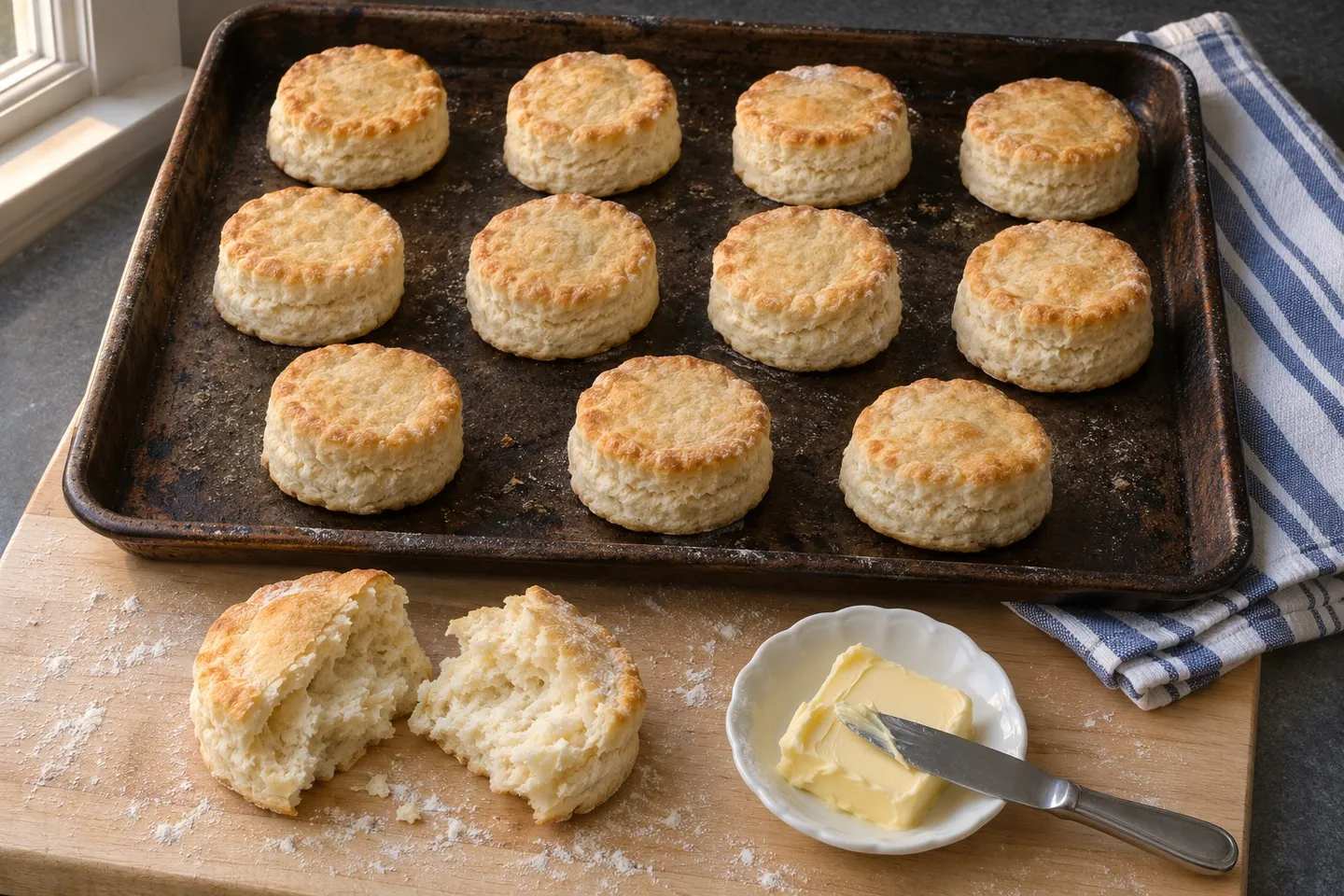
Baking powder biscuits on a baking sheet, one broken open, with butter.
The story behind the recipe
Baking Powder Biscuit II is Fannie Farmer’s richer biscuit. It has the same two cups of flour and four teaspoons of baking powder as her first, but two tablespoons of butter where Biscuit I splits the fat between butter and lard, all milk where Biscuit I uses milk and water, and half the salt. She printed it at the top of page 71 of The Boston Cooking-School Cook Book (1896) with a single line of method: “Mix and bake as Baking Powder Biscuit I.” It follows the home-made powder here as the thing the powder was bought for.
What else did Farmer make from it?
A pinwheel. Lower on the same page, her Fruit Rolls (Pin Wheel Biscuit) begin “Mix as Baking Powder Biscuit II,” then roll the dough a quarter of an inch thin, brush it with melted butter, scatter it with chopped raisins, citron, sugar and cinnamon, roll it up like a jelly roll and slice it before baking. Her Emergency Biscuit, between the two, takes Biscuit I or II with more milk, stirred soft enough to drop from a spoon. The butter-and-milk dough was her base for the fancier things, and it carries her rule from page 56 of two teaspoons of baking powder to each cup of flour. Farmer’s book came out in Boston three years before Missouri’s alum act and has no link to the case; it shows what a Boston cooking-school teacher told cooks to expect from the can.
Read more about this recipe
Making it today
We call for a baking powder whose label lists no aluminum compound, or the Home-Made Baking Powder (1918) used measure for measure, so nothing in these biscuits would have fallen under Missouri’s 1899 act. That choice serves the story and makes no health claim. Farmer prints no temperature, so reading her “hot oven” as 425°F (220°C) is our choice, as are the 2-inch cutter, unsalted butter and whole milk; her twelve to fifteen minutes stay. These are not the army’s Baking-Powder Biscuits (1896), a lean dough of lard or dripping rolled thick and baked crowded together; Farmer’s are buttery, half an inch thick and baked apart. What Happened When Missouri Outlawed Alum Baking Powder? tells how a can of powder brought a St. Louis grocer to court.
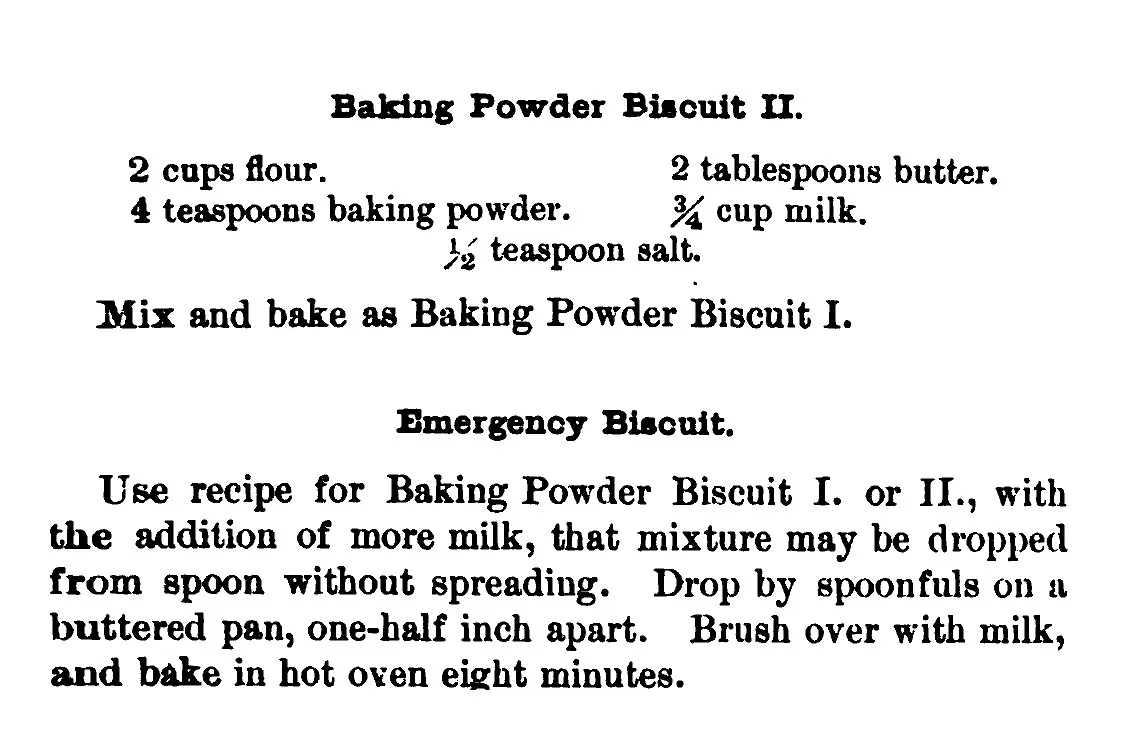
Baking Powder Biscuit II.
2 cups flour. 4 teaspoons baking powder. ½ teaspoon salt. 2 tablespoons butter. ¾ cup milk.
Mix and bake as Baking Powder Biscuit I.
Baking Powder Biscuit I. ...
Mix dry ingredients, and sift twice.
Work in butter and lard with tips of fingers; add gradually the liquid, mixing with knife to a soft dough. It is impossible to determine the exact amount of liquid, owing to differences in flour. Toss on a floured board, pat, and roll lightly to one-half inch in thickness. Shape with a biscuit-cutter. Place on buttered pan, and bake in hot oven twelve to fifteen minutes. If baked in too slow an oven, the gas will escape before it has done its work.
Recipe makes: About 12 biscuits, 2 inches across
Ingredients
For about 12 biscuits, 2 inches across. Quantities are shown as written.
Quantities as written here, for about 12 biscuits, 2 inches across.
- All-purpose flour, plus more for the board2 cups
- Aluminum-free baking powder4 tsp
- Salt1/2 tsp
- Cold unsalted butter2 tbsp
- Cold whole milk3/4 cup
- Soft butter, for greasing
Measurement notes
Ingredients as written here
- 2 cups all-purpose flour, plus more for the board
- 4 tsp aluminum-free baking powder
- ½ tsp salt
- 2 tbsp cold unsalted butter
- ¾ cup cold whole milk
- Soft butter, for greasing
Equipment
 Sieve
 Mixing bowl
 Table knife
 Rolling pin
 2-inch biscuit cutter
 Baking sheet
 Instant-read thermometer
Instructions
Heat the oven to 425°F (220°C) and grease the baking sheet with soft butter.
Mix the all-purpose flour, aluminum-free baking powder and salt, and sift them together twice into the mixing bowl.
Cut the cold unsalted butter into small pieces and work it into the flour with your fingertips until no piece is bigger than a small pea.
Add the cold whole milk gradually, mixing with the table knife, until the dough is soft and just holds together. Flours differ, so you may not need all of it, or may need a little more.
Turn the dough onto a floured board, toss it lightly to coat, pat it flat and roll it lightly to ½ inch thick.
Cut out rounds with the floured cutter, pressing straight down. Press the scraps together once, pat them out and cut again.
Set the biscuits on the buttered sheet a little apart and bake at once for 12 to 15 minutes, until risen and golden and the center of a middle biscuit reads about 200°F (93°C).
Serve hot.
Nutrition
105calories per serving
- Recipe makes
- About 12 biscuits, 2 inches across
- Servings
- 12
Estimated per biscuit (12) from USDA FoodData Central values for all-purpose flour, unsalted butter and whole milk; butter for the pan not included.
Recipe notes
When adjusting quantities
Farmer’s own batch: 4 teaspoons of baking powder to 2 cups of flour, her rule of 2 teaspoons to each cup. Scale the flour, powder, salt, butter and milk together.
Notes
Quantities mentioned in these notes don’t change when you adjust the servings.
The amounts are Farmer’s for Biscuit II and the method is her Biscuit I’s, which she tells the cook to follow. The oven setting, the 2-inch cutter, unsalted butter, whole milk and the internal temperature are our choices; at ½ inch thick the batch gives about 12 biscuits. For her Emergency Biscuit, add more milk until the dough drops from a spoon without spreading, drop spoonfuls half an inch apart on a buttered pan, brush with milk and bake 8 minutes in the same hot oven. With the home-made powder, get the biscuits into the oven the moment they are cut. Don’t taste the raw dough: uncooked flour can carry bacteria. The biscuits are best the day they are baked.
Scaling changes the ingredients only; pan sizes and cooking times need their own judgment. To adapt this recipe further, try the recipe tool at TuneMyRecipe (opens in a new tab), our sister site.
Sources and attribution
After Fannie Merritt Farmer, The Boston Cooking-School Cook Book (Boston, 1896), Baking Powder Biscuit II, mixed and baked as Baking Powder Biscuit I
See the original pages (scan at Internet Archive) (opens in a new tab)
Recipe details
- Course
- Bread & baking
- Dish family
- Breads & Cakes
- Region
- American
- Era
- 19th century
- Source decade
- 1890s
- Main ingredient
- Milk & cream
- Difficulty
- Easy
- Occasion
- Everyday meal