The Supreme Court of Missouri decides State v. Great Western Coffee and Tea Company · Missouri
What Happened When Missouri Outlawed Alum Baking Powder?
Missouri’s 1899 act fined anyone who made or sold food powders with alum. In 1903 its Supreme Court freed a St. Louis grocer: the title named only makers.
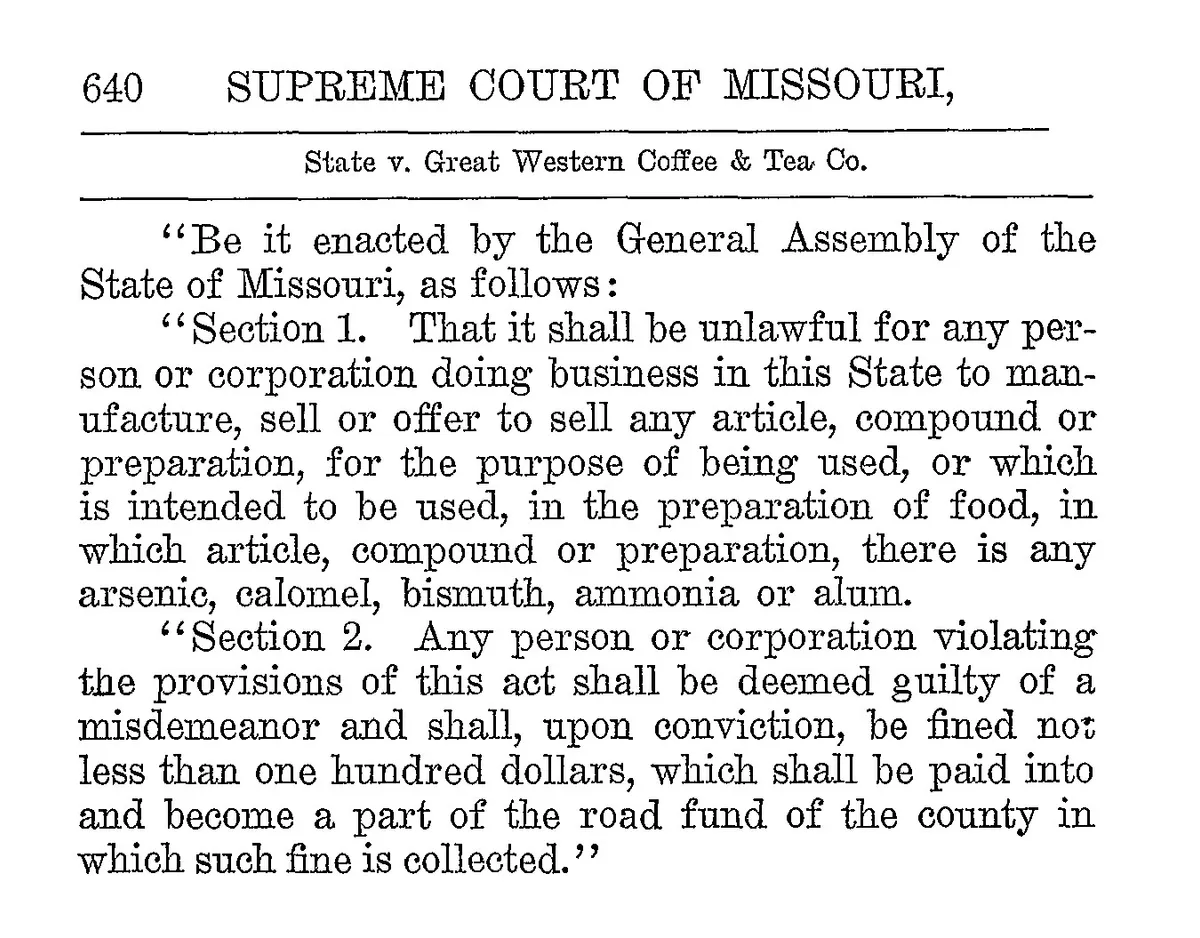
Missouri’s law went after grocers as well as makers, and on February 3, 1903, the Supreme Court of Missouri let a grocer go. The act approved on May 11, 1899, made it a misdemeanor to make, sell or offer to sell any preparation for food that contained arsenic, calomel, bismuth, ammonia or alum. The Great Western Coffee and Tea Company of St. Louis was convicted under it over a single can of baking powder and fined one hundred dollars (about $4,000 today, by US consumer prices, Minneapolis Fed / BLS CPI-U). The state’s highest court reversed the conviction, because the law’s title spoke of preparing and manufacturing food and said nothing about selling it. Whether the can held alum, the court never decided. The act itself had two years left: after a bribery scandal over Royal Baking Powder money in the state senate, Missouri repealed it in February 1905.
One can of Great Western Brand
The prosecution began with a purchase. The court’s own statement of the facts says that W. N. Miller bought a can of baking powder at the company’s St. Louis store on May 23, 1901. The information filed by the prosecuting attorney, H. A. Clover, Jr., and printed in full in the same report, charges a sale of “one can Great Western Brand Baking Powder” on July 6, 1901. The report never reconciles the two dates, and neither do we.
The powder was sold under the store’s own name, but the company had not made it. Its manager, A. H. Freeman, testified that Great Western bought the can “from a most reputable wholesale grocery firm of St. Louis with their assurance that it was a pure phosphate powder containing no alum whatever.” The firm is not named. The state’s experts said the powder contained alum. The company’s evidence, as the court summed it up, tended to show that it contained “no alum such as was contemplated by the legislative mind” when the act was passed. Judge Willis H. Clark of the St. Louis Court of Criminal Correction heard the case without a jury, convicted the company and fined it one hundred dollars, the least the act allowed.
Arsenic, calomel, bismuth, ammonia or alum
The act was short. Its first section forbade any person or corporation doing business in Missouri to “manufacture, sell or offer to sell” a food preparation containing any of the five substances. The second made a breach a misdemeanor, with a fine of not less than one hundred dollars, “which shall be paid into and become a part of the road fund of the county in which such fine is collected.” Above both sat the title: “An Act to prevent the use of unhealthy chemicals or substances in the preparation or manufacture of any article used or to be used in the preparation of food.”
It was not Missouri’s first law about what went into food and drink. Great Western’s lawyer, Thomas B. Harvey, listed older statutes whose titles had named makers and sellers alike, among them a liquor adulteration law of 1865, amended in 1877; an act prohibiting the manufacture and sale of oleomargarine in 1887, in the years when margarine was fought over in state after state; one against adulterated vinegar in 1891; and a pure beer act passed in 1899, the same year as the alum law. Neither court report names an earlier Missouri law aimed at alum in baking powder, and none of the titles Harvey cited reaches it. Cooks had a standard before the legislature did. In 1896 Fannie Merritt Farmer’s Boston Cooking-School Cook Book defined baking powder as soda and cream of tartar with a little flour or cornstarch, and added: “If found to contain alum or ammonia, it is impure.”
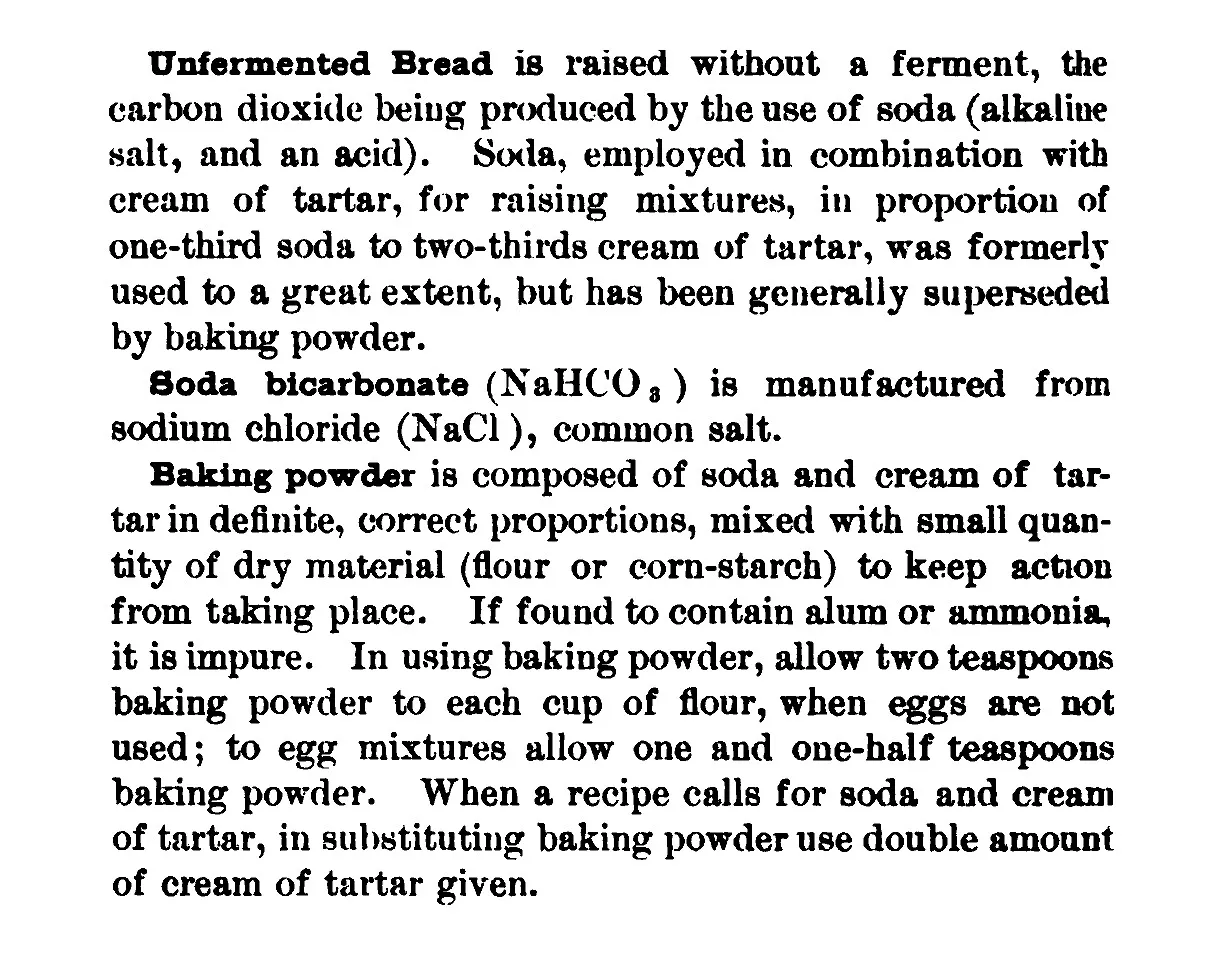 Fannie Merritt Farmer, The Boston Cooking-School Cook Book (Boston: Little, Brown, 1896), p. 56.
Why did the grocer go free?
Because of the title. Missouri’s constitution said that no bill could contain more than one subject, which had to be “clearly expressed in its title.” Harvey argued that this title covered the people who prepared or manufactured food and gave a retail grocer no warning that the act was about him. For the state, Attorney General Edward C. Crow answered with a practical point: “The sale can not be prevented unless the sale of the prohibited substance manufactured in other States is also prohibited.” A Missouri law could not reach a factory in another state, but it could reach the shop that sold its powder.
Judge Fox, writing for the court, sided with the grocer. “The title to this act only embraces one class,” he wrote, “that is, those who prepare or manufacture the article,” while the body of the act reached “all classes of retailers.” He described the man the title left out: a grocer in some country village who knew nothing of how the powder was made, and who “buys it in good faith and sells it in good faith to his customers.” The maker, Fox wrote, knew he was putting a prohibited substance into the article; the retailer sold it “without any knowledge of its contents.” Stretching a law about one class over the other was, in the court’s view, like stretching an act “To prevent the illegal sale of intoxicating liquors” to punish the person who bought the liquor.
Fox did not say sellers were beyond the state’s reach. “It is not contended that the seller can not be reached,” he wrote, “but if so, it must be done by the subject being clearly expressed in the title.” The act, “so far as it is applicable to sellers, who are not manufacturers,” was invalid. The company and its sureties were discharged, and the court noted that its ruling would “prevent any further prosecutions under that subdivision of the act.”
The maker who lost
Another baking powder case had already gone the other way. Whitney Layton, who made baking powder in St. Louis, was prosecuted in the same court for having “unlawfully manufactured, sold and offered for sale” a preparation for food that contained alum: two dozen one-pound cans of baking powder. He admitted the facts. His defense was that the law itself was unconstitutional, and he offered what the United States Supreme Court’s report of his case calls “voluminous evidence”: that the alum baking powder business was old and “very extensive in Missouri and in the United States,” that alum in baking powder was “wholesome, useful and economical,” and “that most grocers in Missouri kept and sold alum baking powders.” The judge excluded all of it, found him guilty and set the penalty at one hundred dollars.
The Supreme Court of Missouri affirmed Layton’s conviction, in a case reported at 160 Missouri 474. Layton then took it to Washington, where on December 22, 1902, the United States Supreme Court dismissed his writ of error without reaching alum at all: the record did not show that he had raised a federal question in the trial court.
When Great Western’s appeal was decided six weeks later, the Missouri court explained why Layton did not settle it. In his case “the question of the sufficiency of the title to the act was not involved nor was it passed upon.” That case had been about whether the legislature could suppress a baking powder “admitted to be in general use; but whose wholesomeness or unhealthfulness, notwithstanding its general use, was in sharp and forceful dispute.” And Layton had admitted that he made the powder. So the state won against the maker who admitted making alum powder and lost against the grocer who sold a can it called alum-free, and in neither case did a court settle what was in the powder.
Royal, the senate and the repeal
Harvey’s brief also made an accusation. In view of the testimony in the Layton case, he told the court, and of facts “which are matters of common knowledge, that these prosecutions are being conducted by the Royal Baking Powder Trust, and that they are the only ones beneficially interested in the prosecutions,” it was not fair to treat the act as a plain health measure. That was a lawyer’s argument, made for a client, and the court’s opinion passes over it.
Outside the courtroom the charge was about to look mild. The historian Linda Civitello, in her 2017 dissertation Baking Powder Wars, notes that the act passed a little more than two months after the Royal Baking Powder Trust was formed, and that alum went into the powders of Royal’s cheaper rivals. Much of her Missouri chapter rests on the record those rivals, the American Baking Powder Association, later published, which reprinted affidavits, newspaper reports and a synopsis of the bribery investigations. In 1901 the Missouri House voted 109 to 5 to repeal the alum law and the senate killed the repeal. By Lieutenant Governor John A. Lee’s own affidavit, on March 19, 1901, the day after the session ended, Royal’s lobbyist Daniel J. Kelley gave him $7,000 (well over a quarter of a million dollars today), and Lee passed it to Senator Frank Farris, who put a thousand dollars in each of seven envelopes. In March 1903, a month after the Great Western ruling, a repeal bill tied 16 to 16 in the senate once Farris had walked out with two other senators, and Lee, presiding, cast the deciding vote against it. That April a St. Louis grand jury took up the bribery. Lee testified on April 24 and resigned three days later.
Repeal came with the next legislature. The House voted 123 to 1, the senate 28 to 4, and on February 21, 1905, Governor Joseph Folk signed it. The alum law had lasted not quite six years. That August a jury acquitted Farris, and the indictments against Lee and the senators said to have taken the money were dismissed, so neither man was ever convicted.
What the powder was for
Every can in these cases was meant for a mixing bowl, and the cookbooks show what cooks were told to expect from it. Farmer’s 1896 book explains the chemistry plainly: the gas in soda is set free by the acid in cream of tartar, both moisture and heat are needed, and “as soon as moisture is added to baking powder mixtures, the gas will begin to escape; hence the necessity of baking as soon as possible.” Her rule, for mixtures without eggs, was two teaspoons of baking powder to each cup of flour. Under “Baking Powder Biscuit I” she warns what happens to a cook who dawdles: “If baked in too slow an oven, the gas will escape before it has done its work.” Her Baking Powder Biscuit II, on the next page, is the richer one, made with butter alone and milk alone, and mixed and baked the same way.
Fifteen years after the ruling, a cook could still skip the grocer’s can altogether. In Two Hundred and Seventy-Five War-Time Recipes (Bedford, Massachusetts, 1918), Carolyn Putnam Webber, a teacher of cookery, printed a “Home-Made Baking Powder”: one cup of soda, one of cornstarch and two of cream of tartar, sifted together “eight to ten times,” to make what she promised would be “one quart of reliable home-made baking powder.” Her soda and cream of tartar stand at one to two, the proportion Farmer gives for the older way of raising with the two. A cook who mixed her own knew exactly what was in the jar, which was the knowledge the court had said the village grocer lacked.
The recipes
No meal belongs to these cases, and neither report says what anyone baked with the disputed cans. The two recipes come from a cookbook printed three years before the act and a war cookbook printed fifteen years after the ruling, and they follow the powder from the jar into the dough. Neither uses alum.
- Home-Made Baking Powder (1918): Webber’s soda, cornstarch and cream of tartar, sifted until even, in a small batch.
- Fannie Farmer’s Baking Powder Biscuit II (1896): her all-butter, all-milk biscuit, rolled half an inch thick and baked in a hot oven.
For a leaner biscuit from the same year, the army’s Baking-Powder Biscuits (1896) use a tablespoon of lard or dripping for two quarts of flour, where Farmer’s second recipe uses two tablespoons of butter for two cups.
Sift the powder first, the full eight to ten times Webber asks for, so that when the milk goes into the Baking Powder Biscuit II only Farmer’s lesson is left: have the oven hot, because a powder of soda and cream of tartar starts giving up its gas the moment it is wet.
 Cook it todayFannie Farmer’s Baking Powder Biscuit II (1896)
Sources
- State v. Great Western Coffee & Tea Co., 171 Mo. 634 (Supreme Court of Missouri, Division Two, February 3, 1903), pp. 634 to 647, including the briefs of Thos. B. Harvey and Attorney General Edward C. Crow (Caselaw Access Project scan (opens in a new tab)).
- Layton v. Missouri, 187 U.S. 356 (1902), pp. 356 to 361 (Library of Congress (opens in a new tab)).
- Fannie Merritt Farmer, The Boston Cooking-School Cook Book (Boston: Little, Brown, 1896), pp. 56, 70 and 71 (Internet Archive (opens in a new tab)).
- Carolyn Putnam Webber, Two Hundred and Seventy-Five War-Time Recipes (Bedford, Massachusetts: The Bedford Print Shop, 1918), p. 51 (Internet Archive (opens in a new tab)).
- Linda Civitello, Baking Powder Wars (PhD dissertation, University of California, Los Angeles, 2017), pp. 173, 175 to 176, 185, 190 to 191, 199, 206 and 207 (eScholarship (opens in a new tab)).
- Federal Reserve Bank of Minneapolis, “Consumer Price Index, 1800- (opens in a new tab),” for the present-day equivalent.