Home-Made Baking Powder (1918)
Reader ratingsCarolyn Putnam Webber’s home-made baking powder of 1918: baking soda, cornstarch and cream of tartar, one to one to two by volume, sifted together until perfectly even.
- Recipe makes
- About ½ cup, 24 teaspoons
- Prep
- Total
Ten minutes, most of it sifting. Webber gives no keeping time, so make it close to baking day. The army’s 1896 manual keeps its own mix in a tight glass jar or bottle.
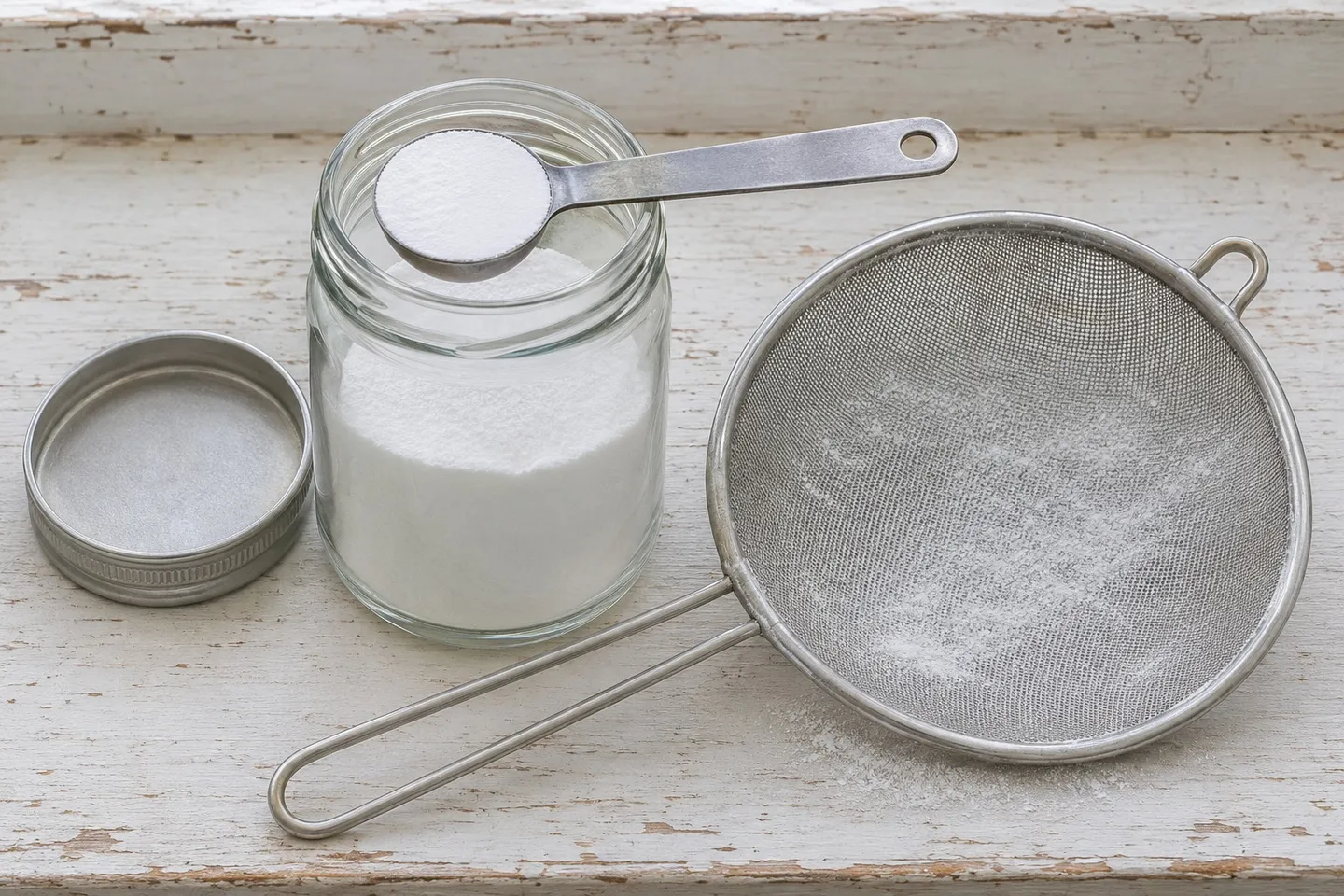
Home-made baking powder in a small glass jar, with a level teaspoonful and a sieve.
The story behind the recipe
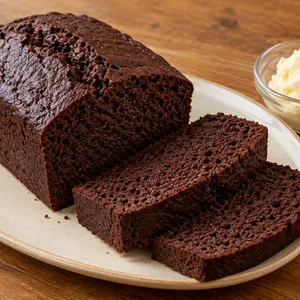
Home-made baking powder is baking soda and cream of tartar with a little cornstarch, sifted together until they are one even powder. Carolyn Putnam Webber, who taught cookery in Bedford, Massachusetts, printed it at the foot of page 51 of her Two Hundred and Seventy-Five War-Time Recipes in 1918, on the same page as the cake that became our Chocolate Potato Cake (1918): a cup of soda, a cup of cornstarch and two cups of cream of tartar, which she promised would make a quart. It comes first here because it is the thing the Missouri prosecutions were about, made by the cook instead of bought in a can.
What is the cornstarch for?
Not for raising. Fannie Farmer’s Boston Cooking-School Cook Book of 1896 describes a bought baking powder as exactly these three things: soda and cream of tartar “in definite, correct proportions,” with a small quantity of flour or cornstarch “to keep action from taking place.” The starch keeps the soda and the acid from reacting in the jar. Webber’s soda and cream of tartar stand at one to two, the same one-third to two-thirds Farmer gives for cooks who once used the two loose. What a home mix changed was who knew the contents: no alum, no ammonia, nothing but what went through the sieve. Webber’s book is a war cookbook printed fifteen years after the Missouri ruling, with no link to the case; it shows what a careful cook could do without the grocer’s can.
Read more about this recipe
Making it today
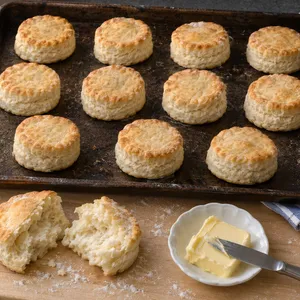
We make an eighth of Webber’s batch, measured in spoons, since a little goes a long way. “Soda” here means baking soda, sodium bicarbonate, never washing soda. Her eight to ten siftings are what make it work: every spoonful needs the same share of soda and acid. Farmer warns that a baking powder mixture starts giving off its gas as soon as it is wet, so mix it into a batter or dough only when the oven is already hot. Using it measure for measure in place of bought baking powder is our choice, and it suits Fannie Farmer’s Baking Powder Biscuit II (1896), whose four teaspoons follow her rule for soda and cream of tartar powders. What Happened When Missouri Outlawed Alum Baking Powder? tells the story of the cans these jars replaced.
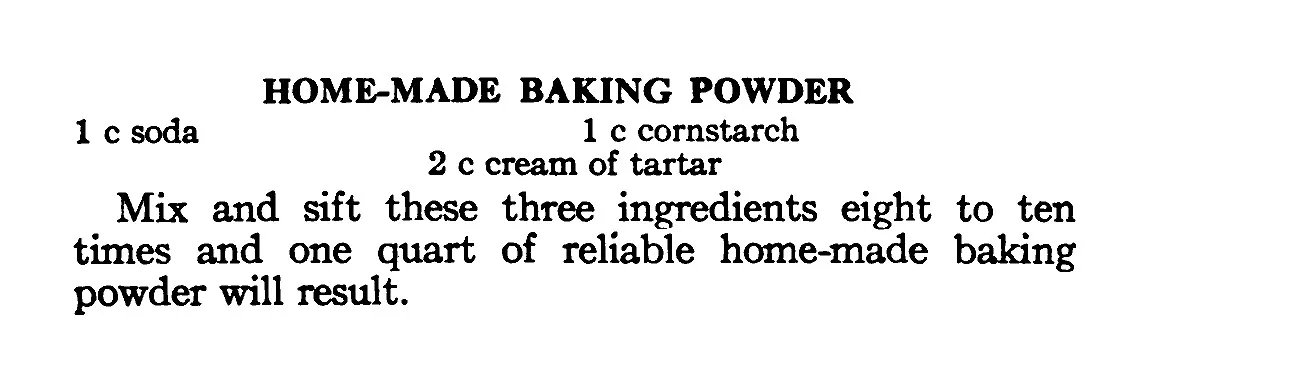
HOME-MADE BAKING POWDER
1 c soda. 1 c cornstarch. 2 c cream of tartar.
Mix and sift these three ingredients ...
Recipe makes: About ½ cup, 24 teaspoons
Ingredients
For about ½ cup, 24 teaspoons. Quantities are shown as written.
Quantities as written here, for about ½ cup, 24 teaspoons.
- Baking soda2 tbsp
- Cornstarch2 tbsp
- Cream of tartar1/4 cup
Measurement notes
Ingredients as written here
- 2 tbsp baking soda
- 2 tbsp cornstarch
- ¼ cup cream of tartar
Equipment
 Measuring spoons and a ¼-cup measure
 Two dry mixing bowls
 Fine-mesh sieve
 Small glass jar with a tight lid
Instructions
Make sure the bowls, spoons, sieve and jar are completely dry; a drop of water starts the soda and cream of tartar working.
Measure the baking soda, cornstarch and cream of tartar level into one bowl, and press out any lumps with the back of a spoon.
Set the sieve over the second bowl and sift the mixture through it. Sift it back into the first bowl, and keep going until it has passed through the sieve eight to ten times in all and looks evenly white, with no specks or streaks.
Spoon the powder into the jar, close the lid tightly and label it with the date.
To use it, measure it level, as you would a bought baking powder, and have the oven heated before any liquid goes in.
Nutrition
6calories per serving
- Recipe makes
- About ½ cup, 24 teaspoons
- Servings
- 24
Estimated per level teaspoon (24) from USDA FoodData Central values for cornstarch and cream of tartar; baking soda has no calories.
Recipe notes
When adjusting quantities
An eighth of Webber’s quart. Keep the baking soda, cornstarch and cream of tartar at 1 to 1 to 2 by volume, measured level: 2 tablespoons, 2 tablespoons and ¼ cup. Metric mode shows the soda and cornstarch by weight (about 28 g and 16 g); the ¼ cup of cream of tartar weighs about 36 g.
Notes
Quantities mentioned in these notes don’t change when you adjust the servings.
Webber’s quart is 1 cup of soda, 1 cup of cornstarch and 2 cups of cream of tartar; we keep her proportions and make an eighth, measured in spoons and stored in a jar. Her recipe stops at the sifting and leaves the rate of use to the cook. Farmer’s 1896 rule of 2 teaspoons to each cup of flour, which she says applies to the soda and cream of tartar powders on the market, makes it measure for measure in her biscuits. Batters made with it should not stand. Webber gives no keeping time and neither do we. For storage, the War Department’s Manual for Army Cooks (1896) says of its own home mix only “Keep in tight glass jar or bottle.” Before baking with a batch that has stood, stir a pinch into a little hot water: it should foam at once, and if it barely fizzes, mix a fresh one. It contains no alum or other aluminum compound, which is the point of making it here.
Scaling changes the ingredients only; pan sizes and cooking times need their own judgment. To adapt this recipe further, try the recipe tool at TuneMyRecipe (opens in a new tab), our sister site.

Sources and attribution
After Carolyn Putnam Webber, Two Hundred and Seventy-Five War-Time Recipes (Bedford, Massachusetts, 1918), Home-Made Baking Powder
See the original pages (scan at Internet Archive) (opens in a new tab)
Recipe details
- Course
- Bread & baking
- Dish family
- Breads & Cakes
- Region
- American
- Source decade
- 1910s
- Difficulty
- Easy
- Occasion
- Everyday meal