Coppergate Pan-Fried Herring
Reader ratingsCoppergate pan-fried herring: fillets dusted with barley flour and fried in butter in an iron pan, after the herring bones of Viking Age York and England’s nearly fish-free pots.
- Recipe makes
- 8 fillets, 4 servings
- Prep
- Cook
- Total
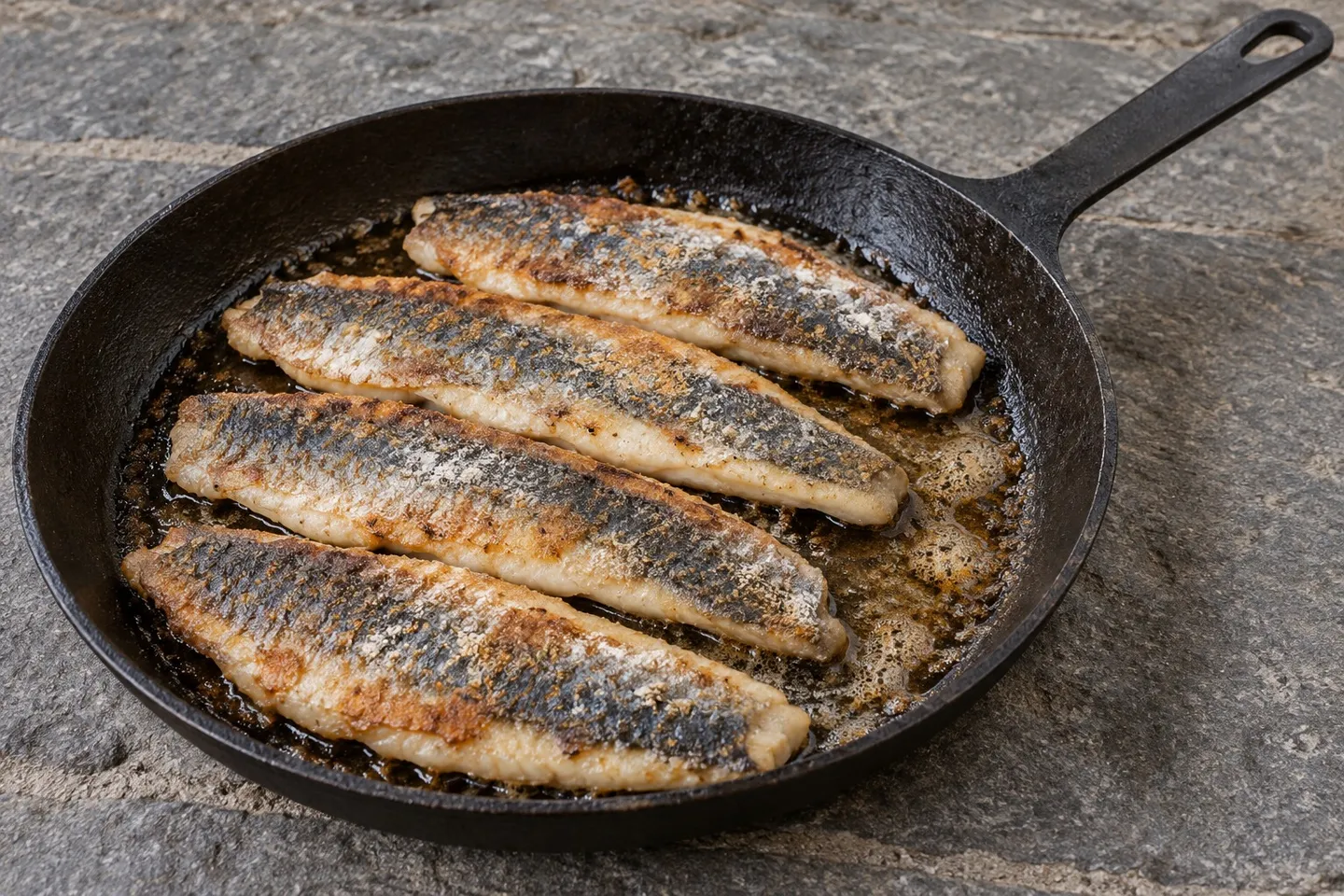
Herring fillets are thin and cook in about 4 minutes. Fry them in two batches so the pan stays hot.
Herring fillets fried in butter in an iron pan.
The story behind the recipe
York ate a great deal of herring, and little of it seems to have gone into a pot. The bones lie thick in the soil of Coppergate, the street where the Anglo-Scandinavian town of the 800s and 900s has been dug up, yet the cooking pots of Viking Age England hold hardly any trace of fish. An iron pan answers both findings. What Did the Vikings Actually Eat? sets York beside Birka’s bread and Iceland’s dairy herds.
Where did York’s herring come from?
Of the 50 soil samples sieved from the town’s first Scandinavian period, 27 held herring bones and 40 held eel. The bone specialist T. P. O’Connor noted that herring shoal in estuaries in summer, so York’s may have been caught in the Humber or the lower Ouse. Or they may have been brought in from elsewhere; the bones can’t say which.
Read more about this recipe
Why not a fish stew?
In Denmark, chemists found fish fats soaked into almost a quarter of the cooking pots they sampled from the period. In England the figure was 13 out of 298, four of them from Coppergate. Steven Ashby and his colleagues read this as Scandinavian settlers who “pragmatically conformed to Anglo-Saxon culinary traditions,” and kept their pots for meat. A stew would put the herring exactly where York’s pots say it rarely went. Iron pans existed: one from the tenth century was found at Coppergate. Nothing shows what was cooked in it.
Making it today
Frying is our choice, one of several ways the study suggests fish could have been cooked without a pot. So are the butter, the light dusting of barley flour, and the salt. Fillets save the work of boning whole fish, and herring is the easier of York’s two commonest fish to find. Eat them with Birka Barley and Pea Flatbreads.
Recipe makes: 8 fillets, 4 servings
Ingredients
For 8 fillets, 4 servings. Quantities are shown as written.
Quantities as written here, for 8 fillets, 4 servings.
- Skin-on herring fillets500 g
- Fine salt1/2 tsp
- Barley flour, for dusting20 g
- Butter30 g
Measurement notes
Ingredients as written here
- 500 g skin-on herring fillets
- ½ tsp fine salt
- 20 g barley flour, for dusting
- 30 g butter
Equipment
- Cast-iron skillet, about 25 cm
- Thin fish spatula
- Paper towels
 Instant-read thermometer
Instructions
Pat the skin-on herring fillets dry with paper towels and run your fingers along each one to find and pull out any loose bones.
Sprinkle the flesh side with the salt. Dust the skin side lightly with the barley flour and shake off the excess.
Heat the skillet over medium-high heat for about 2 minutes, then add half the butter. When it foams and the foam starts to settle, lay in half the fillets, skin side down, and press each one flat with the spatula for a few seconds.
Fry for 2 to 3 minutes, without moving them, until the skin is browned and the flesh has turned opaque most of the way up the sides.
Turn the fillets and cook for about 1 minute more, until the flesh flakes easily and the thickest part reads 63°C (145°F) on the thermometer.
Lift them onto a warm plate, wipe the pan, and fry the rest in the remaining butter. Serve at once.
Nutrition
280calories per serving
- Recipe makes
- 8 fillets, 4 servings
- Servings
- 4
Estimated per serving (4) from USDA FoodData Central values for raw Atlantic herring, butter and barley flour.
Recipe notes
When adjusting quantities
Fry no more than four fillets at a time in a 25 cm pan, adding a little more butter for each batch.
Notes
Quantities mentioned in these notes don’t change when you adjust the servings.
This is a reconstruction. The fish comes from the Coppergate bone report; the cooking method, the butter, the barley flour, the salt and the use of fillets are our choices. Mackerel fillets can stand in if you can’t find herring; check them with the thermometer in the same way. Fish should reach 63°C (145°F) at the thickest part, or be opaque and flake easily, as the US government’s safe minimum temperature chart advises. Refrigerate leftovers within 2 hours and eat them the next day, reheated to 74°C (165°F). Contains fish, milk (butter) and gluten (barley).
Scaling changes the ingredients only; pan sizes and cooking times need their own judgment. To adapt this recipe further, try the recipe tool at TuneMyRecipe (opens in a new tab), our sister site.

Sources and attribution
Reconstruction after the fish bones from 16–22 Coppergate, York (T. P. O’Connor, 1989), and the lipid study of Ashby and colleagues (2026), which found little fish in the pots of Viking Age England
Recipe details
- Course
- Fish course
- Dish family
- Fish & Seafood
- Era
- Medieval
- Main ingredient
- Fish
- Difficulty
- Easy
- Occasion
- Everyday meal