Skyr-Style Fresh Curd
Reader ratingsA skyr-style fresh curd after the dairy farms of Viking Age Iceland: skimmed milk set with store-bought skyr and a little rennet, then drained overnight until thick and sour.
- Recipe makes
- About 750 g, 6 servings
- Prep
- Cook
- Total
Mostly waiting: about 6 hours for the milk to set in a warm place, then 12 hours draining in the refrigerator. Start it the morning before you want to eat it.
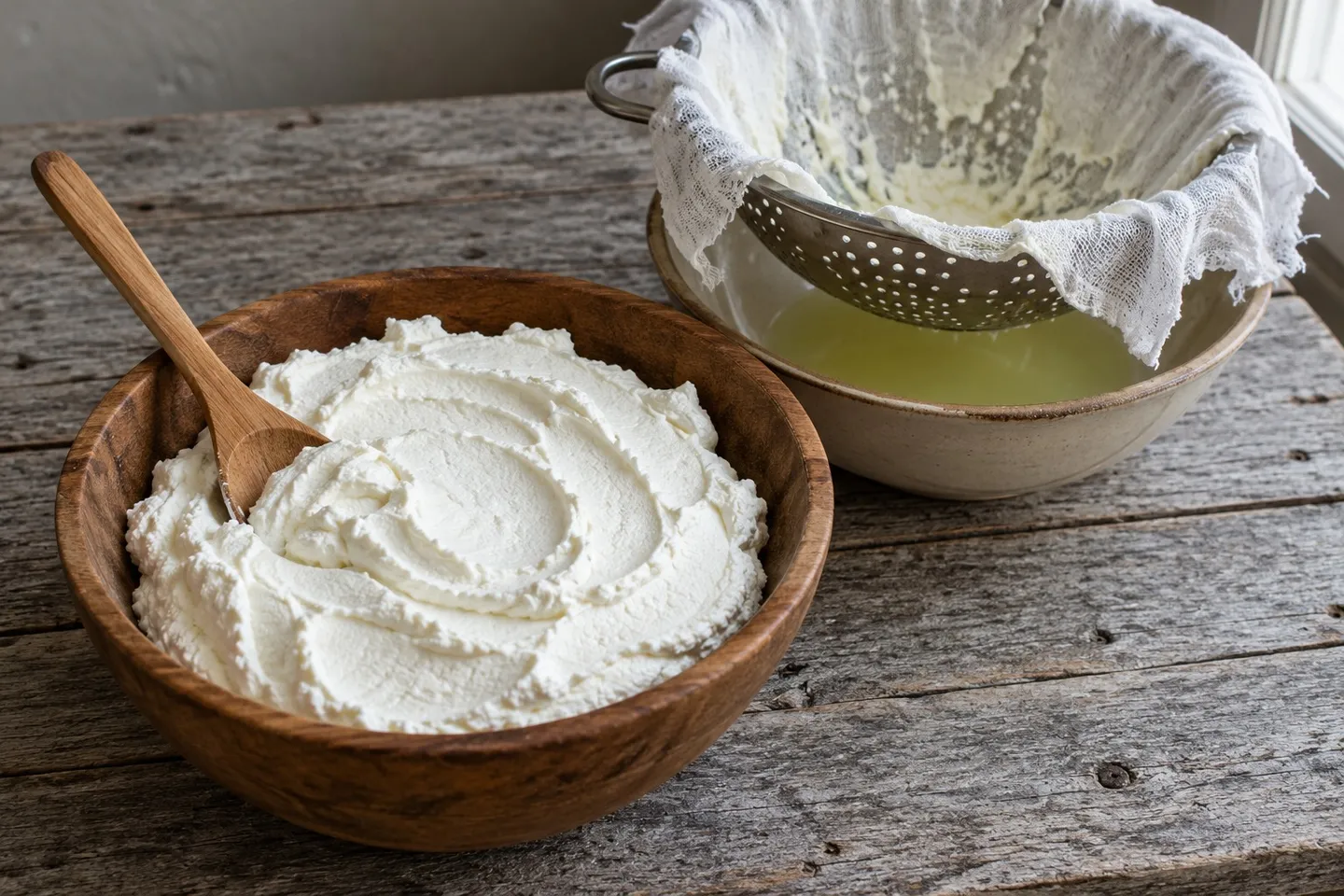
Thick strained skyr-style curd in a wooden bowl.
The story behind the recipe
Iceland’s farms in the Viking Age ran on milk. At Hofstaðir, the great hall near Lake Mývatn whose cattle skulls fill the story in What Did the Vikings Actually Eat?, the cattle and sheep were kept “largely” for “dairy and wool,” and on most other farms of the period the bones show a dairy herd. This thick strained curd puts some of that milk on the table.
What did the sagas call it?
When the sagas were written down in the 1200s, the curd had a name. In Egils saga, set in Norway in the 900s, a steward named Bárd sets out “bread and butter, and large bowls filled with curds” for travelers, in Paul Du Chaillu’s English of 1889. The Old Norse text calls the bowls skyraskar, skyr bowls. The guests are thirsty, Bárd says there is no ale, and they sup the skyr instead; the saga’s verb is supu. Later in the same saga, at another farm whose host claims to have no ale, big bowls of skyr come out and Egil drinks more of it than anyone. Skyr in these scenes is thin enough to drink, and both times it stands in for ale.
Read more about this recipe
Making it today
No recipe for Viking Age skyr survives, and the bones at Hofstaðir record the herd and say nothing of what was made from its milk. Everything here is a modern cook’s choice. Skyr is still made in Iceland from skimmed milk, and this version follows today’s home skyr makers, with a spoonful of store-bought skyr to start it and a little rennet. The temperatures follow University of Illinois Extension’s guidance (opens in a new tab) for making yogurt at home. Drained overnight, it comes out much thicker than the saga’s drinkable skyr. The Birka Barley and Pea Flatbreads make a plain partner for it, and the whey need not go to waste: Forgotten Drink, our sister site, turns it into Blanda (opens in a new tab), Iceland’s whey-and-water drink.
Recipe makes: About 750 g, 6 servings
Ingredients
For about 750 g, 6 servings. Quantities are shown as written.
Quantities as written here, for about 750 g, 6 servings.
- Pasteurized skim milk2 l
- Plain skyr with live cultures125 g
- Liquid rennet1/8 tsp
- Cool water, for the rennet2 tbsp
Measurement notes
Ingredients as written here
- 2 liters pasteurized skim milk
- 125 g plain skyr with live cultures
- ⅛ tsp liquid rennet
- 2 tbsp cool water, for the rennet
Equipment
- Heavy pot, at least 3 liters, with a lid
 Instant-read thermometer
- Whisk and ladle
- Yogurt maker, or an oven with the light on and a thermometer to check it
- Colander and a large bowl
- Cheesecloth or butter muslin
Instructions
Pour the skim milk into the heavy pot and heat it over medium-low heat, stirring often so it doesn’t catch, until it reaches 85°C (185°F). Hold it at that temperature for 10 minutes, stirring now and then.
Take the pot off the heat and set it in a sink of cold water. Stir until the milk cools to 43°C (110°F).
Whisk the skyr in a small bowl with a little of the warm milk until smooth, then stir it into the pot.
Stir the rennet into the cool water for the rennet, pour it into the milk, and stir gently for 30 seconds. Put on the lid.
Keep the pot at 41 to 46°C (105 to 115°F), in a yogurt maker or an oven with only the light on, checking with the thermometer, for about 6 hours, until the milk has set into a soft curd that pulls away from the side with a little clear whey around it. Don’t stir it while it sets.
Line the colander with a double layer of cheesecloth and set it over the large bowl. Ladle in the curd, cover it, and refrigerate for about 12 hours, until it is as thick as you like.
Tip the curd into a clean bowl and whisk it smooth. Keep it covered in the refrigerator.
Nutrition
90calories per serving
- Recipe makes
- About 750 g, 6 servings
- Servings
- 6
Estimated per serving (6) from USDA FoodData Central values for skim milk and plain skyr, allowing for the whey drained off.
Recipe notes
When adjusting quantities
About 60 g of skyr culture per liter of milk, and ⅛ tsp of liquid rennet for every 2 liters. Two liters of milk drain to about 750 g of curd.
Notes
Quantities mentioned in these notes don’t change when you adjust the servings.
This is a reconstruction: no Viking Age recipe for skyr survives, and the culture, the rennet, the temperatures and the times are taken from modern practice. Use pasteurized milk only, since the US Food and Drug Administration warns that raw milk can carry disease-causing germs, and avoid ultra-pasteurized milk, which cheesemaking suppliers advise against for setting curd. If the milk hasn’t set after 8 hours, or smells off, throw it out and start again. Keep the curd at 4°C (40°F) or colder and eat it within a week. Refrigerate the whey and use it soon. For a looser skyr, closer to the drinkable one of the sagas, stop draining sooner. Contains milk.
Scaling changes the ingredients only; pan sizes and cooking times need their own judgment. To adapt this recipe further, try the recipe tool at TuneMyRecipe (opens in a new tab), our sister site.

Sources and attribution
Reconstruction after the dairy economy shown by the animal bones at Hofstaðir (Lucas and McGovern, 2007) and the skyr of Egils saga, made with a modern culture and rennet
Recipe details
- Course
- Side dish
- Region
- Nordic
- Era
- Medieval
- Main ingredient
- Milk & cream
- Difficulty
- Intermediate
- Occasion
- Everyday meal