Birka Barley and Pea Flatbreads
Reader ratingsBirka barley and pea flatbreads: small unleavened rounds cooked on a dry iron pan, after the charred loaves of hulled barley and peas from two Viking graves at Birka.
- Recipe makes
- About 30 small flatbreads, 4 servings
- Prep
- Cook
- Total
The dough rests for 20 minutes so the barley can take up the water. The breads cook in batches, 3 to 4 minutes a side.
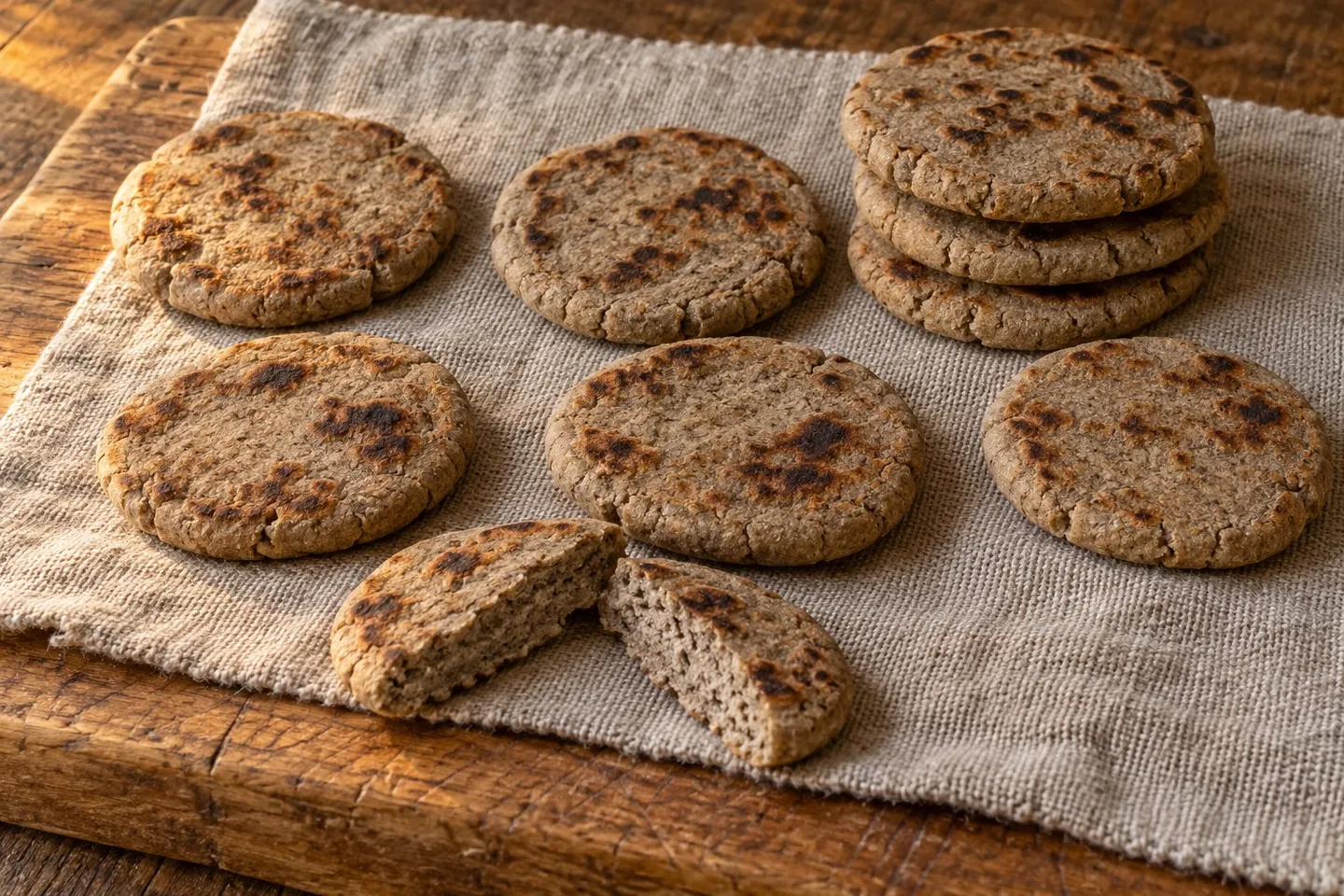
Small barley and pea flatbreads on a linen cloth.
The story behind the recipe
Two graves at Birka, the Viking trading town on an island west of present-day Stockholm, held loaves that the microscope showed were baked from hulled barley and peas. These small flatbreads are built on those two loaves. Barley was the commonest grain in Birka’s grave bread, found in 20 of the 33 loaves analyzed, and peas turned up in three. The town and its graves are part of What Did the Vikings Actually Eat?
What was in the Birka loaves?
The loaves survived because they were burned with the dead and turned to charcoal. Hjalmar Stolpe, who dug Birka’s graves from the 1870s, kept many of them, and later botanists looked at small samples under the microscope for the cell patterns of husks and grains. In 1996 the archaeobotanist Ann-Marie Hansson set the results out grave by grave. Grave Bj 304 held a loaf of hulled barley and peas. So did Bj 469, where three oval loaves had been threaded together on a metal string while they were still soft; she could tell from the way they had pressed into one another. Which of the three was sampled is not recorded.
Hansson found most prehistoric Swedish loaves unleavened, so these were probably made without yeast. They were tiny, too: about two in three of the Birka loaves that could still be measured were less than 2 inches (5 cm) across.
Read more about this recipe
Making it today
A charred loaf records which plants went in but says nothing of how much of each, so we set the proportions. We chose three parts barley to one of pea, which keeps barley in charge. We added salt too, though nothing in the analyses shows it. The size follows the small Birka rounds. We cook them on a dry cast-iron pan, one of the ways Hansson suggests a large Birka loaf could have been baked; others may have gone into the embers. Neither barley nor peas can form much gluten, so the dough has almost no stretch. Warm from the pan, they are the bread for Coppergate Pan-Fried Herring, York’s fish cooked in an iron pan.
Recipe makes: About 30 small flatbreads, 4 servings
Ingredients
For about 30 small flatbreads, 4 servings. Quantities are shown as written.
Quantities as written here, for about 30 small flatbreads, 4 servings.
- Whole-grain barley flour150 g
- Yellow pea flour50 g
- Fine salt1/2 tsp
- Warm water150 ml
- Barley flour, for shaping15 g
Measurement notes
Ingredients as written here
- 150 g whole-grain barley flour
- 50 g yellow pea flour
- ½ tsp fine salt
- 150 ml warm water
- 15 g barley flour, for shaping
Equipment
- Mixing bowl
 Kitchen scale
- Cast-iron skillet or griddle, about 25 cm
- Thin metal spatula
- Clean kitchen towel
 Instant-read thermometer
Instructions
Whisk the whole-grain barley flour, yellow pea flour and salt together in the mixing bowl.
Stir in the warm water, then knead in the bowl for about 2 minutes, until the dough holds together in one soft, slightly sticky ball. Cover with the towel and let it rest for 20 minutes.
Dust your hands with some of the barley flour for shaping. Pinch off pieces of dough a little smaller than a walnut, roll each into a ball, and press it flat between your palms into a round about 5 cm (2 inches) across and 5 mm (¼ inch) thick. Pinch any cracked edges closed.
Heat the dry skillet over medium heat for about 3 minutes.
Cook the rounds in batches, without fat, for 3 to 4 minutes on each side, until both sides have dark brown spots and the bread feels firm. Push the thermometer into the side of one: the center should read at least 93°C (200°F). Break it open to check that it is dry and cooked through with no pale, pasty line. If the outside browns before the center cooks, turn the heat down a little.
Wrap the cooked breads in the towel while you cook the rest, and serve warm.
Nutrition
180calories per serving
- Recipe makes
- About 30 small flatbreads, 4 servings
- Servings
- 4
Estimated per serving (4) from USDA FoodData Central values for whole-grain barley flour and pea flour.
Recipe notes
When adjusting quantities
Three parts barley flour to one of pea flour, by weight, with three-quarters of the flour’s weight in water. Cook any number in batches.
Notes
Quantities mentioned in these notes don’t change when you adjust the servings.
This is a reconstruction. The ingredients, hulled barley and peas, come from the analyses of graves Bj 304 and Bj 469; the proportions, the salt, the water, the size, the resting time and the dry iron pan are our choices. Whole-grain barley flour stands in for flour ground from hulled barley. Pea flour is sold as yellow pea flour; you can also grind dried yellow split peas fine in a spice grinder and sift them. Don’t taste the raw dough: the US Food and Drug Administration advises against eating raw flour or dough. Hansson describes most Swedish prehistoric loaves as made from finely sieved flour, so a finely milled barley flour comes closer than a coarse one. Store the breads in a closed tin and eat them within 2 days; warm them in a dry pan before serving. For a thinner, larger skillet bread of barley and whole wheat, TuneMyRecipe has Skillet Barley Flatbreads (opens in a new tab). Contains gluten (barley) and peas.
Scaling changes the ingredients only; pan sizes and cooking times need their own judgment.
Sources and attribution
Reconstruction after the charred loaves from Birka graves Bj 304 and Bj 469 (hulled barley and peas), as analyzed in Ann-Marie Hansson, Bread in Birka and on Björkö (1996)
Recipe details
- Course
- Bread & baking
- Dish family
- Breads & Cakes
- Region
- Nordic
- Era
- Medieval
- Main ingredient
- Grains & rice
- Difficulty
- Easy
- Occasion
- Everyday meal